
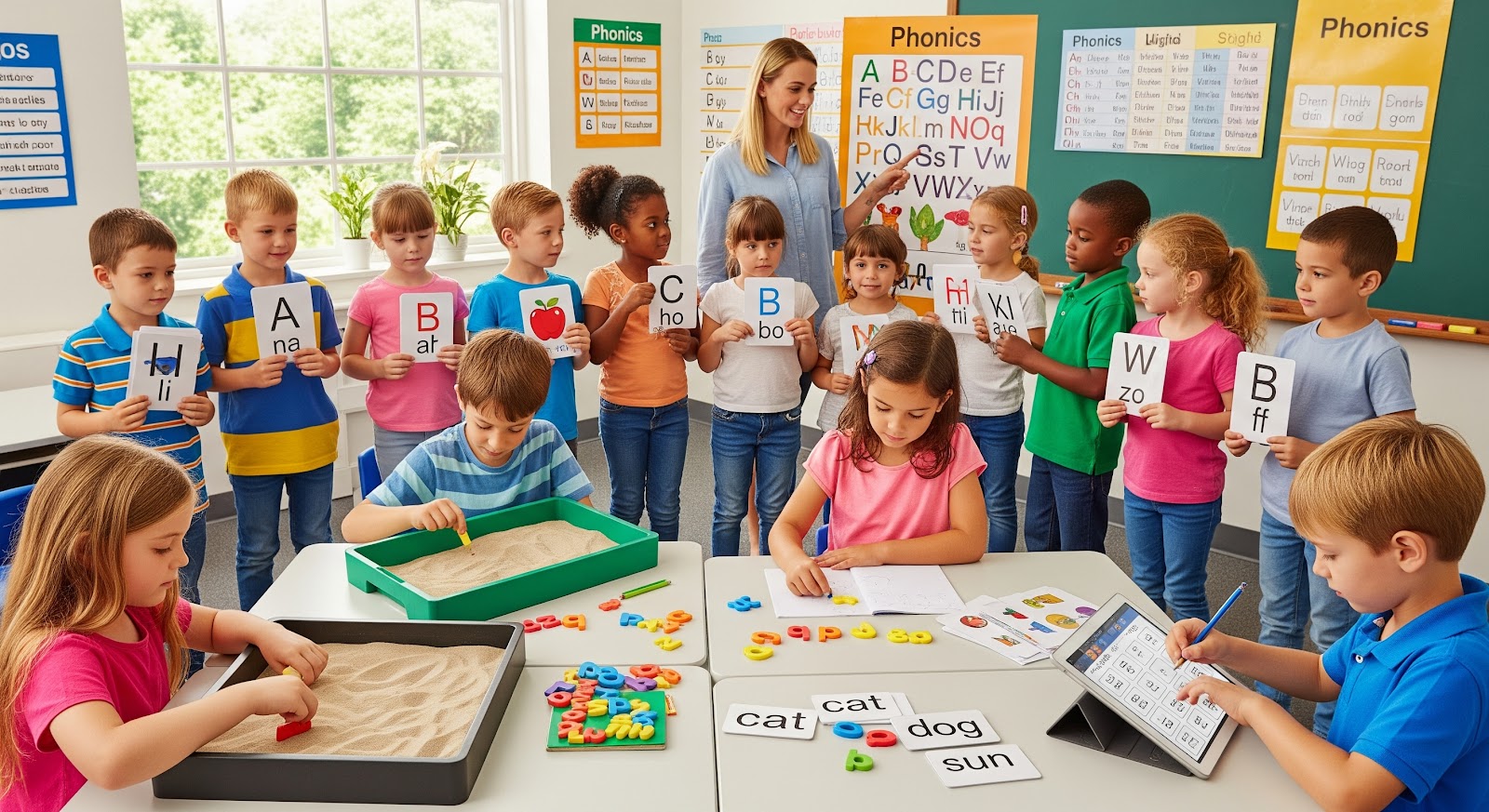
Phonics is the foundational skill that helps children connect letters with their corresponding sounds, a critical step in learning to read. As part of the broader Science of Reading, phonics focuses on developing decoding skills, enabling young learners to sound out unfamiliar words and build fluency over time. Without a strong grasp of phonics, students often struggle to progress beyond memorization, leading to long-term difficulties in reading comprehension and confidence.
In today’s digital world, teaching phonics online has become both a necessity and an opportunity. Whether due to remote learning, homeschooling, or a desire for supplemental instruction, families and educators are increasingly turning to technology to support early literacy.
Fortunately, online tools can do more than just digitize worksheets; they can bring phonics instruction to life with real-time feedback, engaging activities, and adaptive learning pathways that respond to each child’s unique needs.
How Do I Teach Phonics Effectively Online?
Online phonics instruction can be incredibly effective, but it often comes with questions and misconceptions. Is it too passive? Can it really replace in-person instruction? What if I’m not a trained teacher? The truth is, with the right structure and tools, teaching phonics online can be just as impactful, if not personalized, than traditional methods. Let’s explore what makes online phonics instruction successful and how to build a strong foundation for your learner.
Understanding the Challenges and Misconceptions
One of the most common concerns about teaching phonics online is that students might not stay engaged. Without face-to-face interaction, it can seem difficult to keep young readers focused or motivated. Others worry that online tools simply replace books with screens, offering games rather than meaningful instruction. Another misconception is that digital learning is only effective for tech-savvy parents or experienced teachers.
However, these concerns often stem from outdated or limited tools. Effective online phonics programs are interactive, research-based, and designed to support engagement through voice prompts, visuals, and personalized pathways. When done right, they can provide timely feedback, track progress in real time, and reinforce core skills far more consistently than worksheets alone.
Building from the Five Pillars of Literacy
To teach phonics well, especially online, it’s important to understand how it fits within the five pillars of literacy. These pillars, identified by the National Reading Panel and supported by decades of research, are essential for reading success:
- Phonemic Awareness: The ability to hear, identify, and manipulate individual sounds (phonemes) in spoken words. This is a precursor to phonics instruction and can be taught through listening activities and sound games.
- Phonics: Connecting sounds to letters. This is where children learn how written language represents spoken sounds and how to decode words.
- Fluency: Reading with speed, accuracy, and proper expression. Online tools often track fluency with speech recognition and offer gentle corrections.
- Vocabulary: Understanding word meanings. Effective phonics instruction supports vocabulary development by helping students decode and comprehend new words.
- Comprehension: Making sense of what is read. Comprehension is built on the strong decoding skills phonics provides.
Online instruction should integrate these pillars, with special emphasis on phonemic awareness and phonics in the early stages. Look for programs or lessons that include sound isolation, blending, segmenting, and decoding tasks, not just visual games.
The Importance of Systematic and Explicit Instruction
One of the most critical factors in phonics success, online or offline, is systematic and explicit instruction. This means skills are taught in a clear, direct manner and in a logical sequence. For example, children might first learn to recognize individual letter sounds, then move on to blending those sounds into simple consonant-vowel-consonant (CVC) words, and eventually progress to more complex phonics patterns like digraphs and long vowel combinations.
Online platforms that align with this approach guide learners step by step. They also reinforce instruction through repetition, scaffolded practice, and immediate feedback, essential elements for students who need more time or support to master new skills.
Explicit instruction takes the guesswork out of reading. Instead of assuming that students will “pick up” phonics through exposure, this method makes each concept clear, modeled, and practiced until it’s understood. That’s especially powerful for English Language Learners (ELLs) and students with learning differences like dyslexia or ADHD, who often benefit from structured routines and guided practice.
How to Teach Phonics at Home Without Formal Training
Parents and caregivers often ask, “Can I really teach my child phonics if I’m not a teacher?” The answer is yes. With the right support and a consistent routine, families can play a powerful role in early reading development even without a formal educational background.
You Don’t Need a Degree to Support Reading
Phonics is most effective when taught systematically and in small, manageable steps. Fortunately, many of these steps can be integrated naturally into your day-to-day life. You do not need specialized training to help your child build foundational reading skills. What you do need is:
- A basic understanding of letter sounds and how they form words
- A commitment to daily practice
- Access to quality phonics resources
The key is not to replicate a classroom but to build an environment where reading practice is consistent, encouraging, and tailored to your child’s pace.
Consistency and Reading Aloud Build Confidence
Children thrive on routine, and learning phonics is no exception. Setting aside just 10 to 15 minutes a day for focused reading time can create meaningful progress. The goal is to make this time predictable and enjoyable, not rushed or overwhelming.
Daily Habits to Try
- Read aloud together every day. Let your child hear how fluent reading sounds and give them opportunities to echo-read or chime in.
- Practice letter sounds during daily routines. For example, identify the beginning sound of breakfast foods or street signs.
- Celebrate small wins, such as correctly decoding a new word or finishing a short book, to build motivation.
Reading aloud also exposes your child to a wider range of vocabulary and grammar structures, all while reinforcing phonics skills in context.
Using Simple Tools to Support Phonics Learning
Thanks to technology, parents today have access to a wide range of phonics resources that are affordable, interactive, and easy to use, even for those with little teaching experience.
Digital Tools That Help
- Phonics apps: Look for apps that offer structured lessons with audio support and interactive practice (avoid apps that only focus on games without feedback).
- Digital books: Choose leveled readers that highlight new phonics patterns and provide narration.
- Phonics videos: Use short clips to reinforce individual sounds or review letter combinations through songs and visuals.
- Online read-alouds: These can model fluent reading and support comprehension alongside decoding.
Many tools also include progress tracking so you can see your child’s growth in areas like fluency and accuracy.
Make Phonics Part of Real Life
Integrating phonics into your home doesn’t require extra hours, just small moments of intentional practice. Here are a few ideas:
- Label household items with their names and review the starting sound.
- Play “I Spy” using phonemes: “I spy something that starts with /s/.”
- Make a sound scavenger hunt where your child finds items that begin with a certain sound.
- Cook together and read the recipe, sounding out steps or ingredient names.
Everyday experiences provide opportunities to blend phonics instruction into natural, meaningful interactions.
Try This Phonics Activity for Kindergarten Learners
Phonics learning is most powerful when it feels like play. Young children thrive on movement, creativity, and hands-on experiences that connect abstract letter sounds with the real world around them. That’s why digital-friendly, interactive activities are an ideal way to engage kindergarten learners in early reading skills.
Letter Sound Safari: A Fun, Digital-Friendly Game
Letter Sound Safari is a playful and educational phonics activity designed for young learners at home or in the classroom. It helps children practice letter-sound correspondence by turning their environment into an exciting alphabet adventure.
How It Works
This activity is simple to set up and can be played on a tablet or printed out:
- Choose the Target Sound: Select one letter sound to focus on for the day (such as /b/ for B or /m/ for M). Display the letter and say the sound aloud together.
Example: “Today we are looking for things that start with the /b/ sound, like ball or banana.” - Go on a Safari: Let your child explore the house or classroom to find real objects that begin with the target sound. They can take photos using a tablet, draw pictures, or collect small items.
- Record Their Finds: Use a digital worksheet, slideshow, or printable chart to keep track of each item. You can label the pictures together: “B is for book.”
- Extend the Learning: After the safari, reinforce the sound by:
- Writing the names of each object
- Saying the beginning sound out loud together
- Sorting the items by sound (if comparing two letters)
This activity can be adapted for use with online classrooms by encouraging students to share their finds during a virtual session or through photo submissions.
Why This Activity Works
Letter Sound Safari blends phonics with active learning. It gives children the chance to apply what they’ve learned in a meaningful and memorable way.
Key Learning Benefits
- Connects learning to real-life objects: Children begin to notice how letters and sounds appear all around them.
- Incorporates movement: Physical activity improves attention, especially in young learners.
- Reinforces letter-sound correspondence: Repetition of the target sound strengthens phonemic awareness.
- Builds vocabulary: Describing and naming objects helps children expand their word knowledge.
Make It Digital
If you are using a learning platform or app, you can take this activity a step further by:
- Uploading the collected photos into a phonics slideshow
- Using a voice recording tool so your child can say the word and hear it back
- Integrating digital drawing apps to label each item with the beginning letter
These tools support multisensory learning while making it easy to track your child’s engagement and progress.
The Science Behind the Teaching of Phonics
Effective phonics instruction is grounded in decades of reading research, most notably the findings of the National Reading Panel and the framework known as the Science of Reading. These principles emphasize that reading is not a natural process; it must be explicitly and systematically taught.
What the Research Tells Us
The National Reading Panel’s landmark report (2000) concluded that phonics is essential for early literacy. It found that explicit and systematic phonics instruction significantly improves children’s reading and spelling skills, especially in the early grades and for struggling readers. This approach is now foundational to the Science of Reading movement, which integrates research from cognitive psychology, neuroscience, linguistics, and education.
These findings support instruction that is:
- Explicit: Directly teaches the relationship between letters and sounds, rather than leaving students to infer them on their own.
- Systematic: Follows a carefully designed sequence that builds from simple to complex skills.
- Cumulative: Continually reviews and builds upon previously learned concepts to ensure mastery and retention.
Why Sequence and Structure Matter
Teaching phonics randomly or in isolated bits is far less effective than a well-planned progression. Young readers need to begin with high-utility consonants and short vowel sounds, move into blending sounds in simple words, and gradually progress toward digraphs, blends, and multisyllabic words.
This sequential approach reduces confusion and supports orthographic mapping, the process by which children form connections between sounds and written letters in memory. Over time, this helps transform sounding out into fluent reading.
Managing Cognitive Load for Young Learners
Children learning to read must juggle many new skills at once: letter recognition, sound blending, pronunciation, and meaning. That is why instructional design must account for cognitive load, or the mental effort required to learn something new.
Well-designed phonics lessons:
- Break learning into manageable chunks
- Use consistent routines to reduce the mental load
- Limit distractions so students can focus on one concept at a time
Using visual, auditory, and kinesthetic supports also helps distribute the mental effort across multiple channels, increasing retention and reducing frustration.
The Role of Scaffolding and Support
In phonics instruction, scaffolding refers to the temporary supports teachers or parents provide to help children succeed. These supports are gradually removed as the learner becomes more independent.
Scaffolding may include:
- Modeling how to sound out a word
- Giving cues or prompts when a student struggles
- Breaking down words into chunks or syllables
Digital tools can also provide scaffolding through voiceovers, visual cues, and immediate feedback. This makes them particularly useful for beginning readers who need guidance but may be working independently.
Differentiation for Diverse Learners
Not all children learn to read at the same pace. Some need more repetition, while others are ready to move ahead quickly. Differentiated instruction ensures that each learner gets what they need to progress.
Effective phonics instruction online or at home should:
- Offer adjustable levels of difficulty
- Include activities for visual, auditory, and tactile learners
- Provide extra practice or review for struggling students
For English Language Learners (ELLs), differentiation also means integrating vocabulary and comprehension strategies alongside phonics, ensuring they connect sounds to meaningful language.
Building a Strong Reading Foundation at Home
Phonics is not just another reading skill; it is the bridge that connects spoken language to written text. When taught systematically and explicitly, phonics empowers children to decode unfamiliar words, build fluency, and develop a lifelong love of reading. Whether you are a teacher adapting to online tools or a parent supporting learning at home, your role in building that bridge matters deeply.
With consistent routines, meaningful activities, and the right digital tools, phonics instruction becomes not only possible but powerful. Simple daily habits, engaging games, and progress tracking can transform screen time into skill-building time.
And you do not have to do it alone.
Ready to bring powerful, evidence-based phonics instruction home? Try Readability, where real reading meets real progress.
FAQs
How do I teach phonics if I have no formal training?
You do not need a teaching degree to get started. With structured resources and consistent daily routines, parents can teach phonics at home using tools like phonics worksheets, decodable books, and online platforms.
What are the best strategies for teaching phonics at home?
Start with daily practice of letter sounds and use engaging activities such as sound games, read-alouds, and phonics apps. Simple routines like morning reading and evening word review are effective, especially when combined with multisensory learning.
How can I make phonics lessons more fun for kindergarteners?
Try digital-friendly activities like “Letter Sound Safari,” which gets kids moving while identifying sounds in their environment. This approach helps reinforce letter-sound correspondence in a playful, memorable way.
What types of phonics worksheets are best for beginners?
For early learners, use worksheets that include matching beginning sounds to pictures, tracing letters, and CVC word building. Worksheets can be printable or interactive and should align with the child’s current phonics level.
Are phonics worksheets effective when used with online tools?
Yes. Worksheets offer written practice that complements digital learning. When used with online platforms that provide speech recognition and immediate feedback, worksheets help reinforce and extend instruction.
 Español