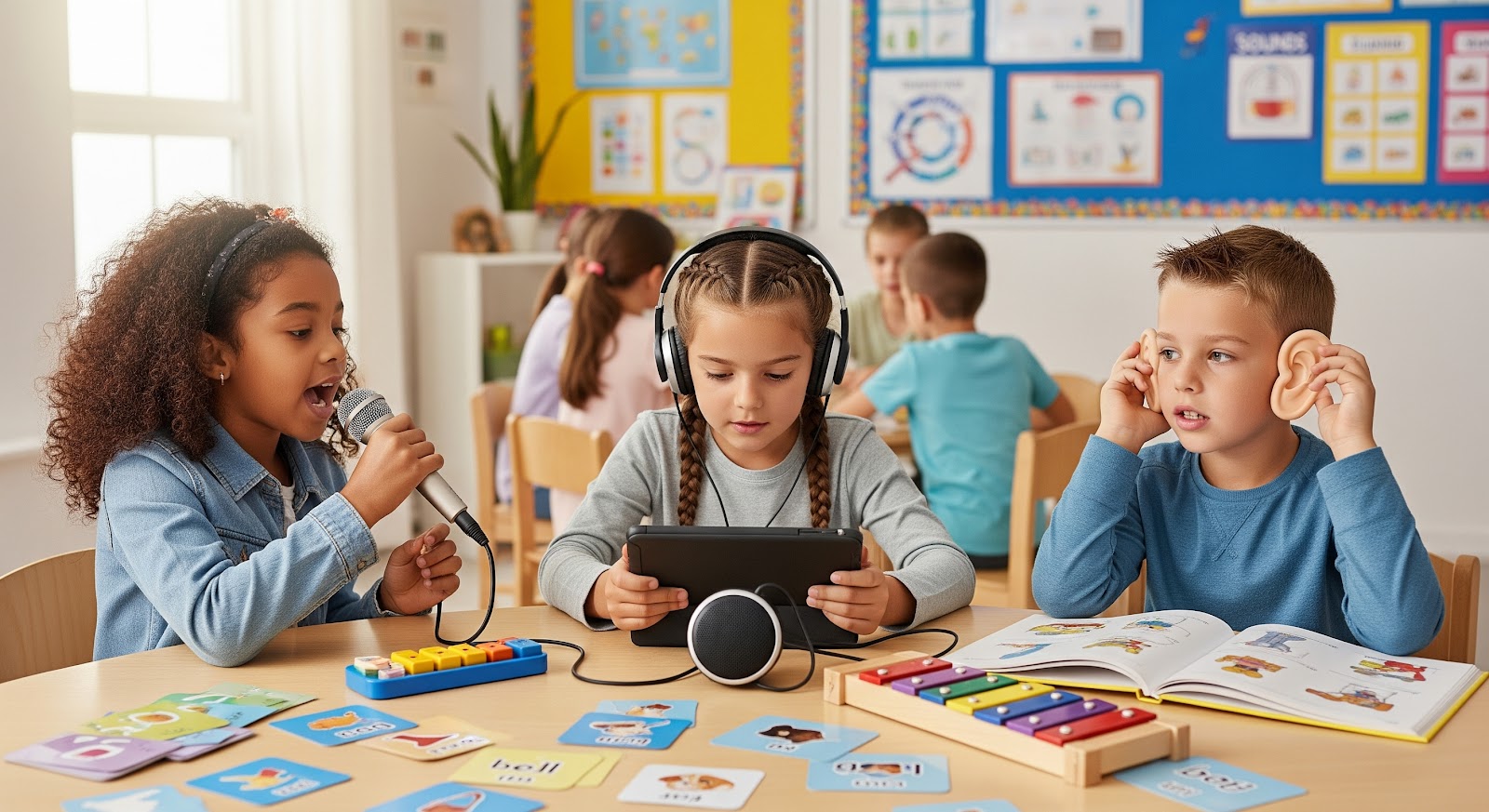
Imagine a child named Maya sitting in a busy classroom. While her peers eagerly scan the pages of their textbooks or highlight diagrams, Maya’s attention sparks not from what she sees but from what she hears. When her teacher explains a concept aloud, she lights up. During group discussions, her thoughts flow freely. But when asked to silently read or follow along with visual aids alone, she starts to disengage. Maya isn’t struggling; she’s an auditory learner.Every student processes information differently, and recognizing these differences is key to effective education. While some learners thrive through visual cues or hands-on experiences, others, like Maya, absorb knowledge best through sound. In a world where traditional teaching often leans heavily on visuals and text, students with a strong auditory learning preference can be unintentionally left behind.Auditory learning, a style in which individuals learn most effectively through listening, plays a crucial role in how many children and adults retain and apply information. Supporting these learners requires not only awareness but also the implementation of strategies tailored to their strengths.Whether you're a teacher, parent, or caregiver, understanding auditory learning can help unlock the potential of students who process the world through sound.
What Is an Auditory Learner?
When asking what an auditory learner is, the answer lies in how individuals process and retain information. An auditory learner is someone who learns best through listening. These learners grasp new concepts most effectively when they hear them explained aloud, rather than by reading text or engaging in hands-on tasks.Instead of relying heavily on visuals or physical interaction, auditory learners absorb and remember details through spoken words, sounds, tone, and rhythm. They often excel when information is presented through lectures, discussions, podcasts, or oral storytelling.
How Auditory Learners Differ from Other Learning Types
Auditory learners represent one of several commonly recognized learning styles. To better understand their strengths, it helps to compare them with two other prominent types: visual learners and kinesthetic learners.
- Visual learners prefer to see information. They benefit most from diagrams, charts, color-coded notes, and other visual aids. For them, learning often involves watching demonstrations or reading written instructions.
- Kinesthetic learners thrive through movement and hands-on experience. They learn by doing, engaging in experiments, building models, or physically manipulating materials to gain a deeper understanding of a concept.
By contrast, auditory learners absorb information most effectively when it is presented orally. They often repeat information aloud to remember it, benefit from group discussions, and may find themselves distracted in silent learning settings that lack verbal interaction.
Learning Environments That Support Auditory Learners
Auditory learners tend to thrive in environments where spoken language is central to instruction. Ideal settings for auditory learners include:
- Classrooms with frequent teacher-led discussions
- Story-based or lecture-heavy formats
- Small group work where students can talk through ideas
- Use of audiobooks or verbal instructions
- Interactive read-alouds and guided oral practice
These environments give auditory learners the opportunity to hear, speak, and process language in meaningful ways. They also allow learners to ask clarifying questions, which is a natural strength of auditory processors who often prefer verbal reasoning over written instructions.By understanding what an auditory learner is, educators and caregivers can create more inclusive, responsive learning environments that allow all students, especially those who process the world through sound, to feel seen, heard, and supported.
Define Auditory Learning Through Research
To define auditory learning is to understand a learning style that relies primarily on sound and spoken language to process and retain information. Auditory learning involves listening, hearing, speaking, and responding to verbal cues. It emphasizes the role of auditory input, such as lectures, discussions, music, and oral storytelling, as the primary channel for comprehension and memory.A formal definition from cognitive education perspectives might read:Auditory learning is a modality of learning in which individuals absorb, retain, and apply knowledge most effectively through hearing and speaking, rather than through visual or kinesthetic input.Learners who favor this style tend to benefit from verbal repetition, listening to information, and engaging in spoken dialogue. This learning style is recognized in many instructional models and often overlaps with auditory processing strengths in language development and phonological awareness.
Auditory Learning and the Science of Reading
The Science of Reading, a body of interdisciplinary research grounded in cognitive science, neuroscience, and educational psychology, affirms the critical role of sound in learning to read. According to the Science of Reading, effective reading instruction must include explicit teaching in phonemic awareness and phonics, two areas directly related to auditory processing.Phonemic awareness, for example, is the ability to hear and manipulate individual sounds in spoken words. This skill is foundational to decoding and fluent reading and is typically strengthened through oral practice and repetition, making it essential for auditory learners.Researchers have found that when students, particularly early readers, engage in auditory-based instruction, they show significant gains in decoding, fluency, and comprehension. These findings are consistent with the National Reading Panel’s recommendations, which emphasize that reading success is built on five core pillars:
Auditory learners naturally align with these pillars, especially in the areas of fluency and comprehension, when instruction is verbal, interactive, and rhythmically structured.
The Role of Auditory Learning in Literacy and Language Acquisition
Auditory learning plays a central role in developing literacy and language skills, especially during early childhood and elementary education. Students who process information aurally often thrive when learning through:
- Rhyming and singing to develop phonological awareness
- Oral repetition of word patterns and sentence structures
- Listening to read-alouds and following along with spoken text
- Engaging in verbal storytelling or narrative retelling activities
In language acquisition, both for native speakers and English Language Learners (ELLs), auditory learning enhances listening comprehension, pronunciation, and expressive vocabulary. When learners can hear words spoken fluently and practice repeating them, they internalize sound-symbol relationships more efficiently. This is especially true in multilingual classrooms where auditory modeling supports both academic and conversational language skills.
Auditory Learning as a Tool for Inclusive Instruction
Understanding and applying auditory learning principles is vital for creating inclusive learning environments. Students with dyslexia, ADHD, autism, and other learning differences often benefit from auditory-based interventions. Many of these students may struggle with visual overload or written decoding, but flourish when information is delivered verbally.By incorporating auditory strategies into instruction, educators ensure that learning is accessible to a broader range of students. This not only supports auditory learners but also enhances classroom engagement, promotes equity, and encourages multiple pathways to academic success.When educators and caregivers take time to define auditory learning through the lens of research and real-world application, they unlock a deeper understanding of how students think, process, and thrive.
Empowering Every Auditory Learner
Auditory learners bring unique strengths to the classroom and home that too often go underrecognized in environments dominated by visual or independent learning methods. By understanding how these students process information through sound, speech, and rhythm, we can begin to meet them where they are and help them thrive.Supporting auditory learners is not about limiting instruction to one style. It is about embracing inclusive, multisensory teaching that acknowledges individual differences and celebrates diverse pathways to understanding. Whether through read-alouds, music, peer discussion, or technology, auditory strategies can unlock deeper engagement, stronger retention, and greater confidence in learning.Every child deserves the opportunity to learn in a way that feels natural and empowering.For families and educators seeking real-time support and feedback for auditory learners, explore how Readability combines AI and research-backed methods to empower every child’s learning journey.By tuning in to the voices of auditory learners, literally and figuratively, we make education not only more accessible but more human.