
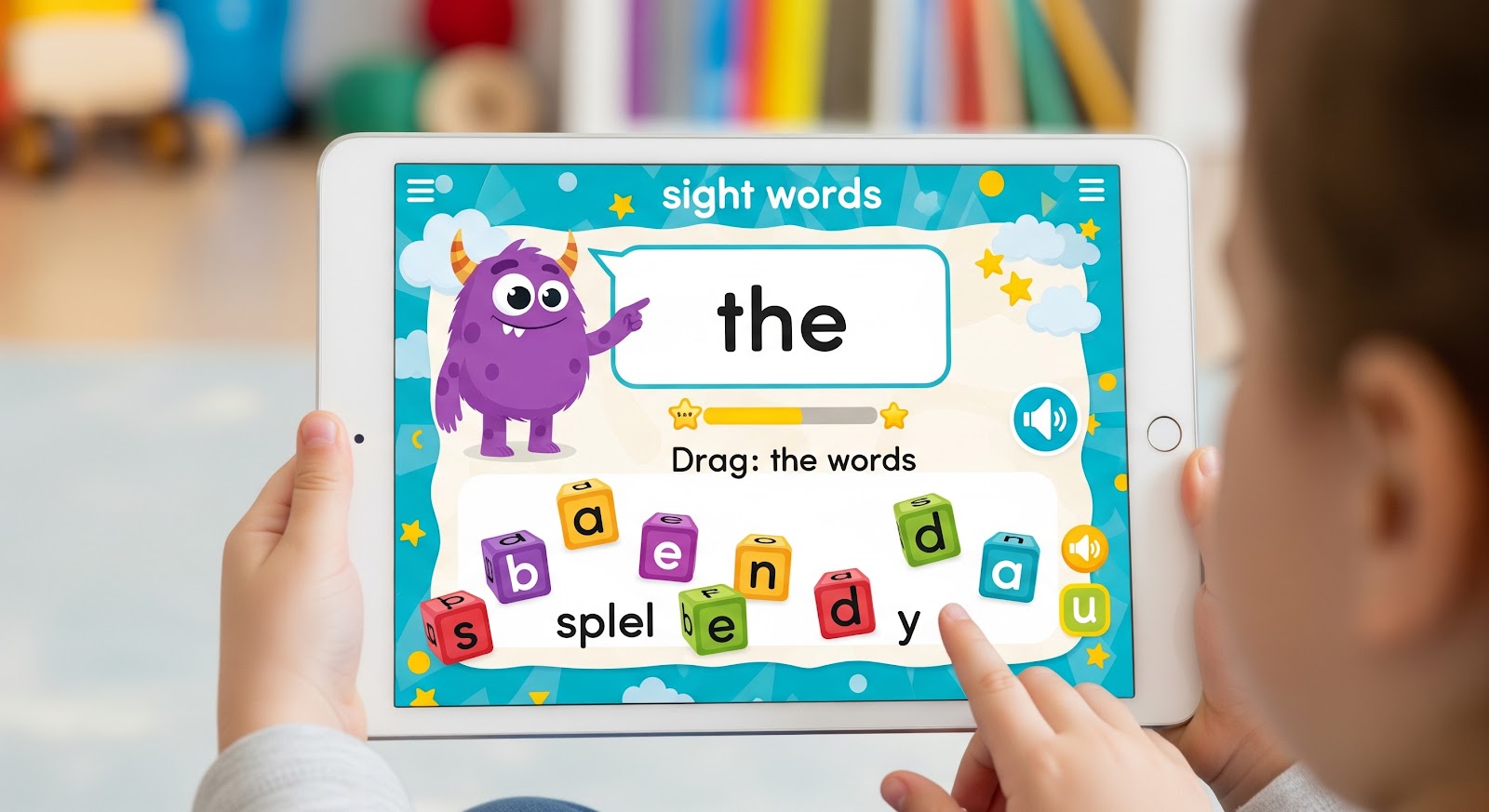
Learning to read is one of the most critical milestones in a child’s educational journey, and at the heart of early reading success is the mastery of sight words. Sight words are high-frequency words that appear so often in text that children must learn to recognize them instantly, without needing to decode them phonetically. These include words like the, said, come, and where, many of which don’t follow regular phonics rules and must be memorized through repeated exposure.
Mastering sight words is essential because they make up 50–75% of the words in early readers’ texts. When children can quickly identify these words, they read more fluently and focus their mental energy on understanding meaning rather than sounding out every word. This automaticity is a cornerstone of reading comprehension and builds the confidence necessary to tackle more complex texts.
However, developing sight word fluency isn’t just about memorization, it requires:
- Daily practice that is purposeful and engaging,
- Immediate feedback to correct errors and reinforce accuracy,
- And structured, evidence-based instruction tailored to a child’s reading level and learning style.
For students with dyslexia, ADHD, autism, or those learning English as a second language, this kind of support is even more critical. These learners often need multisensory, adaptive instruction that goes beyond flashcards or traditional worksheets.
This is where Readability shines. As the most effective sight word app for early readers, it combines real-time speech feedback, AI-powered reading support, and Science of Reading principles to ensure every child, regardless of ability, can build fluency, comprehension, and a lifelong love of reading.
Why Sight Word Mastery Matters in Early Literacy
Sight word mastery is more than just memorizing a list, it’s a foundational skill that empowers children to read smoothly, confidently, and with comprehension. For young learners, sight words represent the building blocks of early texts, and mastering them unlocks access to the majority of what they see in books, assignments, and even everyday print like signs or instructions.
1. Supports Automaticity and Cognitive Efficiency
When children recognize sight words instantly, without needing to decode them, they free up valuable cognitive resources. This concept, known as automaticity, allows the brain to focus less on figuring out individual words and more on understanding the meaning of sentences and stories. Without automaticity, reading becomes a slow, effortful task that hinders comprehension and enjoyment.
2. Builds Confidence in Early and Reluctant Readers
Mastering sight words gives children a sense of achievement. When young readers can fluently read phrases like “I see the dog” or “Where are you going?”, they begin to see themselves as readers. This confidence leads to greater motivation, independence, and a positive attitude toward reading. For reluctant or struggling readers, every recognized word reinforces their belief that they can succeed.
3. Essential for Students with Diverse Learning Needs
Children with dyslexia, ADHD, speech or language delays, and English Language Learners often face additional hurdles in early literacy. Sight word mastery helps level the playing field:
- For students with dyslexia, learning sight words bypasses complex decoding that may be difficult due to phonological processing deficits.
- Children with ADHD benefit from short, repeated practice cycles that improve attention and retention.
- For ELLs, sight word recognition helps accelerate language acquisition and comprehension by reducing reliance on decoding unfamiliar English structures.
- Students with speech delays or autism gain confidence through multisensory repetition and nonjudgmental feedback, especially when supported by tools like Readability that can adapt to their unique speech patterns.
Sight word mastery is not just about learning to read, it’s about access to learning itself. When students unlock fluency early, they are better prepared to transition from “learning to read” to “reading to learn.”
What Makes an Effective Sight Word App?
Not all literacy apps are created equal. While some offer simple flashcards or games, an effective sight word app must go beyond memorization. It should integrate the latest research-backed literacy strategies with engaging, personalized technology. The most powerful apps, like Readability, are rooted in the Science of Reading and designed to meet the needs of diverse learners across multiple dimensions of reading development.
1. Grounded in the Science of Reading
The Science of Reading identifies five essential pillars for successful reading instruction:
- Phonemic Awareness: Recognizing and manipulating sounds in spoken words.
- Phonics: Understanding the relationship between sounds and letters.
- Fluency: Reading smoothly and accurately with appropriate speed and expression.
- Vocabulary: Knowing and understanding the meaning of words.
- Comprehension: Grasping the meaning of text and making inferences.
A strong sight word app doesn’t isolate these elements, it weaves them together, helping children recognize words instantly while also building the decoding and comprehension skills that fuel deeper reading success.
2. Real-Time Speech Feedback
For sight word mastery, children must read aloud and be heard. Readability’s real-time speech recognition listens as children read and provides immediate feedback, correcting misread words, reinforcing accuracy, and modeling proper pronunciation. This immediate support mimics the role of a live reading tutor but is available anytime, anywhere.
3. Adaptive Reading Levels
An effective sight word app meets each child where they are and grows with them. Readability continuously adjusts content based on reading performance, offering just-right texts that are neither too easy nor too difficult. This adaptive technology ensures learners are constantly challenged but never overwhelmed.
4. Immediate Error Correction
Children learn best when errors are addressed as they occur. When a reader stumbles over a sight word, Readability highlights the word, offers pronunciation help, and encourages self-correction. This real-time intervention supports accurate word recognition and long-term retention.
5. Daily Reading Prompts and Comprehension Checks
Sight words should not be learned in isolation. Readability embeds them into meaningful reading passages and full books, encouraging daily reading habits. After each session, the app prompts verbal comprehension questions, building listening and thinking skills alongside sight word fluency.
6. Progress Dashboards for Parents and Educators
Parents and teachers need to see more than just “time spent reading.” Readability offers clear, actionable data on accuracy, fluency (WCPM), vocabulary growth, and comprehension. This helps adults identify strengths, pinpoint challenges, and celebrate milestones, all of which support home-school collaboration and accountability.
7. Explicit, Multisensory Instruction
The most effective sight word instruction uses a multisensory approach, engaging visual, auditory, and kinesthetic pathways. Readability supports this with on-screen word highlighting, verbal prompts, and interactive feedback that reinforce word recognition through seeing, hearing, and speaking. This is especially effective for students with dyslexia, ADHD, and ELLs.
The best sight word apps go beyond rote repetition. They create dynamic, personalized learning environments where children build fluency, confidence, and comprehension, all supported by sound pedagogy and powerful technology. Readability embodies this approach, making it the most effective tool for mastering sight words and beyond.
Why Readability Is the Most Effective Sight Word App
Readability stands apart because it doesn’t treat sight words as a memorization task, it treats them as part of a complete, evidence-based reading system. By combining the Science of Reading with advanced AI technology, Readability ensures that sight word instruction leads to real fluency, comprehension, and long-term reading success.
A. Systematic Instruction Aligned with the Science of Reading
Readability is built on the five pillars of literacy identified by the Science of Reading: phonemic awareness, phonics, fluency, vocabulary, and comprehension. Sight words are taught in context, not in isolation. Children encounter high-frequency words naturally within leveled books and meaningful sentences, reinforcing understanding rather than rote recall.
Instruction is systematic and scaffolded:
- Children begin by decoding words with support.
- Repeated exposure in connected text strengthens recognition.
- Over time, words move from conscious decoding to automatic recognition.
This progression ensures that sight word mastery supports, not replaces, strong foundational reading skills.
B. Real-Time Feedback That Builds Fluency
One of Readability’s most powerful features is its ability to listen as children read aloud. Using advanced AI and speech recognition, the app acts like a patient, nonjudgmental reading tutor:
- It identifies misread sight words instantly.
- Models correct pronunciation.
- Encourages self-correction and rereading.
This immediate feedback loop is critical for fluency development. Children don’t practice mistakes, they practice accurate reading, which leads to smoother, faster, more confident reading over time.
C. Personalized Learning for Every Child
No two readers are the same, and Readability is designed with that reality in mind. The platform automatically adjusts:
- Reading level
- Text complexity
- Vocabulary exposure
- Instructional pacing
This personalization is especially impactful for diverse learners, including:
- English Language Learners who need pronunciation support and repeated exposure
- Students with dyslexia, who benefit from structured, explicit instruction
- Children with ADHD or autism, who thrive with predictable routines, short reading sessions, and immediate feedback
By meeting children exactly where they are, Readability helps every learner experience success, often for the first time.
D. Data-Driven Progress Tracking
Effective sight word instruction doesn’t stop with the child, it empowers the adults supporting them. Readability provides a clear, easy-to-understand AI-powered dashboard that tracks:
- Reading fluency (words correct per minute)
- Accuracy with sight words and decoding
- Comprehension performance
- Time spent reading and consistency
Parents and educators gain actionable insights, not just screen-time data. This visibility makes it easier to identify growth, address challenges early, and celebrate progress, strengthening the home–school connection.
E. Proven Results That Go Beyond Sight Words
Readability’s effectiveness is backed by measurable outcomes:
- 74% of students show significant improvements in reading fluency
- Students read an average of 138 books per year
- Consistent gains in reading level, comprehension, and vocabulary retention
These results highlight a key truth: when sight word instruction is embedded within high-quality, daily reading practice, children don’t just recognize words, they become capable, confident readers.
Conclusion
Sight word mastery is one of the most important milestones in a child’s early reading journey. These high-frequency words appear so often in texts that recognizing them instantly is essential for fluency, comprehension, and confidence. Without this foundational skill, young readers can struggle to keep up, falling behind in reading and across subjects.
That’s why choosing the right tool for sight word instruction matters.
Readability is more than just a reading app, it’s a personal AI reading tutor built on the most effective, research-based literacy methods available. Unlike flashcard-style apps or passive reading games, Readability provides a comprehensive, structured, and supportive reading environment. It listens as children read aloud, gives immediate feedback on sight word accuracy, adapts to their skill level, and delivers daily, meaningful instruction aligned with the Science of Reading.
But what truly sets Readability apart is its impact.
- Children don’t just practice, they progress.
- They don’t just guess, they gain fluency.
- And they don’t just read more, they read better.
With Readability, sight word learning becomes part of a larger literacy transformation, one that builds confident, capable readers who are equipped for lifelong success.
For parents, educators, and schools seeking a proven, inclusive, and intelligent reading solution, Readability is the most effective sight word app and so much more.
 Español