In our last guide on understanding dyslexia, we explored what dyslexia is, what causes it, and why it affects reading differently. We broke down the science behind dyslexia into practical terms and shared a few simple ways you can begin supporting your child's learning journey.
In this guide, we'll take the next step by focusing on how children with dyslexia learn to read through six core reading skills and the teaching methods that can make the biggest difference.
We'll explore the evidence-based strategies that help build reading skills, explain why they work, and share practical activities you can use to support your child at home.
As with our previous guide, we'll translate decades of dyslexia research into clear, approachable language. Along the way, we'll explain not only what effective reading instruction looks like, but also why it works – so you can better understand your child's learning process and feel more confident supporting their progress.
A Quick Review of Dyslexia
Dyslexia is a disability that affects an individual's ability to read and spell. As a specific learning disability, it is entirely separate from a child's overall intelligence and has no bearing on their potential. Rather, it stems from under-activated components within the brain's broader reading system. In short, it's a bottleneck rather than a complete breakdown.
Most importantly, dyslexia is not a barrier to becoming a successful reader. Thanks to the brain's remarkable ability to adapt – a process known as neuroplasticity – consistent, well-directed practice can meaningfully strengthen the pathways a dyslexic reader relies on.
It's this last point that sets the stage for what follows. If reading skills can improve, the next question becomes: What exactly does "consistent, well-directed practice" look like? Let’s explore the evidence-based teaching methods that help children with dyslexia build strong reading skills, one step at a time.
Not sure if your child may have dyslexia? Take our free dyslexia test to identify common signs and determine the next best steps:
Navigating the Storm
It'll be useful to ground today's subject matter by attaching it to an image – in this case, a view of a hurricane. It may seem like an unusual place to begin, but stick with us. Together, we'll navigate the storm and arrive at a clearer understanding of how to approach the teaching process.
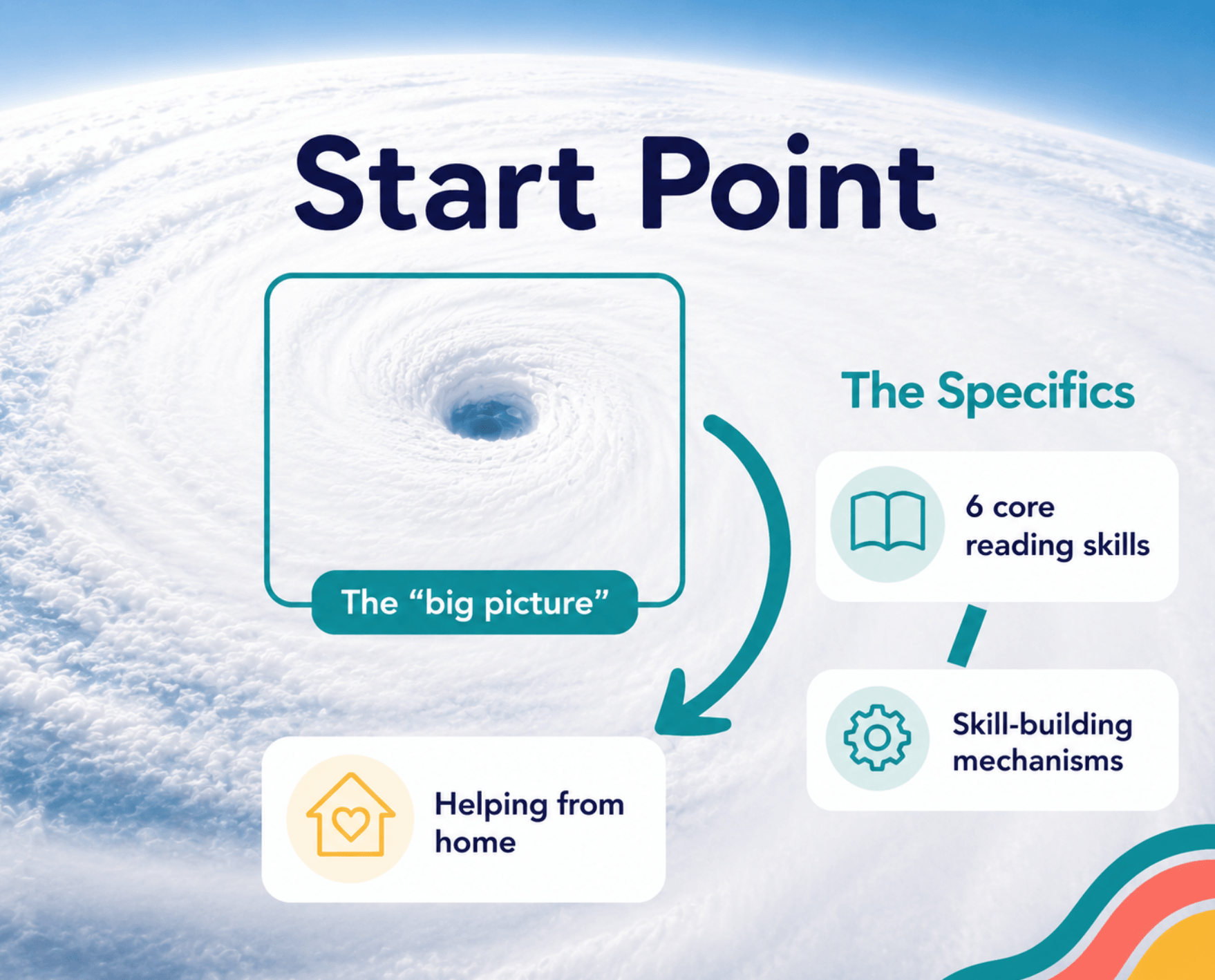
The visualization of a storm aptly reflects the research landscape of dyslexia education. There is a wealth of information exploring how best to teach children with dyslexia to read, with ideas branching in many different directions. While it can feel overwhelming to navigate, nearly all of the research revolves around a single realized point – the eye of the storm, if you will.
That's where we'll begin.
The Eye of the Storm: The Big Picture
Our approach to teaching children with dyslexia to read must be fundamentally, entirely different from teaching neurotypical learners, because the cognitive processes that underpin learning for each are different.
For children with dyslexia, teaching needs to be active, not passive. Reading instruction should be explicit, systematic, and cumulative, directly teaching the structure of written language rather than expecting children to infer it through exposure alone.
These ideas may sound technical now, but they'll become much more concrete as we move through the teaching process. Before defining each one, it's helpful to understand why children with dyslexia require a different approach to learning.
The Difference
Technically, learning to read isn't accomplished passively for anybody. Our brains aren't innately wired for it, so nobody simply "catches it" all at once. If we think of reading as a sort of racetrack, however – with fluent literacy as the finish line – the divide between neurotypical and dyslexic readers quickly becomes apparent. While every child must learn to read, their starting lines are vastly different.
For neurotypical learners, the reading process gradually begins to reinforce itself. As they gain an initial foothold in decoding (the process of connecting letters to the sounds they represent), each successfully read word becomes an opportunity to absorb its spelling and store it for future use. Through this process, much of the finer machinery of written language is effectively self-taught through independent reading.

Children with dyslexia don't benefit from this same jump-start because the brain regions responsible for decoding are under-activated. As a result, letter-to-sound connections never become fully automatic in the same way they do for typical readers. Rather than mapping print to sound instantly and effortlessly, many dyslexic readers must work through words more deliberately, one sound at a time.
The bottom line is this: because decoding isn't an automatic process running in the background while a child reads, simply exposing them to more text isn't enough on its own.
This is what we mean when we say the approach to teaching must be different – it can't be passive.
The Specifics: A Structured Approach to Reading
Don't worry if you haven't heard many of the technical aspects of reading we're about to explore. In an educational environment built around neurotypical learning, many of the unseen "tools" of reading instruction often go unnoticed. To understand how children with dyslexia learn to read, we'll uncover these tools one by one before bringing them together into a comprehensive strategy.
This strategy is known as Structured Literacy, a term coined by the International Dyslexia Association (IDA). Rather than being just one approach among many, Structured Literacy is grounded in decades of scientific research and is widely recognized as one of the most effective methods for teaching children with dyslexia to read.
At its core, Structured Literacy emphasizes reading instruction that is explicit, systematic, and cumulative. These principles shape both what children are taught and how they are taught.
- Explicit: Skills and concepts are taught directly rather than left for children to discover on their own.
- Systematic: Instruction follows a carefully planned sequence, with each new skill building on those that came before it.
- Cumulative: Previously learned skills are continuously reviewed and reinforced as new concepts are introduced.
Together, these principles create a structured pathway for learning to read. Instead of relying on repeated exposure alone, Structured Literacy helps children build reading skills step by step, creating a strong foundation for long-term success.
The 6 Core Reading Skills for Dyslexia
Now that we've introduced the framework of Structured Literacy, let's explore the six core reading skills that support successful reading. We'll examine each skill individually, explaining both what it is and how you can help your child develop it.

1. Phoneme Awareness: The Building Blocks
Phoneme awareness refers to your child's ability to recognize and work with the individual sounds that make up words. A phoneme is the smallest unit of sound in a word.
Think /k/ /a/ /t/ in cat. Phoneme awareness is the ability to both put CAT together from its individual sounds and break CAT apart into those same sounds.
It's like working with a LEGO set. You need to recognize the individual pieces the instructions call for, as well as understand how they fit together to build the complete model.
Practicing Phoneme Awareness at Home
You can help support phoneme awareness at home by using short oral games that encourage your child to hear, blend, and segment the individual sounds in words.
A structured routine could look like:
- Say the word aloud. Cat
- Ask your child to repeat it.
- Ask them to stretch the word out and clap each sound. C – A – T
- Ask them to put the sounds back together.
- Then, if they are ready, have them connect the sounds to the letters by asking what each specific letter corresponds to. What does C make? Cuh (at).
Try not to turn it into guessing or picture games that jump too quickly into visual letters before the child can reliably hear the sounds in words. The research-backed idea is that children need direct practice with sound structure first.
Other examples to use:
- Say cat. Now say it without the c.
- What word do these sounds make? /m/ /a/ /p/ - (map)
- Tell me the first sound in ship.
- Clap once for each sound in ‘sun’.
For more ways to make this kind of practice engaging, try these dyslexia games for kids, which include simple activities for building reading and language skills at home.
2. Decoding: Turning Letters into Sounds
Decoding refers to your child's ability to turn visual letters into sounds, then blend those sounds into words. It is the first foundational skill in the physical act of reading. Once a child can hear the sounds in words (phoneme awareness), the next step is learning how those sounds are represented in print.
Explicit instruction is especially important here so children don't learn to guess words from pictures or context, or become frustrated when they encounter unfamiliar words.
The eventual goal is for your child to understand how the print system works so they can read unfamiliar words independently. In other words, you're giving them the tools they need to figure words out on their own.
Practicing Decoding at Home
You can help support decoding at home with concrete, structured activities: you model the sound-symbol link, your child practices blending the sounds, then your child reads the word again and again until the pattern becomes more automatic.
A structured routine could look like:
- Say a word slowly and have your child repeat it. Ship. Ship.
- Point to each letter or letter pattern as your child says the word. Ship – Sh / i / p /
- Read the letter sounds individually before blending the whole word. / Sh / i / p / - ship.
- Repeat this practice with a few carefully chosen words that use the same pattern. Ship, shop, shut, shell.
- Revisit the pattern across days so it becomes automatic.
As children get older or move beyond simple words, decoding also includes syllable division, vowel patterns, affixes, and strategies for reading multisyllabic words.
You can also try activities like:
- Word chunking: Help your child decode a longer word by breaking it into manageable parts. Take a word like sunset. Have your child identify the two word parts, read each one, then blend them together.
- Controlled sentence reading: After practicing a pattern in single words, read a short sentence that uses the same pattern, such as The cat sat. Ask your child to decode each word before reading the entire sentence smoothly.
3. Orthography: Spelling and Its Patterns
Orthography refers to the set of rules and patterns that govern how written English is formed. It includes spelling patterns, common letter combinations, and other conventions in print.
You can think of it as helping your child understand, "This is how English usually spells this sound," or, "This is a common pattern words follow." It's about making sense of the logic that written English usually follows, rather than treating every word as a random sequence of letters.
Once your child begins decoding words, the next step (which often develops alongside decoding) is helping them notice that English spelling follows predictable patterns. Orthographic instruction teaches how letters and sounds usually work together in written words, with the goal of helping your child recognize unfamiliar words more confidently.
Orthographic learning is the essential step that helps children move from sounding out every word slowly to recognizing familiar spelling patterns automatically.
Practicing Orthography at Home
You can help support your child's understanding of orthography by explicitly pointing out and reviewing repeated spelling patterns in words.
A structured routine could look like this:
- Point out repeated spelling patterns in words as you come across them, such as sh, ch, and th.
- Group together words that share the same pattern and ask your child to compare them, such as ship, shop, and shut.
- Make short word lists using the same pattern and practice them over several days, revisiting the pattern regularly.
These activities work because they connect sound, print, and memory in a structured way, which is the goal of orthographic learning. They also keep spelling from becoming simple rote memorization, which is often less helpful for children who benefit from a clearer system.

For example, you could practice with the word ship:
- Say ship aloud.
- Ask your child to clap out /sh/ /i/ /p/.
- Have them write ship.
- Ask, "What letters make the first sound, /sh/?"
- Practice with shop, shut, and shell so they can recognize the same sh pattern across different words.
You can also try activities like:
- Word sort: Give your child a small set of words and ask them to group them by spelling patterns, such as sh, ch, or th.
- Word building: Use letter tiles or index cards and change one sound or spelling at a time so your child can see how words stay related, such as ship → shop → shot.
- Word trace: Have your child read a word, trace it while saying its sounds, then write it from memory.
4. Morphology: Parts That Carry Meaning
Morphology refers to the study of word parts that carry meaning, such as prefixes, suffixes, and roots. In short, they are the segments of words that carry shared meaning across different words, like un in unhappy and unlikely, where the prefix un- means the opposite of the base word it's attached to.
After children begin learning to decode words and develop a grasp of spelling patterns, the next step is helping them notice that many words are built from smaller parts that carry specific meanings. Teaching these parts explicitly helps children recognize patterns that make reading and spelling more predictable.
Helping your child understand morphology is important because it teaches them how words are built, not just how they sound.
Practicing Morphology at Home
You can help support your child's understanding of morphology by pointing out and reviewing the parts of words that carry meaning, such as prefixes, suffixes, and the base words they're attached to.
A structured routine could look like this:
- Point out meaningful word parts as you come across them, such as un-, re-, -ful, and -ness.
- Explain what these parts mean. Group them together in context and ask your child to compare words that share the same part, such as redo, retell, and rebuild.
- Make short word lists using the same prefix, suffix, or base word, and practice them over several days to reinforce their meanings.
For example, you could practice with the word unhappy:
- Say unhappy aloud.
- Ask your child to break the word into its parts: un + happy.
- Have them write unhappy both as a complete word and separated into its parts.
- Ask what un- means and how it changes the meaning of the word.
- Practice with unfair, untie, and unkind so they can recognize the same un- pattern and how it functions across different words.
These activities help make spelling and vocabulary more predictable. Breaking words into their meaningful parts shows that English words have an intentional structure rather than being random combinations of letters. By attaching meaning to these written segments, children strengthen both their understanding and memory of new words. Over time, this leads to smoother, more confident independent reading as they learn to understand unfamiliar words through the familiar prefixes, suffixes, and roots they've already encountered.
You can also try activities like:
- Meaning-match sort: Give your child a mix of words and ask them to group words that share the same prefix or suffix, such as replay, reheat, and rewrite, or helpful, playful, and careful.
- Word family building: Start with a base word and add different affixes to create new words, such as help → helpful → helpless → helper.
- Affix hunt: While reading together, ask your child to identify familiar prefixes or suffixes and explain how they change the meaning of the word.
- Base word swap: Start with a base word and change the prefix or suffix, then ask your child how the meaning changes. For example: do → redo → undo.
5. Fluency: Moving Smoothly
Fluency refers to your child's ability to read text accurately, smoothly, and with appropriate expression. In this case, expression means using natural rhythm, intonation, and emotional tone. Simply put, fluency is reading without having to labor over every word.
Once the foundational skills of decoding, orthography, and morphology are well developed, the focus shifts to reading as smoothly and effortlessly as possible. This is called fluency – and it doesn't mean rushing or reading as quickly as possible. It means reading accurately and automatically enough that your child can focus on the meaning of what they're reading rather than the act of reading itself.
Fluency is the final bridge to reading comprehension. Slow, effortful reading can use up a child's attention and mental energy before they have a chance to understand the text. For children with dyslexia, fluency often improves as decoding becomes more stable through repeated, supported practice.
It sits between decoding and comprehension in the structured sequence because it helps your child move from simply reading words to understanding their meaning. When decoding becomes less of a struggle, fluency frees up mental energy for comprehension.
Practicing Fluency at Home
You can help build your child's fluency through activities that use complete sentences and passages rather than isolated words.
A simple rule to follow with any fluency activity is this: model it, repeat it, support it, and keep it short enough that your child can succeed.
A structured routine could look like this:
- Read a single sentence together with your child, taking your time.
- Read it again and notice whether it feels smoother, paying attention to any difficult words or phrases.
- Encourage your child to keep their eyes on the words and read phrase by phrase, rather than getting lost in the meaning of a longer or more challenging sentence.
You can also:
- Have your child reread a short passage several times, aiming to increase accuracy and ease with each reading.
- Read a passage aloud first so your child hears fluent reading before attempting it themselves.
- Practice reading a few lines or sentences with a focus on smooth phrasing rather than speed.
- Use short, manageable texts that build confidence instead of overwhelming your child with passages that are too difficult.
Repeated success builds momentum, momentum fosters confidence, and confidence drives motivation to continue. When your child practices with text they can reasonably handle, they experience fewer breakdowns, and visible progress makes them more willing to keep trying.
You can also try activities like:
- Echo reading: Read a sentence or short passage aloud first, then have your child read the same line back, copying your phrasing and expression.
- Phrase reading: Break a sentence into small chunks and practice each phrase together instead of having your child struggle through every word individually.
- Audio-assisted reading: Have your child follow along with printed text while listening to a fluent narrator, then reread the passage aloud independently.
- Reader's voice: Ask your child to reread a line using expression, such as a surprised or scared voice, so they pay attention to phrasing and punctuation.
6. Comprehension: Understanding the Text
Comprehension refers to your child's ability to understand and think about what they read. It includes everything from making sense of individual sentences to connecting ideas across a text and relating what they read to their own background knowledge.
Comprehension is the final skill in our structured approach and the ultimate goal of reading. It's what most people think of when they think about reading itself. More importantly, comprehension is the gateway to learning across virtually every subject and the foundation upon which education is built.
Practicing Reading Comprehension at Home
You can help support your child's reading comprehension by discussing what they read, what it means, and how the ideas connect throughout the text.
A structured routine could look like this:
- Preview the text before reading by looking at the title, pictures, headings, or key vocabulary. Ask your child what they think the text will be about.
- Read the text together, pausing occasionally to ask simple questions about what's happening, what a detail means, or why something is important.
- Ask your child to summarize the text in their own words. Encourage them to identify the main idea and relate the reading to something they already know.

By previewing vocabulary, asking questions, and talking through the meaning of a passage, you help reduce the mental effort required to understand the text. This is especially important for children with dyslexia, as the effort of decoding can leave less mental energy available for comprehension unless it is supported directly.
You can also try activities like:
- Think and pause: Stop during reading and ask your child what they think is happening or why a character acted a certain way.
- Main idea sort: Give your child a short passage and ask them to choose the main idea from several options.
- Story map: For straightforward stories, have your child identify the characters, setting, conflict, and resolution.
- Prediction checks: Pause while reading and ask your child what they think will happen next. Continue reading together and discuss whether their prediction was correct or how it changed.
- Retell practice: After reading, ask your child to tell the story back to you in their own words, using the text as support when needed.
In Summary
After reading all of this, it may feel like supporting your child's reading requires becoming an educational specialist overnight – mastering the terminology, running flawless lessons, and making sure every minute detail is done perfectly.
That isn't the message we're trying to convey.
You do not have to become an expert, and you certainly don't have to take on your child's entire reading education yourself. While this guide goes into considerable depth, it's designed to give you options, not expectations. Think of it as a roadmap, not a prescription.
What matters far more than following every activity perfectly is showing up consistently, keeping practice sessions short and encouraging, and understanding the general path your child is on.
Even a modest amount of the right kind of practice, done regularly, patiently, and with intention, can make a profound difference over time.
The activities in this guide aren't a test you have to pass. They're simply tools to help guide your child. And of all those tools, your steady presence is by far the most powerful.
How Readability Tutor Can Help
Beyond providing a practical roadmap for supporting structured literacy at home, Readability Tutor provides a dyslexia app for kids that helps reinforce the same foundational skills your child is developing through everyday practice.
Designed to support guided reading, the app brings the structured literacy process into a manageable, trackable routine. While it doesn't replace direct instruction, it gives children additional opportunities to practice sound-letter relationships, spelling patterns, and word recognition in connected reading.

For example, if your child is learning a pattern like sh, you can introduce it directly during practice, then use Readability Tutor to reinforce that same pattern through short, engaging reading passages. As your child begins recognizing spelling patterns and meaningful word parts, the app provides repeated exposure in authentic reading experiences that help strengthen those skills over time.
One example comes from Salisbury Elementary, where a third- and fourth-grade teacher introduced Readability Tutor to students with dyslexia and other learning challenges. Over a ten-week period, students used the app for just 20 minutes a day – 10 minutes at school and 10 minutes at home.
The results included:
- 36% improvement in reading fluency
- 97% improvement in reading accuracy
- One student increased from 22 to 54 words per minute.
- Another increased from 52 to 101 words per minute, while also gaining confidence in their reading abilities.
These results reflect the same principle this guide has emphasized from the beginning: consistent, well-directed practice, done a little each day, leads to meaningful growth.
Readability Tutor simply helps make that daily practice easier to maintain, reinforcing the structured reading skills your child is building at home. Try Readability Tutor 30 days free.
About the Author: Michael Kirst is a writer, journalist, and student of English currently studying at Trinity College, Dublin.