Diagnostic language can often feel sterile, dense, and opaque. Medical terminology tends to explain the biological side of disability while overlooking the lived experience: the frustrations, victories, and day-to-day realities that families navigate together.
At Readability Tutor, our goal is to bridge that gap by combining research-backed information with straightforward, practical guidance for parents.
This guide is designed to help you better understand dyslexia, recognize common signs, and learn ways to support your child's reading journey. It is not intended to diagnose or treat dyslexia, but rather to serve as a helpful starting point for understanding how your child learns and how you can support them.
Why Understanding Dyslexia Matters
Despite being the most common specific learning disability – accounting for an estimated 80% of diagnosed learning disabilities in the United States – dyslexia remains widely misunderstood and under-supported in many educational environments. Because of this, receiving a diagnosis can sometimes feel frightening, overwhelming, or even fatalistic.
If there is one thing we hope you, the parent and reader of this article, walk away understanding, it is this: Dyslexia is not a death sentence for reading.
Dyslexia is increasingly understood as an example of “human variability” – a natural variation in how human brains develop and process language, no more a defect than differences in height, handedness, or eyesight. It is not a complete failure of the brain to read. Rather, it reflects differences in the way particular parts of the brain's reading network operate. And, crucially, these networks can be supported and strengthened over time.
Not sure if your child may have dyslexia? Take our free dyslexia screener to identify common signs and determine the next best steps:
Reading Isn't Simple
Many of us take reading for granted. In modern life, reading is often treated less as a specialized skill and more as an automatic process happening quietly in the background of the mind. But in reality, reading is one of the most remarkable things the human brain learns to do.
For most of human history, literacy was rare. Prior to the early 1800s, only a small fraction of the world's population could read, and it wasn't until the expansion of public education in the twentieth century that literacy became commonplace. The situation becomes even more fascinating when you realize that our brains were never evolutionarily designed for reading in the first place.
Unlike spoken language, which humans appear biologically primed to develop, reading is a cultural invention, and a relatively recent one at that. As children learn to read, the brain adapts and repurposes existing neural systems, particularly those involved in visual recognition and language processing, to accommodate written language.
In other words, reading is not innate. It is a skill that the brain painstakingly builds over time. And it is an extraordinarily complicated skill. To read even a single sentence, the brain must recognize visual symbols, connect letters to sounds, blend those sounds into words, access vocabulary and meaning, hold information in memory, and integrate all of it into understanding – often within seconds.
Literacy, the ability to read, write, and understand written language, has become the foundation upon which much of modern education rests. Understanding this complexity matters because it helps us understand something equally important: When reading becomes difficult for a child with dyslexia, it is not because they are lazy, unintelligent, or not trying hard enough.

So, What Is Dyslexia?
As we mentioned earlier, the goal of this guide is to provide parents with useful, memorable information and practical tools to support their child's learning journey. Effective support begins with understanding. Before we can help a child overcome challenges, we first need to understand what those challenges actually are.
The International Dyslexia Association defines dyslexia as:
A specific learning disability characterized by difficulties with word reading and/or spelling that involve accuracy, speed, or both.
Let's break that definition down into simpler terms.
First things first. It's important to understand what we mean by specific learning disability. A specific learning disability (SLD) is a neurodevelopmental condition characterized by difficulties in a particular skill area, such as reading, spelling, writing, or mathematical calculation. In the case of dyslexia, those difficulties primarily involve reading and spelling.
Perhaps the most important thing to understand about specific learning disabilities is that they are not reflections of overall intelligence. An SLD signals a particular weakness in one area rather than an overall cognitive deficit.
Dyslexia Is Not a Reflection of Intelligence
Children with dyslexia are fully capable of high-level thinking, creativity, problem-solving, and learning. The capacity is there. The challenge lies in how specific information is processed.
This distinction is important because it addresses one of the most common misconceptions surrounding dyslexia: it is not a lack of intelligence or potential.
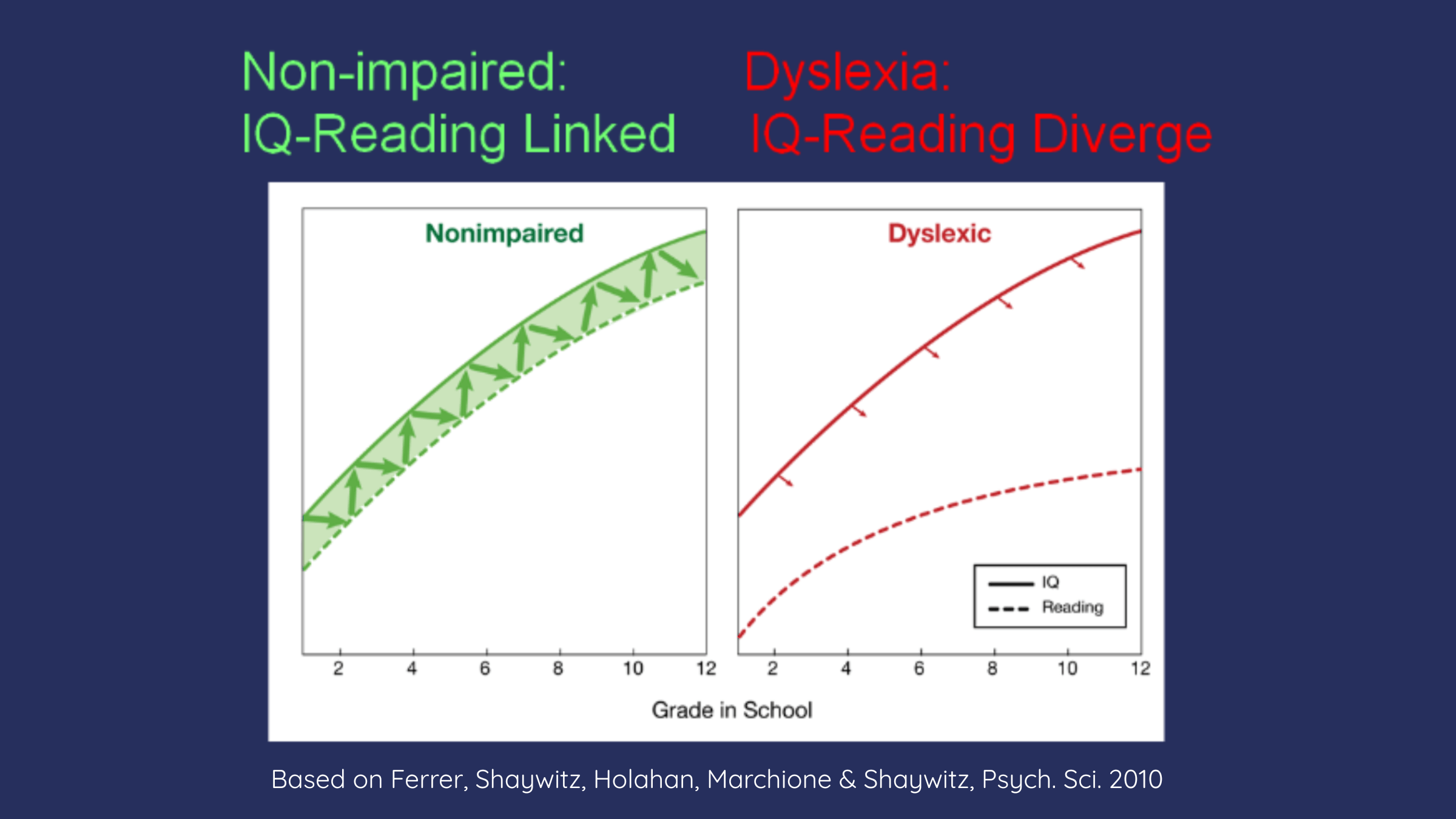
It can be helpful to think of dyslexia less as a broken system and more as a bottleneck in an otherwise powerful one. Imagine a Ferrari that struggles to get out of first gear. The engine is powerful. Once it gets moving, it can reach incredible speeds. It simply needs a little more support at the starting line.
What Exactly Is Impaired in the Dyslexic Reading Process?
To answer that, it’s helpful to map out how reading actually takes place, step by step, in the brain. Reading isn't something that happens in a single location. Rather, it relies on an intricate network of regions working together to transform visual symbols on a page into language and meaning.

First, you physically see a printed word with your eyes. That information travels, in the form of electrical signals, to the back of the brain where visual processing begins. From there, the brain utilizes a region in the left hemisphere commonly referred to as the Visual Word Form Area (VWFA). This area plays a critical role in connecting written symbols to the sounds they represent. This is a process known as phonological processing.
Phonological processing includes skills such as identifying individual sounds in words, blending sounds together, recognizing rhymes, and breaking words into smaller parts such as syllables. For many individuals with dyslexia, this is where the bottleneck in the reading process tends to occur.
Why the Bottleneck Makes Reading So Difficult
In a dyslexic reader, parts of the brain’s reading network may activate less efficiently. The connections responsible for turning print into recognized sounds quickly and automatically require more effort. The system is not broken. One crucial part of it simply works more slowly, placing greater demands on the rest of the brain.
This is why reading can feel laborious, tiring, and deeply frustrating for a child with dyslexia, even when their vocabulary, reasoning, and overall understanding are fully intact. The ideas are there. The route from the page to meaning is simply more congested.
The most immediate effect of this bottleneck appears during decoding: the process of sounding out a word, blending the sounds together, and recognizing the word itself.
For example:
C-A-T → “cuh-ah-tuh” → cat
For a dyslexic reader, this process may take longer and require more concentration, especially with unfamiliar or multisyllabic words. As a result, reading aloud can be particularly demanding. You may notice your child pausing frequently, guessing a word from its first letter or the surrounding context, or skipping it altogether rather than spending a long time trying to work it out.
Spelling is often affected by the same underlying difficulty because it relies on similar sound-to-letter connections, only in reverse.
Why Decoding Can Affect Comprehension
There is an important secondary effect as well. When so much mental energy is devoted to lifting words from the page, less energy remains for understanding, remembering, and connecting the ideas behind them. This helps explain why a child may easily follow a story when someone else reads it aloud, yet struggle to understand the same story when reading independently.
Once again, the understanding is there. The effort of decoding simply crowds it out.
You may also notice your child rereading a sentence two or three times before it fully makes sense. By the time they have decoded the final words, the beginning of the sentence may already have faded from memory. This struggle is not a reflection of ability. It is the very real cost of a brain working overtime to compensate for a less efficient part of the reading process.
Keep in Mind: No Two Dyslexic Readers Are Alike
While all of this information is integral to understanding the anatomy of dyslexia and what is functionally challenging your child in their learning, it still presents only a static image – a partial piece of a much larger puzzle. It is equally important to understand that dyslexia does not present as a single, uniform experience.
The difficulties described above exist along a spectrum of severity. Some children may experience only mild interruptions to the reading process, while others face more significant challenges. Even within the same child, those struggles can look different from one task to the next. Critically, from an educational standpoint, a dyslexic child's difficulties tend to persist even when they are given instruction that works perfectly well for their classmates.
This is part of what sets dyslexia apart from a simple lack of practice or exposure. It is not simply a matter of "not trying hard enough" or "being a slow reader." Rather, it reflects genuine differences in neurological wiring that distinguish the dyslexic learner from the neurotypical. No two brains are created identically. The same applies to those with dyslexia.
Underlying difficulties with phonological processing (working with the individual sounds that make up words) and morphological processing (working with the building blocks of words, like prefixes and suffixes) are common, but not universal. The causes underlying these differences in wiring are genuinely complex, too.

What Are Some Key Takeaways?
Left unrecognized and unsupported, the effects of dyslexia can ripple outward, affecting learning beyond simply reading books. As we discussed earlier, reading underpins much of modern formal education. A child who finds reading exhausting may write less, and in turn have fewer opportunities to build vocabulary, knowledge, and confidence in expressing themselves through language.
Over time, this can weigh on academic achievement – and just as importantly, on confidence and emotional well-being. That may seem like a great deal to take in… Take a deep breath.
We raise these possibilities not to alarm you, but to make the opposite point clearer: These are the downstream consequences of dyslexia going unrecognized and unsupported. They are not inevitabilities.
Even by simply absorbing and applying the information offered in this article, you are already taking active steps to support your child and mitigate many of the difficulties dyslexia can present.
With recognition and the right targeted support, the trajectory changes dramatically. That support is valuable at any age, but it is especially effective when it begins early – in the years before and during a child's first encounters with formal reading.
So, how can we help spot these challenges early on?
Potential Signs of Dyslexia
Before we go any further, one important caveat: what follows is not, and should not be used as, a diagnostic checklist. At Readability Tutor, we cannot tell you whether your child has dyslexia. Only a qualified professional, such as an educational psychologist or specialist assessor, can make that determination through a formal evaluation.
As we mentioned earlier, dyslexia varies enormously from one person to the next. No child will show every sign. Showing several does not confirm dyslexia, and showing none does not necessarily rule it out. Instead, think of the list below simply as a collection of patterns that parents and teachers sometimes notice.
These observations can be useful for starting a conversation with your child's teacher or another professional – an important first step – but they are not a substitute for formal assessment.
With that firmly in mind, some commonly observed patterns include:
- Reading that is slow, hesitant, or noticeably effortful, often accompanied by frequent guessing at words.
- Difficulty sounding out unfamiliar or longer words, or connecting letters to the sounds they represent, particularly in the early reading years.
- Spelling that is inconsistent or unexpected for the child's age, sometimes spelling the same word several different ways on the same page.
- Avoiding reading aloud, or becoming visibly anxious, reluctant, or tired when asked to read.
- A noticeable gap between strong spoken language skills (ideas, vocabulary, storytelling) and much weaker reading or writing on the page.
- Difficulty with rhyming or learning sequences such as the alphabet, the days of the week, or the months of the year.
- Reading or written work that takes far longer than expected, given the clear effort and intelligence the child brings to it.

It is just as important to remember that children with dyslexia frequently demonstrate remarkable strengths alongside these challenges. Strong reasoning, creativity, problem-solving, storytelling, and big-picture thinking are all commonly reported strengths among individuals with dyslexia.
If several of these patterns sound familiar and have been persistent over time, the most useful next step is not self-diagnosis but conversation. Readability Tutor’s free dyslexia test for kids can be a helpful starting point.
Talk with your child's teacher and other professionals about arranging a formal assessment. An accurate evaluation is often the gateway to appropriate support. And, as we'll discuss next, support is where meaningful progress is made.
How Can You Help?
Supporting a child with dyslexia is about steady, patient habits and effort. We have gathered a handful of evidence-based, research-backed approaches that you can implement to help your child in their reading journey:
- Make reading a short, regular ritual. Brief daily sessions (ten or fifteen minutes) can do far more good than irregular, long, draining sessions. Consistency is what strengthens the reading pathways.
- Read together. Read aloud.
- Meet your child where they are. Lean into their interests. Choose books and topics your child loves, even if the reading level feels light. You can also try dyslexia games for kids to make reading and language practice feel more engaging. Engagement and small successes build the confidence necessary to progress to the next level.
- Praise the effort involved, not just the outcome. Acknowledge persistence and progress rather than speed or perfection. Protecting and building confidence is just as important as building skills.
- Utilize audiobooks alongside printed text.
- Keep it calm. Frustration is the enemy of practice, especially when the reading process is already heavily taxed. If it becomes too stressful, it is perfectly fine to pause and return later.
- Involve their school. Talk to teachers. Let them know what is going on. Ask about formal evaluations and what accommodations and supports may be available. As a parent, you are your child's most important advocate.
How Can Readability Tutor Help?
Everything above has been leading to a single, hopeful conclusion: The dyslexic reader's brain grows stronger with consistent, well-supported practice. This is precisely the need Readability Tutor was built to meet.

Readability Tutor is a dyslexia app designed to give children the steady, structured practice their developing reading network depends on. Our platform offers the kind of repetition that, when approached step-by-step and consistently, gradually makes reading feel less effortful and helps young readers grow in confidence.
We offer:
- Consistent, independent practice. Readability gives your child a low-pressure space to read regularly, helping turn practice into a daily habit rather than a daily battle.
- Real-time support. As your child reads, our technology listens and responds, offering gentle help with difficult words so they can maintain momentum and stay engaged.
- Progress you can track. Readability tracks growth over time, allowing both you and your child to watch improvement unfold.
To leave a final, honest word: Readability is not a cure, nor is it a replacement for professional assessment or specialist instruction. What it can be is a genuinely useful tool in your ever-growing arsenal – an accessible, everyday way to put the most important principle of this guide into practice:
Keep reading, consistently, even when it is hard.
That is how progress is made.
One page at a time.
Try Readability Tutor 30 days free.
About the Author: Michael Kirst is a writer, journalist, and student of English currently studying at Trinity College, Dublin.