When your child struggles to read simple words but can explain complex ideas with ease, it can be difficult to understand why. This puzzling gap may seem like a lack of concentration or effort, but it can actually reflect an underlying difficulty with how reading works.
It's the end of another school day, and you've picked up your eight-year-old from the car line to drive home. In the backseat, your child recounts with curious liveliness and clear detail the contents of science class that day. Astronauts on the space station, you're informed, aren't actually floating because there's no gravity – they're just falling the whole time, moving so fast sideways that they keep missing the Earth.
You glance in the mirror, a bit stunned. You're fairly sure you didn't know these things at their age. Frankly, you're not entirely sure you knew it last week.
A bit later that evening, you see that a note has come home in your child's backpack, and you ask them to read it aloud: "Please bring a coat on Friday."
Six words.
As your child lifts the note to their gaze and tries to read it, they stall on "please," guess "bring" as "bin," and by the time they reach "Friday," they've given up and handed the note back to you. These two moments, while only a few hours apart, seem impossible to square. How can a child who understands orbital physics struggle to read six simple words about a coat?
It's all too easy to brush it off as a lack of concentration or mere laziness, but the reality of the situation is more complicated. Both moments are genuine, and both are the product of the same evidently capable, intelligent mind.
They don't contradict each other. Placed side by side, they form one of the most recognizable patterns in children's reading difficulties, and one of the most often misunderstood.
Reading: One Skill, or More?
From the outside, and especially without mounds of research on linguistics and neuroanatomy (which the vast majority of people obviously don't have), reading looks like a single ability. Your child either can read, or they can't… Right?
Not really.
In reality, "reading" is shorthand for several skills stacked on top of each other, each simultaneously being employed to allow us to extract meaning from text.
We can't feel these individual processes going on in our skulls – as they are in this very moment as you're reading – but it helps to pull them apart to understand the gap we've witnessed.
The combined skill of reading, that is, seeing language and making sense of it in our heads, can be better understood when broken down into the individual mechanisms that drive it.

Decoding, Fluency, and Comprehension
- Decoding is the process of working out what a printed word says by linking its letters to the sounds they represent. It's the skill that turns a random string of letters, b-r-i-n-g, into "bring."
- Reading fluency grows out of decoding. Fluency is decoding accurately, at a comfortable pace, and with natural expression. It develops once words are recognized so quickly that your child no longer has to stop and think about them.
- Language comprehension is understanding spoken language. It's our linguistic capacity that predates our ability to read. Following an explanation, knowing what words mean, catching humor and tone, and drawing on what you already know about the world. It's what your child was demonstrating in the car.
- Reading comprehension is the end goal: understanding what's actually being said in the written text on the page. It depends on decoding and language comprehension working together. Your child has to get the words off the page and understand them once they have. If either component is weak, reading comprehension suffers, no matter how strong the other is.
This is why the gap is so confusing. In many children with dyslexia (as well as other reading struggles), language comprehension is a real strength. They have a rich vocabulary, demonstrate sophisticated ideas, and exhibit a bottomless curiosity.
But when it comes to the page, all of these things have to arrive through decoding first. And decoding is exactly where dyslexia causes trouble. An easy way to think about it is like picturing a powerful computer held up by a slow internet connection. The computer itself is perfectly capable, and it can produce dazzling results, but these results arrive at a crawl, if they even arrive at all.
Give it a faster connection (by reading the book aloud or playing an audiobook), and suddenly its full capability is on seamless display. There's a reason dyslexia is often described as "unexpected." Widely used definitions describe word-reading difficulties that are surprising because they don't match a child's other demonstrated abilities.
A child's reasoning ability and reading skills don't necessarily develop at the same rate. A child can be exceptionally capable and still find decoding extraordinarily hard. The two aren't tied together.
P.S. Wondering if your child's reading difficulties could be signs of dyslexia? Try our free dyslexia screener to learn more:
Why the Gap Gets Mistaken for Laziness
If you've ever caught yourself thinking that your child could simply do this if they just tried harder, you shouldn't beat yourself up, because you're far from alone. When your child talks like a ten-year-old and reads like a six-year-old, it's natural to assume the higher level is the "real" one and the lower must be some sort of choice.
The fact of the matter is that the contrast is jarring, and without context, it can leave you scraping your brain for answers. Finding an answer can also be troubling because reading with dyslexia is often inconsistent. Your child might read "said" correctly at the top of a page yet go on to stumble over it three lines later, or read a specific book seamlessly on Monday and poorly on Thursday.

Bright children are often remarkably good at covering the gap. They memorize their favorite books, make clever guesses from pictures and context, and lean on their strong spoken language to fill in the blanks. That can carry them a surprisingly long way, often until the texts get longer and more difficult to decode. It's why children's reading difficulties can seem to suddenly "appear" a few years into school.
These difficulties aren't just randomly manifesting on a whim. It's simply that, until that point, your child's other strengths were able to partially compensate for their decoding difficulties. Misreading this gap, however, can have real costs.
Children often absorb what adults believe about them, and a child who keeps hearing "you're not trying" while trying as hard as they possibly can will eventually settle on an explanation of their own, usually along the lines of "I'm lazy" or "I'm stupid." Reading difficulty is already closely tied to anxiety and low confidence as a learner, so being misjudged on top of that only deepens the issue.
So what's the alternative? How can you reorient your approach to this gap while protecting your child's confidence and development?
How to Support a Child Who Struggles With Reading
A solid first step is to pause and change the question you're asking. Instead of why won't they try?, ask what's making this hard right now?
Doing so turns a reading struggle from a test of character and intelligence into an approachable problem the two of you can solve together.
It also helps to explain the gap to your child directly, in terms they can understand. Many children with dyslexia are quietly relieved to hear that being a slow reader and a clever person aren't opposites. After all, as we've highlighted in this article, understanding the intricacy of that fact isn't automatic.
If you're having trouble sorting out what the gap is caused by, chances are your child is too! Knowing that their overall potential and intelligence aren't tied to their ability to pull words from a page gives your child a far kinder explanation than "I'm stupid," and it's an explanation that's actually true.

Finally, it's useful to separate thinking from decoding wherever you can, so your child's understanding gets the credit it deserves. If your child can explain a story beautifully but can't write it down, let them tell it to you first, or record it, before tackling the writing. And praise the specific things they do well:
- "You noticed that clue before I did."
- "You went back and fixed that word yourself."
A child who hears, again and again, that their mind is strong and their reading is a skill being built will be far more willing to keep doing the hard work of building it.
When Reading Difficulties May Point to Dyslexia
According to the International Dyslexia Association, dyslexia is characterized by difficulties with accurate or fluent word reading and/or spelling. The gap between strong understanding and weak word reading is a common pattern in children with dyslexia, but it isn't definitive proof. Noticing this pattern is a good reason to look more closely, but it isn't a reason to reach a verdict at the kitchen table.
When professionals assess your child for dyslexia, they look well beyond a single reading task. Your child might have an undetected vision or hearing problem. Attention difficulties can make reading erratic, and they frequently occur alongside dyslexia rather than instead of it. Some children simply haven't yet had clear, systematic teaching in how letters map to sounds.
None of these factors settles the question on its own, which is exactly why the whole picture matters more than any single observation.
Feed the Mind, Build the Skills
Regardless of whether or not an assessment is underway, nothing is stopping you from addressing the underlying issue and getting ahead of the curve to support your child's reading growth. There is a wealth of articles on our site that point to a range of detailed, evidence-based approaches, but in general, the most helpful responses work on these two fronts at once:

Keep the Big Ideas Flowing
A child with strong understanding needs material that matches their mind, not just their decoding ability.
Audiobooks for dyslexic children, reading aloud together, documentaries, museum trips, and long conversations about whatever has caught your child's interest all keep vocabulary and knowledge growing while their reading catches up. This helps prevent an isolated decoding difficulty from developing into a knowledge gap as well.
Build the Foundations Directly
At the same time, word reading needs explicit, structured teaching. An effective approach regularly blends systematic instruction in how letters and sounds work together, consistent reading practice with text at the right level, and well-timed feedback. Understanding alone won't teach decoding, however bright your child may be.
Each half needs the other. Rich ideas without skill-building can leave a child who understands the world but can't reach it through print. Skill-building without rich ideas can leave a child grinding through simple texts while their curiosity quietly withers. Together, they let your child grow as a thinker and a reader at the same time.
Our guide to dyslexia reading programs can help you compare different approaches and find one that fits your child's needs. You can also make practice more engaging by incorporating dyslexia games for kids that reinforce phonics, word recognition, and other foundational reading skills.
Understanding Your Child's Reading Strengths and Challenges
A child who can explain why astronauts float but can't read a note about bringing a coat isn't a child who's being careless. They're showing you two very different skills developing at two very different speeds. Neither cancels out the other, and neither tells the whole story alone. Your child's potential is independent of the reading struggles they face.
Treat their understanding as evidence of what they're capable of, and treat their struggles as a sign that something specific needs attention. Most importantly, resist the urge to chalk it up to laziness and settle the difference with "try harder."
If an assessment points toward dyslexia, or you'd simply like to start strengthening those foundations now, Readability Tutor’s dyslexia app for kids offers structured reading practice built around the sounds and patterns your child finds difficult. With that support in place, your child's reading can start catching up with the thinker they already are.
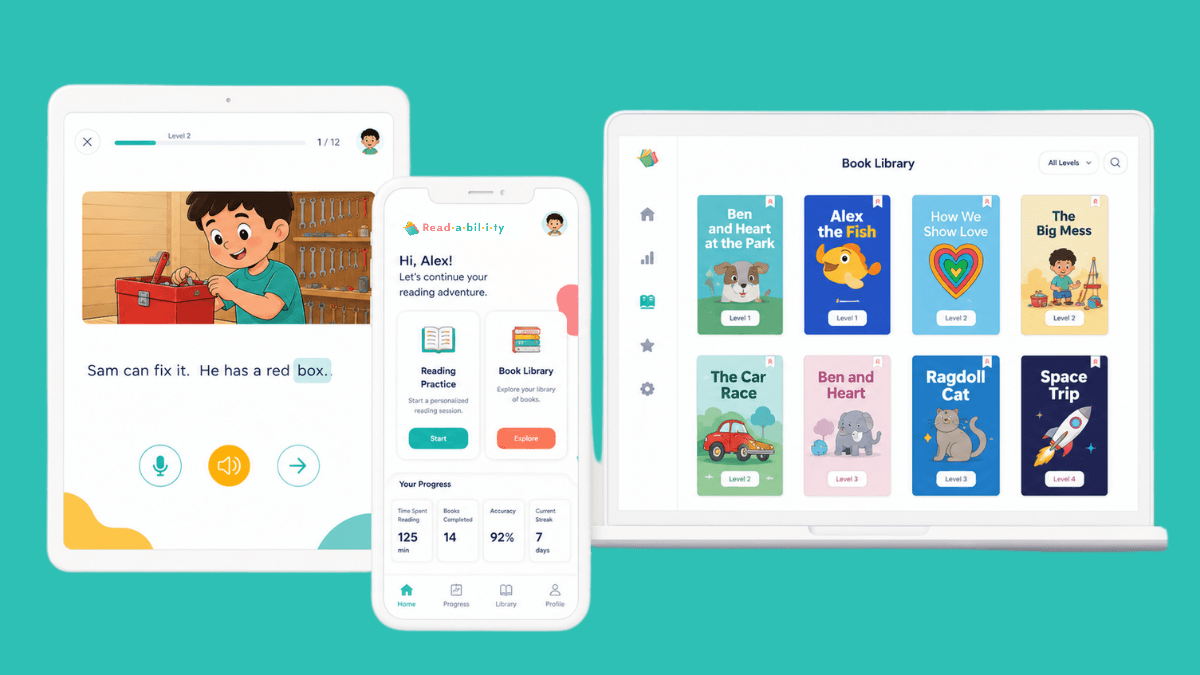
Every child deserves reading support that recognizes their strengths. Help your child build reading skills and confidence with our app, one word at a time:
Frequently Asked Questions
Why does my child struggle to read simple words but understand complex ideas?
Your child may have strong language comprehension but difficulty with decoding, the process of connecting written letters to their sounds. These skills develop separately, so your child can understand complicated ideas and stories while still struggling to recognize simple words on the page.
Can a child be intelligent and still have dyslexia?
Absolutely. Dyslexia affects reading-related skills, particularly accurate and fluent word recognition, but it doesn't determine intelligence. Your child can have a rich vocabulary, strong reasoning abilities, and advanced comprehension while experiencing significant reading difficulties.
Is struggling to decode words a sign of dyslexia?
Difficulty sounding out unfamiliar words, recognizing familiar words consistently, or reading fluently can be signs of dyslexia in kids. However, these challenges don't automatically indicate dyslexia. A qualified professional can assess your child's reading skills and help determine whether dyslexia or another factor may be involved.
About the Author: Michael Kirst is a writer, journalist, and student of English currently studying at Trinity College, Dublin.