

Introduction: Why Is It Important to Recognize Early Signs of Dyslexia in Young Children?
Recognizing the signs of dyslexia early plays a pivotal role in shaping a child's reading development and overall confidence. For many parents, caregivers, and educators, navigating the early years of literacy can be challenging, especially when a child seems to struggle more than their peers with foundational skills. It is essential to understand that dyslexia is a common language-based learning difference, and its presentation can vary significantly from one child to another. By identifying the early signs of dyslexia, caregivers and teachers can implement timely, effective strategies that foster reading success and prevent the emotional toll that often accompanies unrecognized learning challenges.
This comprehensive guide provides clear definitions and detailed age-by-age checklists to help you identify the signs of dyslexia in children ages 4 to 7. We will explore the differences between typical developmental variability and potential red flags, offering practical next steps for those seeking to support their young learners. While this information is educational and not diagnostic, it serves as a valuable resource to encourage open, informed discussions with educators, pediatricians, and reading specialists. Early intervention is key, and understanding what to look for is the first step in empowering children to overcome reading challenges. When children are supported early, they are more likely to view reading not as an insurmountable hurdle, but as a skill they can master with the right tools, such as the best reading apps for kindergartners.
What Is Dyslexia and What Are Common Misconceptions?
To effectively identify the signs of dyslexia, it is crucial to first understand exactly what dyslexia is and, equally important, what it is not. Dyslexia is a specific learning disability that is neurological in origin. It is characterized by difficulties with accurate and fluent word recognition, as well as poor spelling and decoding abilities. These challenges typically result from a deficit in the phonological component of language, which involves processing the individual sounds of spoken words. This deficit is often unexpected in relation to other cognitive abilities and the provision of effective classroom instruction.
A Concise Definition of Dyslexia
Dyslexia primarily involves difficulties with phonological awareness, decoding, and automatic word recognition. Children with dyslexia often struggle to connect letters to their corresponding sounds (phonics), making it difficult to sound out words accurately and fluently. It is vital to note that intelligence and vision are not the cause of dyslexia. In fact, many children with dyslexia possess strong reasoning skills, exceptional creativity, and a deep capacity for learning complex concepts. They simply process language differently, which requires specialized, explicit, and multisensory instructional approaches. For more foundational knowledge, consider exploring our guide on understanding dyslexia signs and symptoms.
Common Misconceptions About Dyslexia to Avoid
Several misconceptions surround dyslexia, which can unfortunately lead to confusion, stigma, and delayed support for children who need it most. One of the most prevalent myths is that letter reversals (such as confusing "b" and "d" or "p" and "q") or reading words backward are definitive signs of dyslexia. While some children with dyslexia may reverse letters, this behavior is actually quite common among all young children who are just learning to write and orient letters in space. Furthermore, dyslexia is not a visual problem, and vision therapy is not an effective treatment.
Another damaging misconception is that dyslexia is caused by a lack of effort, laziness, or poor teaching. This could not be further from the truth. Dyslexia is a neurobiological difference that requires specific, evidence-based reading interventions. A child with dyslexia is often working twice as hard as their peers just to keep up.
Why Does Early Identification of Dyslexia Matter for Reading Development?
Early identification of dyslexia is critical because it connects directly to significantly better outcomes in reading, writing, and overall school participation. The earlier a child receives targeted, evidence-based support, the more likely they are to develop the foundational skills necessary for fluent reading and to maintain a positive self-image as a learner.
The Reading-Development Window
The early years of a child's education represent a critical, neuroplastic window for reading development. Foundational skills, such as phonemic awareness (the ability to hear and manipulate individual sounds in words) and letter-sound mapping, are most malleable during this time. When decoding issues go unaddressed during these formative years, they can negatively impact a child's reading fluency, comprehension, and motivation. This often leads to a cycle of frustration and a reluctance to engage with texts, a phenomenon sometimes referred to as the "Matthew Effect" in reading, where the "rich get richer and the poor get poorer" in terms of vocabulary and reading exposure.
What Does "Early" Look Like?
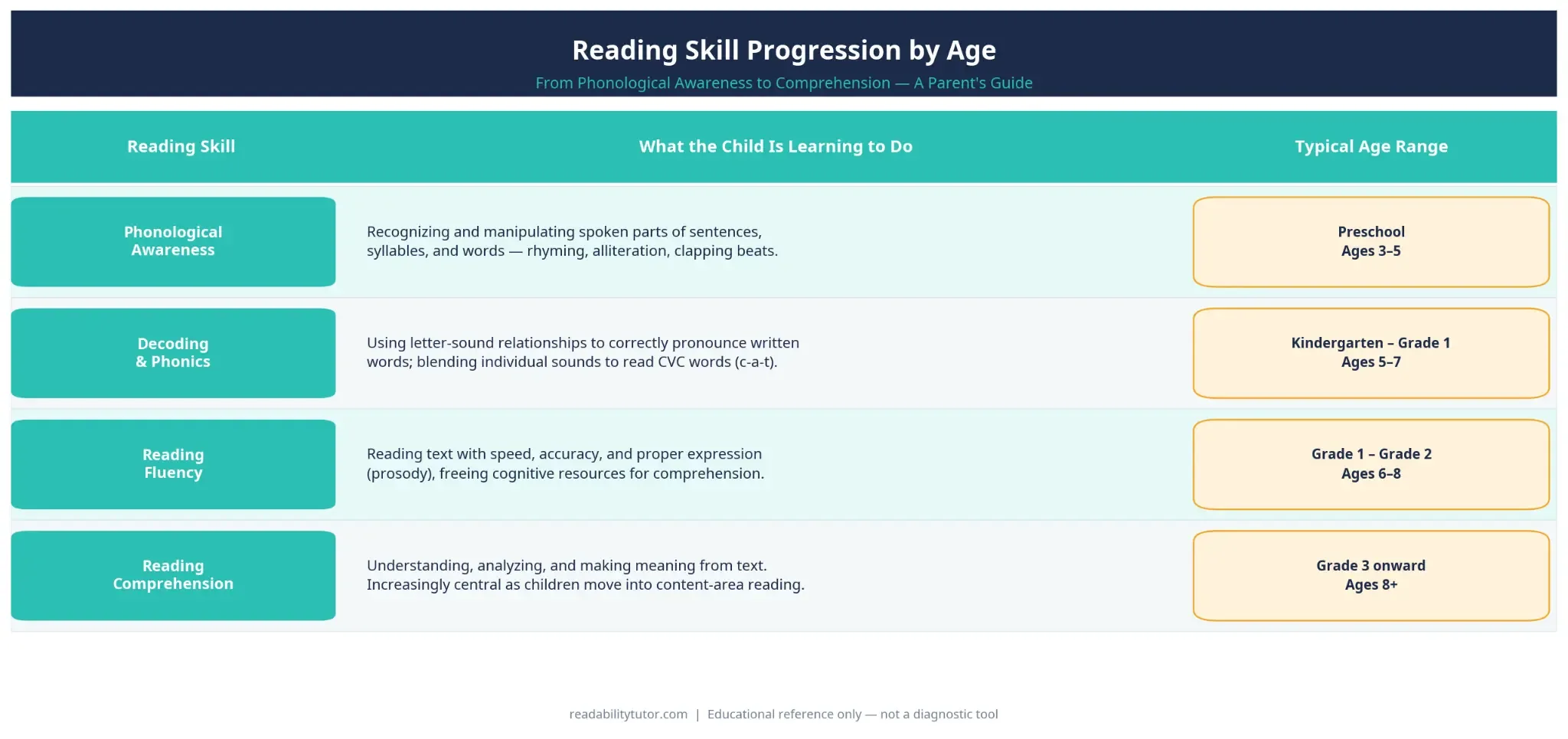
The period from preschool to grade 2 (ages 4 to 7) is prime time for noticing patterns and seeking screening. During these years, children are actively engaged in learning the building blocks of literacy. It is also important to consider family history, as dyslexia is highly heritable and often runs in families. If a parent, sibling, or close relative has dyslexia or a history of reading struggles, there is a higher likelihood that a child may also experience similar challenges, making vigilance even more warranted. For a broader view of what to expect, review our comprehensive guide on reading milestones by age.
What Are the Cross-Age Core Signs of Dyslexia to Watch For?
While some signs of dyslexia are specific to certain age groups or developmental stages, others can appear across various ages and contexts, forming recognizable patterns over time. These core signs often provide the earliest and most consistent clues that a child may be struggling with language processing and the mechanics of reading.
Language and Sound Awareness
Difficulties with language and sound awareness are often among the very first indicators of dyslexia, sometimes appearing even before a child begins formal schooling. Children may have profound trouble with rhyming, segmenting words into syllables, blending sounds together to form words, or identifying the first and last sounds in spoken words. Additionally, frequent and persistent mispronunciations of common words past the expected developmental age can be a significant red flag.
Rapid Naming, Memory, and Sequencing
Another core sign involves challenges with rapid automatized naming (RAN), working memory, and sequencing. A child might experience notably slow recall of familiar items such as letters, numbers, colors, or days of the week when asked to name them quickly. They may also have trouble remembering multi-step directions or learning sequences that other children pick up easily, such as the alphabet song, nursery rhymes, or daily classroom routines.
Reading and Spelling Markers
As children begin to interact more directly with print, reading and spelling markers become more apparent. A child might rely heavily on guessing words from pictures or the first few letters, rather than systematically sounding them out. They may also exhibit significant difficulty mapping letters to sounds (orthographic mapping), resulting in phonetic spelling that remains unusually inconsistent. To understand the importance of this process, read about what orthographic mapping is and why it matters for fluent reading.
What Are the Early Signs of Dyslexia in 4-Year-Olds (Preschool)?
In preschool, the signs of dyslexia are often subtle and can be best observed during daily routines, conversations, and play-based learning activities. At this stage, the focus is not on formal reading, but on early language development and emergent print awareness.

Early Language and Play
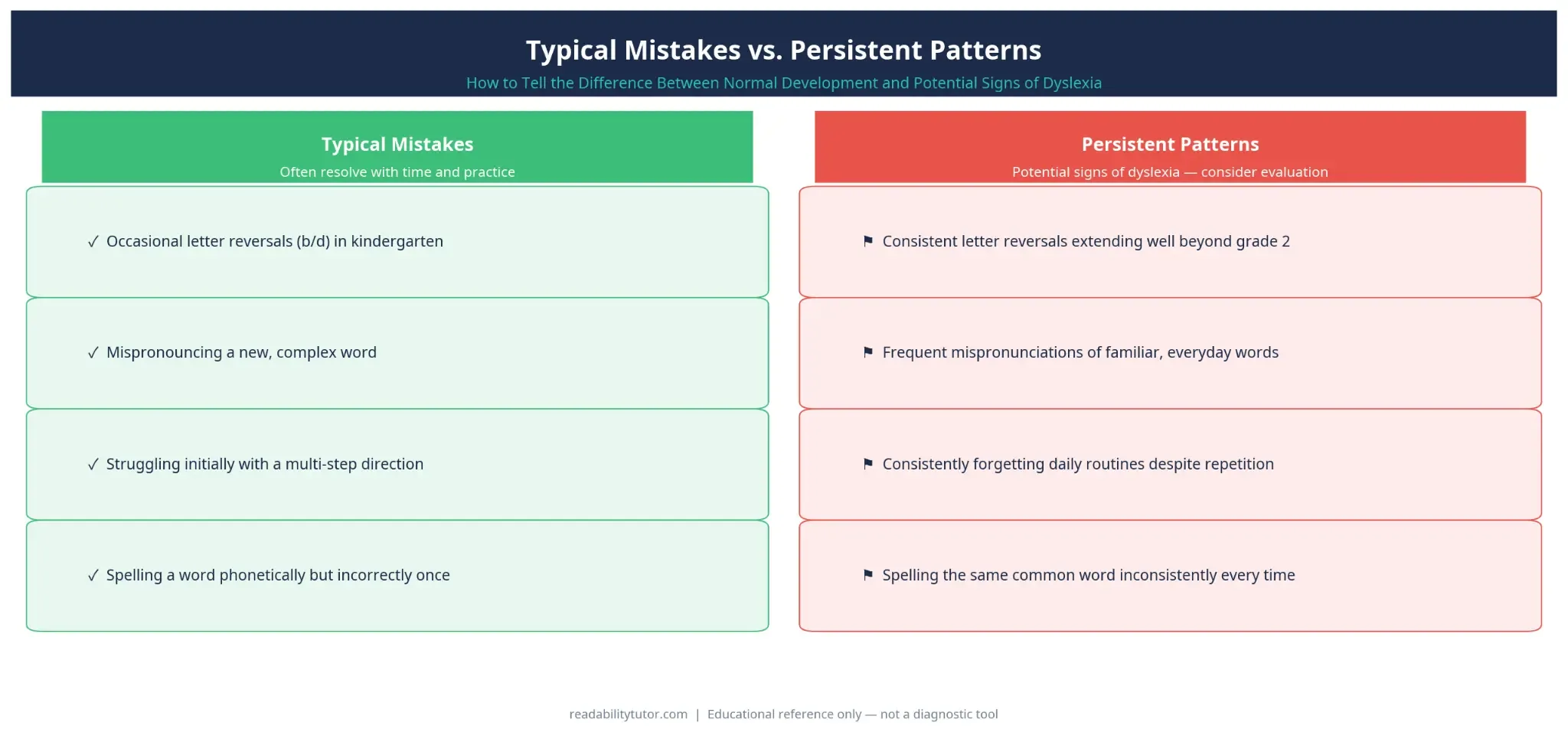
A 4-year-old who may be at risk for dyslexia might show limited interest in or noticeable difficulty with rhyming games and nursery songs, which are staples of early childhood education. They may also face challenges when asked to clap out syllables in their name or notice alliteration (words starting with the same sound, like "big brown bear").
Early Print Awareness
When it comes to early print awareness, a child might demonstrate limited recognition of the letters in their own name, even after repeated exposure and practice at home or in preschool. They might actively avoid letter-focused activities, puzzles, or tracing, although they typically still enjoy listening to stories and being read to by adults.
Everyday Communication
In everyday communication, you might notice persistent "baby-like" pronunciations that their peers have outgrown. They may experience word retrieval difficulties (frequently using filler words like "stuff" or "thing" because they are struggling to find the right specific word), or mixing up similar-sounding words (e.g., saying "aminal" instead of "animal," or "pasghetti" instead of "spaghetti").
How Do Signs of Dyslexia Present in Kindergarten (5 to 6 Years Old)?
As children enter kindergarten, school-based skill expectations increase significantly, and emerging literacy tasks become a primary focus of the curriculum. The signs of dyslexia often become more noticeable and impactful in this structured learning environment.

Letter-Sound Learning
A kindergartener with dyslexia may be noticeably slow to learn letter names and their corresponding sounds despite regular, explicit practice. While their peers begin to quickly associate the letter "m" with the /m/ sound, a child with dyslexia may struggle to make this connection stick. They might also experience significant difficulty blending individual sounds to read simple, consonant-vowel-consonant (CVC) words (like c-a-t) and segmenting sounds to spell them. For insights on building these skills, review our article on phonics for reading.
Early Reading Behaviors
In early reading behaviors, a child might rely heavily on pictures or the context of the story to guess words, showing limited growth in their ability to actually decode words on the page. They may also have profound trouble learning common high-frequency words (often called sight words) that cannot be easily sounded out and must be recognized automatically. To support this specific challenge, parents and teachers can explore resources on how to teach high frequency words.
Classroom Functioning
In the classroom setting, a child might consistently confuse left and right or struggle with routines that require sequential steps. They may exhibit visible frustration with phonics tasks, sometimes acting out or withdrawing. It is common to see signs of fatigue or avoidance during designated reading time, as the cognitive effort required for them to process print is exhausting.
What Are the Signs of Dyslexia in Ages 6 to 7 (Grade 1 to 2)?
During grades 1 and 2, reading expectations consolidate. Children are expected to transition from "learning to read" to "reading to learn." As the reading load increases and texts become more complex, the signs of dyslexia often become more pronounced and undeniable.
Accuracy and Fluency
A child in this age group might exhibit slow, highly effortful decoding. Every word seems like a new puzzle to solve. They may frequently skip, add, or substitute small function words (like "in," "on," "the," "a") and have significant difficulty tackling multi-syllable words. Reading aloud is often halting, choppy, and lacks expression. Notably, their oral comprehension (their ability to understand a story when it is read to them) is typically much stronger than their reading performance when they have to decode the text themselves. To understand what fluency should look like at this age, read about what age a child should read fluently.
Spelling and Writing
Spelling and writing can also present significant, persistent challenges. A child's spelling may not reflect sounds in predictable ways, and they might have trouble remembering spelling patterns that have been explicitly taught and practiced repeatedly. They may actively avoid writing tasks, have frequent erasures on their papers, and experience difficulty copying information accurately from the board to their notebook.
Subject Spillover
The challenges associated with dyslexia are not confined to language arts; they can spill over into other subjects. For example, a child might struggle with math word problems primarily due to the reading load involved, not a lack of mathematical understanding. This pervasive struggle can lead to reduced confidence, anxiety, and increased frustration around any literacy-based tasks.
How Can You Tell the Difference Between Typical Developmental Variability and Red Flags for Dyslexia?
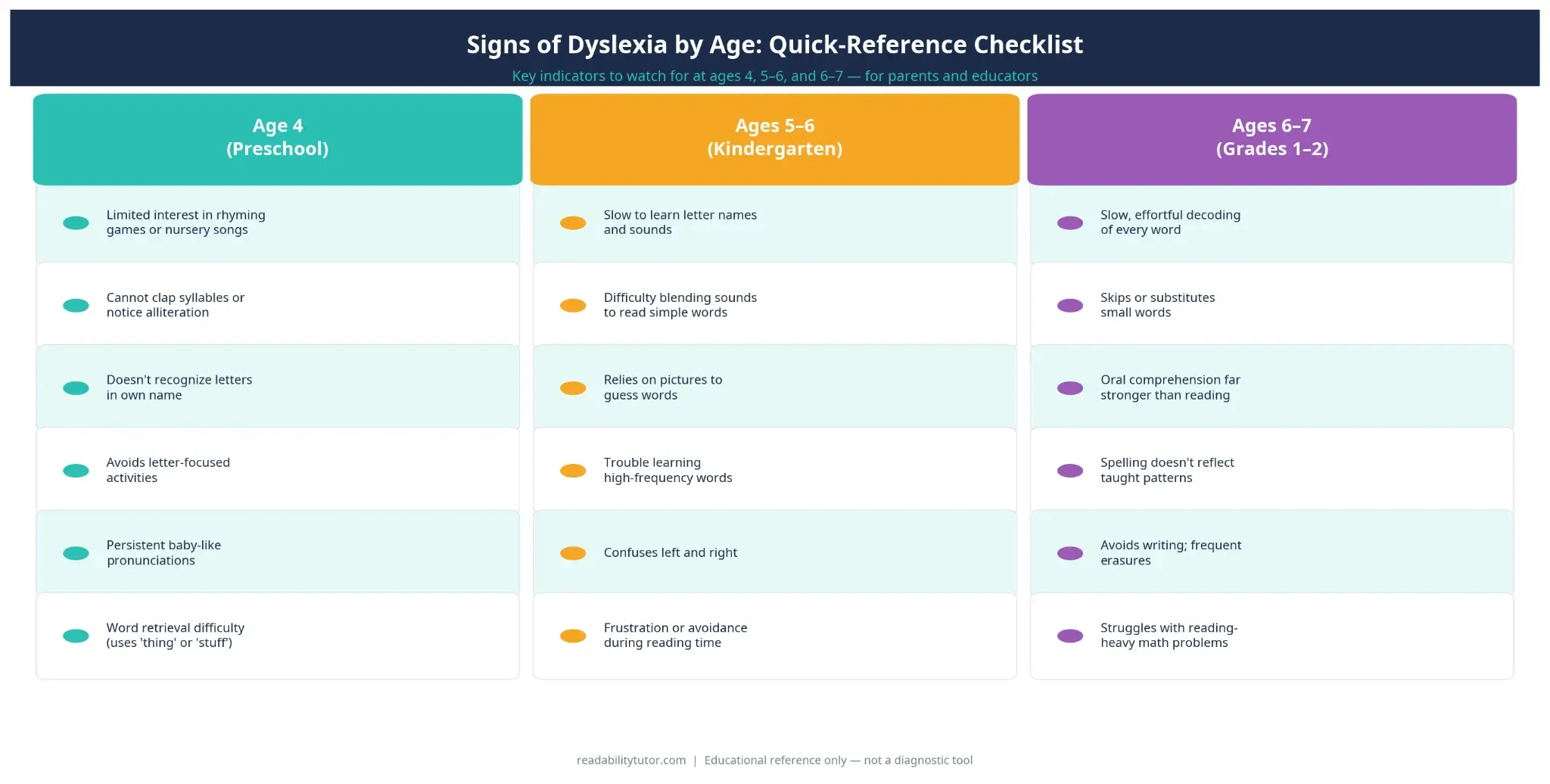
It is entirely common for children to experience bumps in the road as they learn the complex skill of reading. However, distinguishing between typical developmental variability and persistent patterns that merit professional evaluation is crucial for timely intervention.
What Is Considered Typical Development?
Occasional letter reversals (such as b/d or p/q) are typical before the end of second grade. It is also normal for a child to need extra practice to learn a handful of tricky letter-sound pairs or to occasionally stumble over a new, long word. Developing reading fluency takes time, and some children simply need more exposure and practice than others. To understand what is typical, it helps to know when kids learn to read and what the research-based timeline looks like.
What Are the Concerning Red Flags?
Concerning red flags involve clusters of signs across different settings (both at home and at school) that persist over several months. If a child makes minimal progress despite receiving targeted, explicit practice, or if there is a strong family history of reading difficulties, it is important to seek further evaluation. A child who becomes deeply anxious or resistant to school because of reading activities is also showing a significant red flag.
Looking for Patterns Over Time
When observing a child, emphasize looking for consistency across home and school environments, rather than focusing on isolated incidents or one-off bad days. A persistent pattern of difficulty, especially when compared to peers receiving the same instruction, is the most significant indicator that additional, specialized support may be needed.
What Should You Do If You Notice the Early Signs of Dyslexia?
If you notice persistent signs of dyslexia in a child, taking practical, stepwise actions can help ensure they receive the evaluation and support they need to thrive.
Document and Communicate Your Observations
Start by keeping dated notes with concrete examples of the child's reading behaviors from both home and school. Note specific words they struggle with, errors they consistently make, and their emotional reactions to reading. Share these detailed observations with the child's teacher and ask what they see during phonics and reading blocks. Open, collaborative communication between home and school is essential for creating a supportive environment.
Request Screening and Formal Evaluation
Request school-based screening where available. Many schools now use universal screeners to identify students at risk for reading failure. If concerns persist despite initial interventions, discuss the possibility of a formal evaluation. A comprehensive evaluation typically includes measures of phonological processing, decoding, oral reading fluency, spelling, rapid naming, working memory, and oral language. Understanding the evaluation process can be empowering; consider reading more about empowering students with dyslexia through effective reading programs.
Develop a Support Plan and Home Strategies
Work with educators to develop a formal support plan that includes structured, explicit, and multisensory reading instruction. Regular progress monitoring is crucial to ensure the intervention is working. At home, engage in short, consistent practice with phoneme games, letter-sound review, and decodable texts. Reading aloud daily is also a wonderful way to maintain vocabulary and background knowledge while preserving the child's confidence. For more strategies on how to support reading at home, explore how to improve reading skills in students. Furthermore, leveraging technology can be incredibly beneficial; learn about home solutions for better dyslexia reading and consider utilizing a multisensory approach to reading for dyslexia.
Conclusion: How Can Noticing the Signs of Dyslexia Early Lead to Better Reading Outcomes?
Noticing the signs of dyslexia early can profoundly alter a child's educational trajectory, leading to timely support, more confident reading, and a healthier self-esteem. By tracking patterns across settings and ages, caregivers and educators can collaborate effectively with health professionals to clarify needs and plan evidence-based next steps. Remember, small, steady supports compound over time, turning reading challenges into opportunities for growth and resilience. With the right tools, specialized instruction, and unwavering encouragement, every child can develop the skills they need to become a successful, independent reader. Early action is the most powerful tool we have to ensure that a learning difference does not become a learning barrier.
Frequently Asked Questions About the Signs of Dyslexia
Are Letter Reversals Always a Sign of Dyslexia?
No, letter reversals are not always a sign of dyslexia. Many young children occasionally reverse letters like "b" and "d" as they are learning to write and understand spatial orientation. It becomes a concern if the behavior persists consistently beyond the second grade along with other foundational reading difficulties.
At What Age Can Dyslexia Be Identified Reliably?
While early warning signs of dyslexia can be noticed as early as preschool, a formal and reliable identification is typically made around ages 5 to 7, when children begin formal reading instruction and their response to targeted intervention can be accurately assessed.
How Do Dyslexia, ADHD, and Language Disorders Differ and Overlap?
Dyslexia primarily affects accurate reading and spelling, while ADHD impacts focus, attention, and impulsivity. Language disorders affect the broader understanding and use of spoken language. These conditions frequently co-occur, making a comprehensive evaluation essential for accurate diagnosis and effective support. Learn more about how we support children with ADHD and reading challenges.
Can a Child Have Dyslexia and Still Read at Grade Level for a Time?
Yes, some children with dyslexia can read at grade level for a time, often by relying heavily on their memory, context clues, or exceptionally strong oral language skills. However, as reading demands increase in later grades, their underlying decoding difficulties usually become more apparent and limiting.
What Is the Difference Between Screening and a Formal Evaluation for Dyslexia?
A screening is a brief, quick assessment used to identify children who may be at risk for reading difficulties and need closer monitoring or initial intervention. A formal evaluation is a comprehensive, in-depth assessment conducted by a qualified professional to formally diagnose dyslexia and determine specific areas of need.
Do Vision Exercises Fix Dyslexia?
No, vision exercises do not fix dyslexia. Dyslexia is a language-based processing difference, not a visual or eye-tracking problem. Effective, evidence-based interventions focus on structured literacy, phonics, and phonological processing, not visual training therapies.
How Can I Talk With My Child's Teacher About My Concerns Regarding Dyslexia?
Approach the teacher collaboratively by sharing specific, dated examples of what you have observed at home. Ask the teacher what they are noticing during reading instruction and discuss the possibility of initiating a screening or exploring additional support options. For a broader perspective on effective teaching methods, read about how to teach reading using research-backed methods.
What Types of Instruction Help Students With Dyslexia?
Students with dyslexia benefit most from structured, explicit, systematic, and multisensory reading instruction. This method systematically teaches phonics, decoding, and spelling rules, allowing children to connect letters to sounds effectively using visual, auditory, and kinesthetic pathways. To learn more about effective approaches, read about the multisensory approach to reading for dyslexia. You can also explore the benefits of using a dedicated reading app for kids.