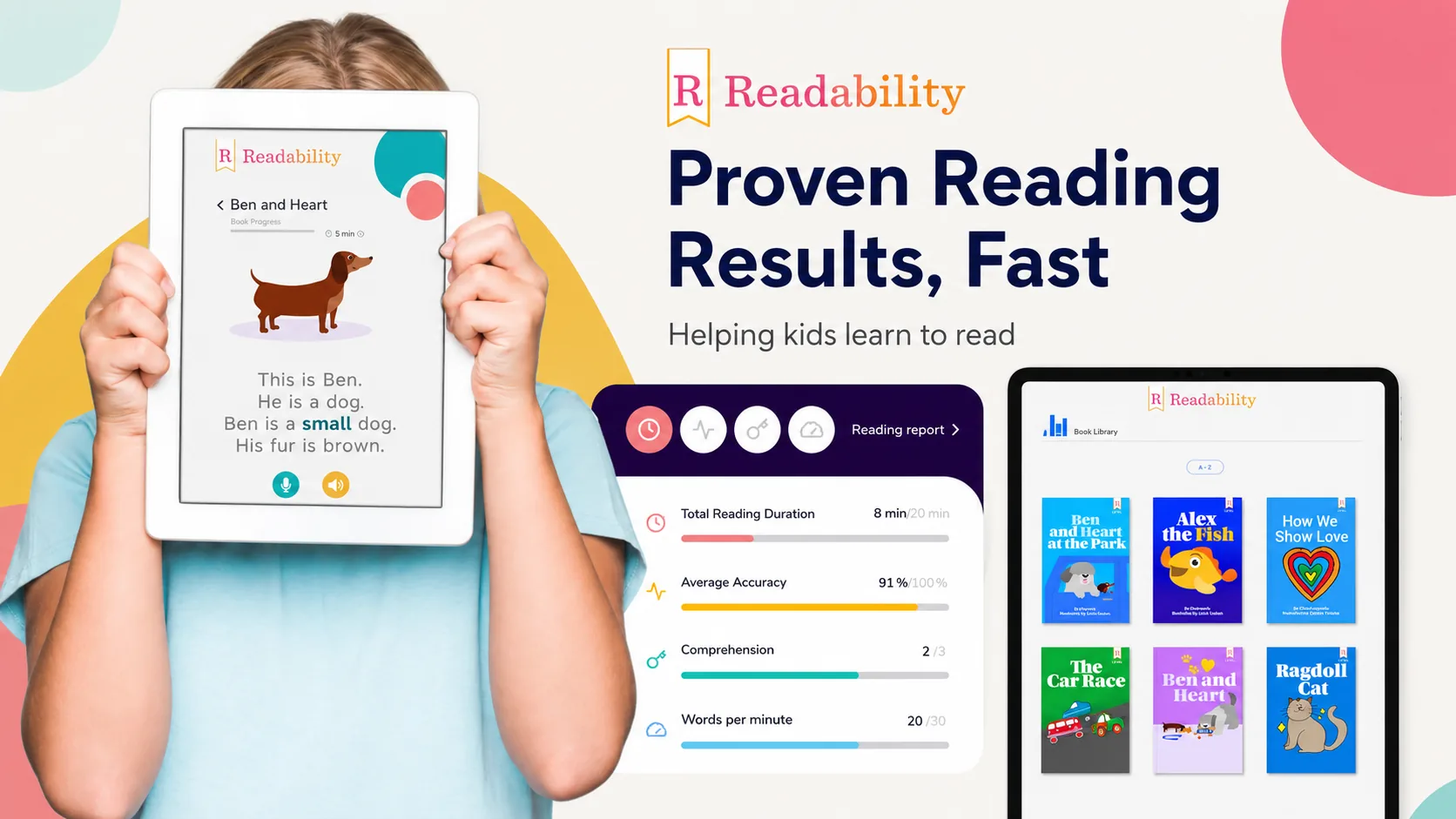
Every year, millions of families and teachers search for the best apps for learning to read, and every year the app marketplace responds with a flood of colorful icons, animated characters, and bold promises. The problem is that app stores are not designed to surface what actually matters for reading growth. A high star rating can reflect entertainment value just as easily as it reflects genuine literacy gains. A popular download count says nothing about whether an app teaches children to decode words or simply rewards them for tapping the right picture.
This guide cuts through that noise. Rather than comparing specific products, it explains the evidence-based features that define a truly effective reading app, the red flags that signal a tool is built for engagement rather than learning, and how to match an app to a child's current skills and instructional needs. Whether you are a parent supporting a kindergartner at home or a teacher looking for supplemental tools for your K-3 classroom, the framework here will help you evaluate any candidate app with confidence.
The foundation of that framework is the Science of Reading, a body of converging research that has transformed how literacy experts understand the process of learning to read. Research suggests that over 90 percent of children could learn to read proficiently if they received instruction grounded in this evidence base [1]. That is a remarkable statistic, and it places enormous responsibility on the tools we choose to support early readers.
What Does the Science of Reading Say the Best Apps for Learning to Read Should Actually Teach?
The Science of Reading establishes that skilled reading is built on five interconnected pillars: phonemic awareness, phonics and decoding, fluency, vocabulary and morphology, and comprehension [2]. A reading app that genuinely supports literacy development must address all five of these areas in a systematic, explicit, and cumulative way.
Phonemic awareness is the ability to hear, identify, and manipulate the individual sounds, called phonemes, within spoken words. Before a child can connect letters to sounds, they must first understand that spoken words are made up of discrete sound units. Effective apps provide daily practice in segmenting words into their component sounds, blending sounds together to form words, and manipulating sounds by substituting or deleting them. This is not a passive activity; it requires active engagement and immediate corrective feedback.
Phonics instruction builds directly on that phonemic foundation by teaching children the systematic relationships between sounds and the letters or letter combinations that represent them. The key word here is systematic. A strong phonics reading app follows a carefully designed scope and sequence, starting with the simplest and most common sound-symbol relationships and progressing in a logical, cumulative order. Children learn consonant-vowel-consonant words before moving to consonant blends, then digraphs, then vowel teams, and eventually to multisyllabic words. Each new pattern builds on what came before. For a clear explanation of how these two pillars work together, How Phonics and Phonemic Awareness Work Together offers a helpful overview.
One of the most important distinctions an app can make is between decoding and guessing. Some early reading programs encourage children to look at pictures, use context clues, or predict words based on the first letter. While these strategies feel intuitive, they actually undermine the development of true decoding skills. When a child guesses a word from a picture, they skip the process of orthographic mapping, which is how words become permanently stored in long-term memory for instant, automatic retrieval. The best apps for learning to read are designed to eliminate guessing and replace it with reliable decoding.
Fluency, vocabulary, and comprehension round out the instructional picture. Fluency is the bridge between decoding and understanding. A child who reads slowly and haltingly because they are working hard to decode every word has little cognitive capacity left for comprehension. Vocabulary and morphology instruction, particularly the explicit teaching of roots, prefixes, and suffixes in grades 1 through 3, helps children unlock the meaning of words they have never seen before. And comprehension, the ultimate goal of all reading instruction, requires both literal understanding and the ability to draw inferences from text evidence.
Literacy PillarWhat It InvolvesWhat to Look For in an AppPhonemic AwarenessSegmenting, blending, and manipulating sounds in spoken wordsDaily sound practice, immediate corrective feedbackPhonics and DecodingSystematic sound-symbol relationships, blending, and word readingCumulative scope and sequence from CVC to multisyllabic wordsFluencyAccurate, appropriately paced, expressive oral readingReal-time oral reading feedback, WCPM tracking, repeated readingsVocabulary and MorphologyWord meanings, roots, prefixes, suffixesExplicit vocabulary instruction, morphology lessons in grades 1-3ComprehensionLiteral and inferential understanding of textText-dependent questions, before/during/after reading prompts
Table 1: The Five Pillars of Reading and What to Look For in a Reading App, based on the National Reading Panel framework [2].
How Do the Best Reading Apps Personalize Placement, Pacing, and Progress Monitoring?
Understanding what an app should teach is only half the equation. The other half is ensuring that the instruction meets each child where they are. A child entering kindergarten with strong phonemic awareness has very different needs from a second grader who has been taught to guess at words and now needs to rebuild their decoding foundation. An app that places every child at the same starting point, or that advances children based on time spent rather than mastery demonstrated, will not serve either of these learners well.
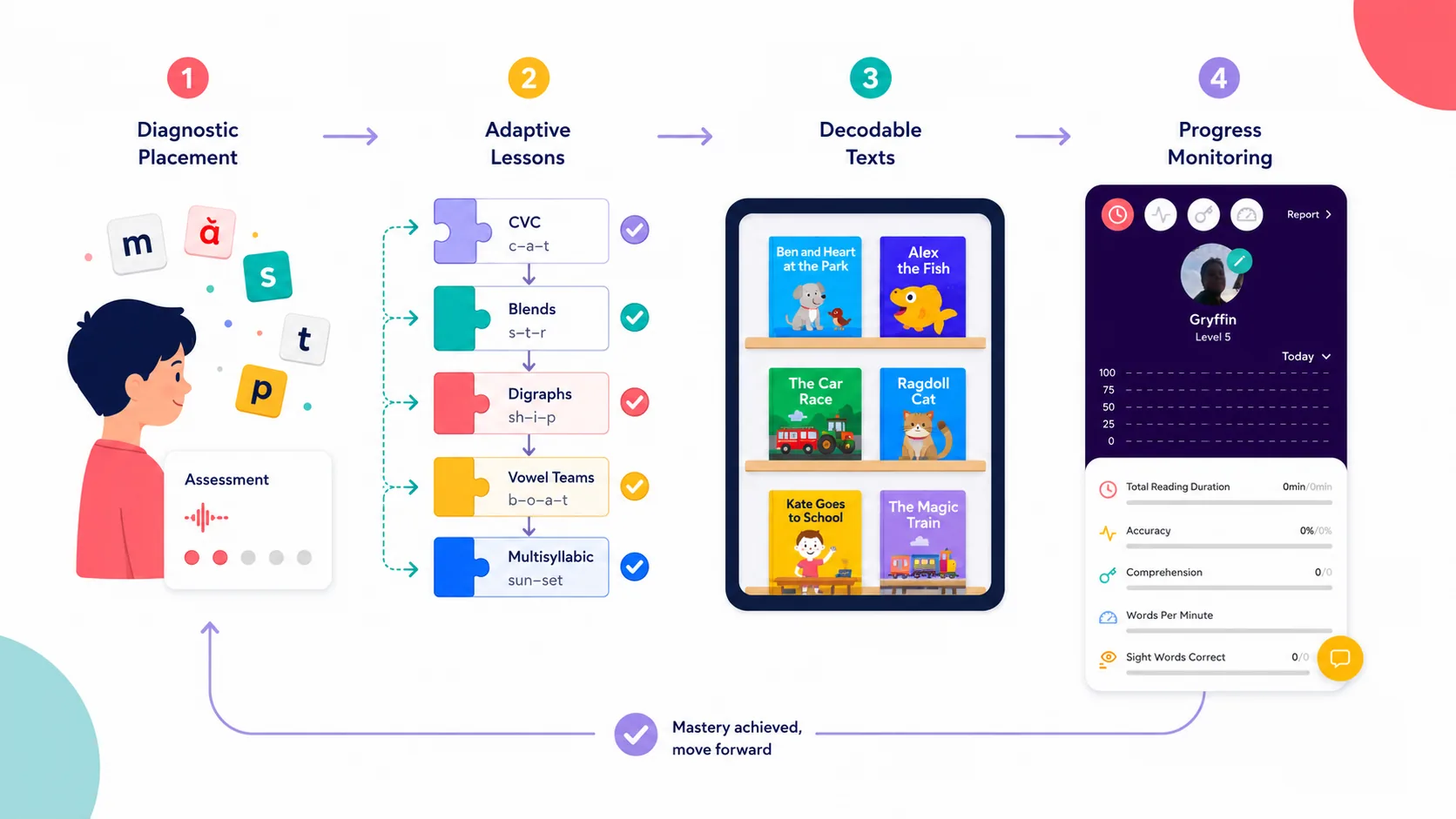
Strong apps begin with a genuine diagnostic assessment. This initial placement should evaluate letter-sound knowledge, decoding ability across a range of phonics patterns, and oral reading baseline. The goal is not to sort children into broad levels but to identify the precise point in the phonics scope and sequence where instruction should begin. Once that baseline is established, the app should adapt continuously. Progression to the next skill should occur only after the child has demonstrated mastery, typically defined as a high accuracy threshold across multiple trials. When a child struggles, the app should provide re-teaching and additional practice rather than simply repeating the same exercise.
Text complexity must be managed with equal care. In the early stages of reading development, the texts a child practices with should be tightly controlled decodables, meaning they contain only the phonics patterns and high-frequency words the child has already been taught. This is not a limitation; it is a scaffold that allows children to experience genuine success and build confidence. As their skills develop, the app can gradually introduce more complex texts. For more on how to support this progression at home, How to Help My Kindergartner Read at Home offers practical guidance.
Progress monitoring is the third component of effective personalization. Parents and teachers need more than a percentage score or a star rating. They need to know which specific phonics patterns a child has mastered, which error types are appearing most frequently, whether fluency is improving over time, and which high-frequency words still need reinforcement. This level of data granularity transforms an app from a passive practice tool into an active instructional partner.
The table below illustrates the oral reading fluency benchmarks that research-aligned apps should use as reference points for progress monitoring. These figures are drawn from the widely used Hasbrouck and Tindal norms [3].
GradeFall WCPM (50th Percentile)Winter WCPM (50th Percentile)Spring WCPM (50th Percentile)Grade 1N/A2960Grade 25084100Grade 38397112
Table 2: Oral Reading Fluency Benchmarks (Words Correct Per Minute at the 50th Percentile) based on Hasbrouck and Tindal (2017) [3]. Apps should track WCPM over time and flag students who fall 10 or more words below the 50th percentile for their grade.
Why Does Real-Time Oral Reading Feedback Set the Best Reading Apps for Kids Apart?
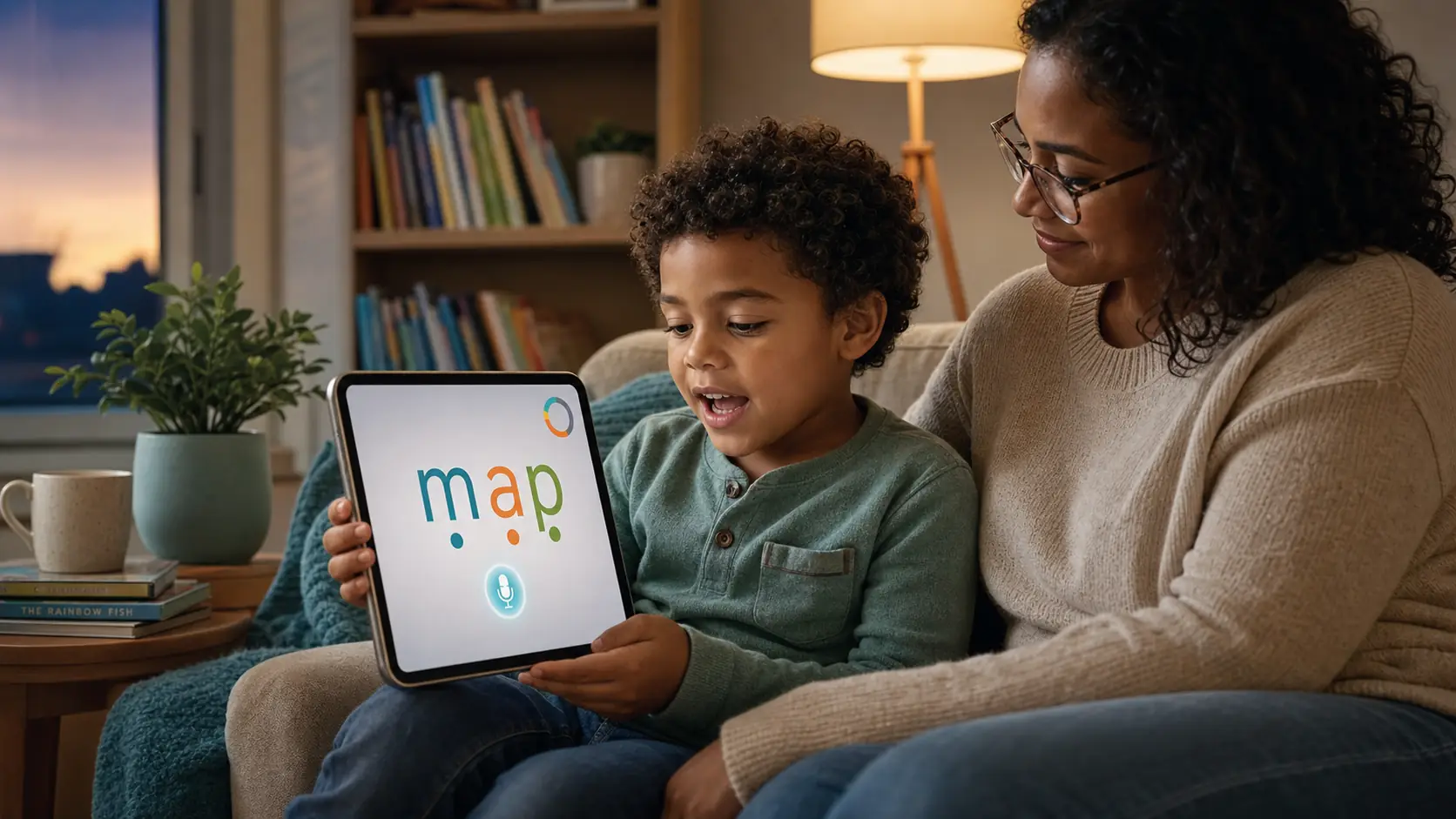
Of all the features that distinguish a genuinely effective reading app from a merely entertaining one, real-time oral reading feedback may be the most important and the most underrepresented in the marketplace. The research is clear: children need practice reading aloud to someone who can listen and provide feedback in order to grow as readers [4]. Yet less than half of students receive the 15 minutes per day of reading practice that researchers recommend, and round-robin reading in classrooms gives each child only about one minute of actual read-aloud time per session [4].
Speech recognition technology that listens as a child reads aloud and flags miscues in real time has the potential to dramatically expand access to this kind of practice. When a child substitutes one word for another, omits a word entirely, or struggles with a particular phonics pattern, the app can provide immediate, targeted feedback. This is not the same as a human tutor, but it is far more effective than silent reading practice, which does not measurably impact reading skills on its own [4].
When evaluating an app's oral reading feedback, there are several specific qualities to look for. The speech recognition engine should be calibrated for children's voices, which present unique challenges due to higher pitch, developing articulation, and regional accents. The feedback itself should be instructional, not just corrective. Rather than simply marking a word as wrong, a strong app models the correct pronunciation and prompts the child to try again. Fluency tracking should capture not only accuracy but also rate, measured in words correct per minute, and ideally some indicator of prosody, which is the natural rhythm and expression of fluent reading.
Privacy considerations are equally important here. Any app that uses a microphone to record a child's voice must be transparent about how that audio data is collected, stored, and used. Look for clear consent mechanisms, secure data handling, and the option to disable the microphone in settings where recording is not appropriate. Families exploring listening-based practice can review how ReadabilityTutor.com describes its oral reading feedback to understand what a robust implementation looks like.
How Should a Decodable Reading App Library Be Structured to Reinforce Phonics Instruction?
The texts a child reads during practice are not incidental to the learning; they are the learning. An app can have a beautifully designed phonics scope and sequence, but if the texts it provides do not align with that sequence, children will be forced to guess at words that contain patterns they have not yet been taught. This is precisely the problem with many leveled readers, which are organized by overall text difficulty rather than by phonics pattern alignment.
Decodable texts solve this problem by ensuring that the vast majority of words in a given text can be sounded out using the phonics patterns the child has already learned. Research supports the use of decodable texts in early reading instruction, with studies showing that first graders taught with decodable texts outperformed peers in word reading and decoding accuracy [5]. The key is alignment: the decodables in an app should map directly to the phonics scope and sequence the app teaches.
A high-quality decodable library is also not static. As a child's skills develop, the library should expand to include a wider variety of genres and topics. Narrative fiction, informational texts, and even poetry all serve important purposes in building reading stamina, background knowledge, and vocabulary. Cultural and topical variety matters too. Children are more motivated to read when they see themselves and their interests reflected in the texts they encounter. Comprehension tasks embedded in these texts should require children to return to the words on the page for evidence, reinforcing the habit of reading carefully rather than relying on memory or pictures.
For a deeper understanding of the distinction between decodable and leveled texts, Reading Apps for Second Graders: Phonics and Comprehension Guide provides a practical breakdown of what to look for at different grade levels.
What Instructional Design Principles Make a Reading App Actually Effective?
Strong content and a well-structured library are necessary but not sufficient. The way an app delivers instruction matters enormously. Cognitive science research on learning and memory offers clear guidance here, and the best reading apps incorporate these principles into their design.
Effective instructional design follows a gradual release model. The app first models a new skill or pattern explicitly, then provides guided practice with support, and finally invites independent application. This "I do, we do, you do" structure ensures that children are not left to discover patterns on their own, which is inefficient and unreliable, but are instead guided through a clear learning sequence. Multimodal supports, such as visual highlighting of target words, audio modeling of correct pronunciation, and on-screen manipulatives for phoneme segmentation, can reinforce learning for children who benefit from multiple input channels.
Session length is another critical design consideration. Research on cognitive load suggests that short, focused practice sessions are more effective for young learners than longer, more diffuse ones. For kindergarten and grade 1 children, sessions of 10 to 15 minutes are generally appropriate. For grade 2 and 3 students, sessions can extend to 15 to 20 minutes as reading stamina develops. The app should support this by building in natural stopping points and avoiding the kind of open-ended gameplay that can extend sessions far beyond what is beneficial.
Embedded formative assessment is the final piece of strong instructional design. Rather than waiting for a weekly or monthly assessment to identify gaps, a well-designed app checks for mastery after each lesson and uses that data to determine what comes next. This continuous feedback loop keeps instruction responsive and prevents children from advancing past skills they have not yet consolidated.
Session Length by GradeRecommended DurationKey FocusKindergarten10-12 minutesPhonemic awareness, letter-sound introductionGrade 112-15 minutesPhonics decoding, CVC to blends and digraphsGrade 215-18 minutesVowel teams, fluency building, decodable textsGrade 318-20 minutesMultisyllabic words, morphology, comprehension
Table 3: Recommended Daily App Session Lengths by Grade Level, based on cognitive load research and early literacy best practices.
How Do the Best Apps for Learning to Read Support Diverse Learners and Multilingual Families?
A reading app that works well for the average learner but fails children with dyslexia, ADHD, or developing English proficiency is not truly the best app for learning to read. Universal design principles require that effective tools accommodate a wide range of learning profiles and linguistic backgrounds from the outset, not as an afterthought.
For children with dyslexia, the most important features are a highly structured and explicit phonics progression, reduced visual clutter, and options for dyslexia-friendly fonts and adjustable text spacing. Explicit morphology instruction is particularly valuable for these learners, as understanding word structure can help compensate for slower orthographic mapping. The Best Reading Apps for Dyslexia page offers additional guidance on what to look for in this context.
For children with ADHD, the most effective apps feature short, predictable session structures, minimal pop-up distractions, and clear, immediate rewards for effort and accuracy. An ad-free environment is essential, as unexpected interruptions can be particularly disruptive for children who already struggle with sustained attention. For more on this topic, ADHD Reading App for Kids explores features that support focus and confidence building.
English learners benefit from picture-supported vocabulary introduction, first-language directions where appropriate, and oral language activities that build the spoken language foundation on which reading comprehension depends. It is important, however, that these supports do not inadvertently encourage guessing. The goal is to build English decoding skills, not to provide so many contextual cues that decoding becomes unnecessary.
Accessibility features, including captions, audio controls for instructions, high color contrast options, and keyboard or switch compatibility, ensure that children with a range of physical and sensory needs can engage with the app successfully. Before adopting any app, families and schools should review the app's accessibility statement and help center documentation.
What Privacy Protections and Practical Constraints Should You Evaluate Before Choosing a Reading App?
Data privacy is not a secondary concern when it comes to children's educational technology. It is a fundamental requirement. Any app that collects data on a child's reading performance, and particularly any app that records a child's voice, must meet a high standard of transparency and protection.
At a minimum, look for alignment with COPPA, the Children's Online Privacy Protection Act, and FERPA, the Family Educational Rights and Privacy Act, for school-based use. The app's privacy policy should clearly explain what data is collected, how it is stored, how long it is retained, and whether it is ever shared with third parties. There should be no third-party advertising within the app, and parents should have a clear mechanism for requesting the deletion of their child's data.
Practical constraints matter as well. An app that requires a high-speed internet connection to function will not serve families in areas with limited connectivity. Look for offline reading options or low-bandwidth modes that allow practice to continue even when internet access is unreliable. Device compatibility is another consideration; the app should work reliably on the devices your family or school already owns, without requiring frequent updates or significant storage space.
Screen time hygiene is the final practical consideration. The best apps are designed to be used for focused, time-limited sessions rather than as open-ended entertainment. They should provide clear guidance on recommended session lengths by age and actively encourage families to balance app-based practice with real book reading at home. For more on the relationship between digital tools and children's development, The Foundation of Cognitive Development: Reading for Pleasure in Early Childhood offers valuable perspective.
How to Shortlist and Pilot a Reading App: A Practical Two-Week Evaluation Plan
The most reliable way to evaluate any reading app is to run a structured pilot with a real child or a small group of students. Marketing materials and feature lists can only tell you so much. What matters is whether the app produces measurable progress in the specific learner you are trying to support.
Day 0 Setup. Before the pilot begins, confirm that the app's placement assessment has accurately identified the child's starting level. Cross-reference the app's placement with what you know about the child's phonics knowledge and oral reading ability. Identify the specific phonics patterns that will be the focus of the next two weeks and ensure the app's scope and sequence aligns with those targets.
Daily Routine. Aim for 10 to 20 minutes of guided practice each day, including at least one decodable text at the child's current level. Keep brief notes on any patterns you observe: which words are causing difficulty, whether the child is self-correcting errors, and how their motivation and engagement are holding up. Consistency matters more than duration; five sessions of 15 minutes each will produce better results than two sessions of 45 minutes.
End-of-Pilot Review. After two weeks, review the progress data the app has generated alongside your own observations. Look for measurable changes in accuracy and fluency, identify any persistent error patterns that suggest a gap in the phonics sequence, and assess whether the skills practiced in the app are transferring to print books. If the app offers export options, use them to create a record you can share with a teacher or reading specialist.
The checklist below summarizes the key criteria to apply throughout this evaluation process.
Evaluation CriterionWhat to Look ForGreen FlagRed FlagPhonics Scope and SequenceSystematic, cumulative, explicitClear progression from CVC to complex patternsRandom skill selection, no visible sequenceOral Reading FeedbackReal-time, word-level, instructionalFlags miscues, models correct pronunciationNo listening feature, or only scores at endDecodable Text LibraryAligned to taught patterns, varied genresTexts match the phonics sequenceTexts require guessing or heavy picture relianceProgress DataActionable, skill-specific, adult-facingAccuracy by pattern, WCPM trends, error typesOnly aggregate scores or "stars earned"Accessibility and InclusionUniversal design, dyslexia and EL supportsFont options, audio controls, language supportsOne-size-fits-all interface, no accommodationsPrivacy and SafetyCOPPA/FERPA aligned, no ads, clear policyTransparent data practices, parental controlsVague privacy policy, third-party ads
Table 4: Reading App Evaluation Checklist for Parents and Teachers.
If listening-based oral reading feedback is a priority for your evaluation, ReadabilityTutor.com is one example that families and educators can research further. For additional support strategies, Reading Strategies for Struggling Readers offers a practical companion resource.
Conclusion
The search for the best apps for learning to read does not have to be overwhelming. When you understand what the Science of Reading tells us about how children learn to decode and comprehend text, the criteria for evaluation become clear. The best apps share a phonics-first instructional design, real-time oral reading feedback that builds accuracy and fluency, a library of decodable texts aligned to a systematic scope and sequence, meaningful and actionable progress data for parents and teachers, inclusive supports for diverse learners, and strong privacy protections.
No app, however well designed, replaces the irreplaceable role of a caring adult who reads with a child, asks questions about the story, and celebrates every hard-won word. But the right app, used consistently and purposefully, can provide the kind of daily oral reading practice that research shows is essential for reading growth, and that most children are simply not getting enough of.
Run the two-week pilot. Use the checklist. Let the data from your child's actual reading, not the marketing claims on the app store page, guide your decision. The goal is not to find the most popular app or the most visually impressive one. The goal is to find the one that helps your child become a confident, skilled, lifelong reader.
Frequently Asked Questions
Are Reading Apps Enough to Teach a Child to Read, or Do They Need Print Books and Adult Guidance Too?
Reading apps are powerful tools for targeted, consistent practice, but they work best as one component of a broader literacy environment rather than as a standalone solution. Print books expose children to richer vocabulary, more complex sentence structures, and the physical experience of holding and navigating a book. Adult guidance provides the emotional support, comprehension conversations, and real-time coaching that no app can fully replicate. The most effective approach combines structured app-based practice with daily read-alouds and regular adult-child reading time. For more on the broader impact of reading on development, see Examining the Impact of Reading on Children's Development.
What Age Should a Child Start Using a Learn to Read App?
Most children are developmentally ready to begin structured phonemic awareness and letter-sound activities around age 4 or 5, which aligns with the typical start of pre-K and kindergarten. At this stage, sessions should be very short, no more than 10 minutes, and should feel playful rather than pressured. The app should focus on foundational skills like sound segmentation and letter recognition rather than rushing into full decoding. For guidance on supporting early readers at home, Nurturing Early Literacy Skills: Essential Tips for Childhood is a helpful starting point.
How Long Should Daily Practice Be for Kindergarten, Grade 1, and Grade 2?
For kindergarten students, 10 to 12 minutes of focused daily practice is generally appropriate. Grade 1 students can typically sustain 12 to 15 minutes of productive engagement. By grade 2, sessions can extend to 15 to 18 minutes as reading stamina increases. The most important variable is not duration but consistency. Five short sessions per week will produce better results than one or two long ones. For more on building effective reading habits, How to Improve 1st Grade Reading Skills offers practical strategies.
What Is a Decodable Text, and How Is It Different From a Leveled Reader?
A decodable text is written specifically to include only the phonics patterns and high-frequency words a child has already been taught, allowing them to sound out nearly every word on the page using their existing knowledge. A leveled reader, by contrast, is organized by overall text difficulty and often relies on repetitive sentence structures, picture cues, and context to help children navigate words they cannot yet decode. While leveled readers have their place in building reading stamina and comprehension at later stages, decodable texts are essential for early phonics practice because they allow children to apply and consolidate newly learned sound-symbol relationships.
How Accurate Is Speech Recognition With Children's Voices?
Speech recognition for children is technically more challenging than for adults because children's voices are higher pitched, their articulation is still developing, and they may have regional accents or speech differences that deviate from standard training data. The best reading apps address this by using speech recognition engines specifically trained on children's voices and by building in guardrails that distinguish genuine mispronunciations from background noise or hesitations. Accuracy has improved significantly in recent years, but it remains important to evaluate any app's listening feature with your specific child before committing to it as a primary practice tool.
How Do I Know If an App's Phonics Sequence Is Research Aligned?
A research-aligned phonics sequence is systematic, explicit, and cumulative. It typically begins with the most common consonant sounds and short vowels, progresses through consonant blends and digraphs, then introduces long vowel patterns, vowel teams, and eventually multisyllabic word structures. The app should clearly document its scope and sequence, and that sequence should demonstrate a logical, evidence-based progression rather than a random or interest-driven selection of skills. For a foundational explanation of this topic, What Is Phonics for Reading and Why Does It Matter? is an excellent resource.
What Features Help Children With Dyslexia or ADHD Use a Reading App Effectively?
Children with dyslexia benefit most from apps that offer a highly structured and explicit phonics progression, dyslexia-friendly font options, adjustable text spacing, and reduced visual clutter. Explicit morphology instruction, which teaches roots, prefixes, and suffixes, can be particularly valuable for building vocabulary and word recognition. For children with ADHD, the most effective apps feature short and predictable session structures, minimal pop-up distractions, an ad-free environment, and clear, immediate rewards tied to meaningful skill milestones rather than random taps. For more specialized resources, Best Reading Apps for Dyslexia and ADHD Reading App for Kids are both worth exploring.
How Can Teachers Use Reading App Data to Plan Small-Group Instruction?
The most actionable app data for teachers is skill-specific rather than aggregate. When an app reports that a group of students is showing consistent errors on vowel team patterns, for example, that information directly informs the composition and focus of a small-group lesson. Teachers can use accuracy-by-pattern data to form flexible groups around shared instructional needs, use fluency trend data to identify students who may need a more intensive intervention, and use error-type data to distinguish between students who are making random mistakes and those who have a systematic gap in their phonics knowledge. For more on effective intervention approaches, Bridging the Gap: Effective Reading Intervention Tactics for Young Learners provides a practical framework.
References
[1] CAEP. (2024). The Science of Reading Guide. Council for the Accreditation of Educator Preparation. https://caepnet.org/wp-content/uploads/the-science-of-reading-guide.pdf
[2] National Reading Panel. (2000). Teaching Children to Read: An Evidence-Based Assessment of the Scientific Research Literature on Reading and Its Implications for Reading Instruction. National Institute of Child Health and Human Development.
[3] Hasbrouck, J., and Tindal, G. A. (2017). An Update to Compiled ORF Norms. Behavioral Research and Teaching, University of Oregon. https://www.aimpa.org/uploaded/pdfs/Hasbrouck-ORF_NATIONAL_NORMS_Full_and_50ile.pdf
[4] Utgoff, A. (2019). Speech Recognition for Early Literacy. Thomas B. Fordham Institute. https://fordhaminstitute.org/sites/default/files/2019-11/Speech%20Recognition_Anna%20Utgoff.pdf
[5] Juel, C., and Roper-Schneider, D. (1985). The influence of basal readers on first grade reading. Reading Research Quarterly, 20(2), 134-152. As cited in Shanahan, T. (2024). Should We Teach with Decodable Text? Shanahan on Literacy. https://www.shanahanonliteracy.com/blog/should-we-teach-with-decodable-text-1