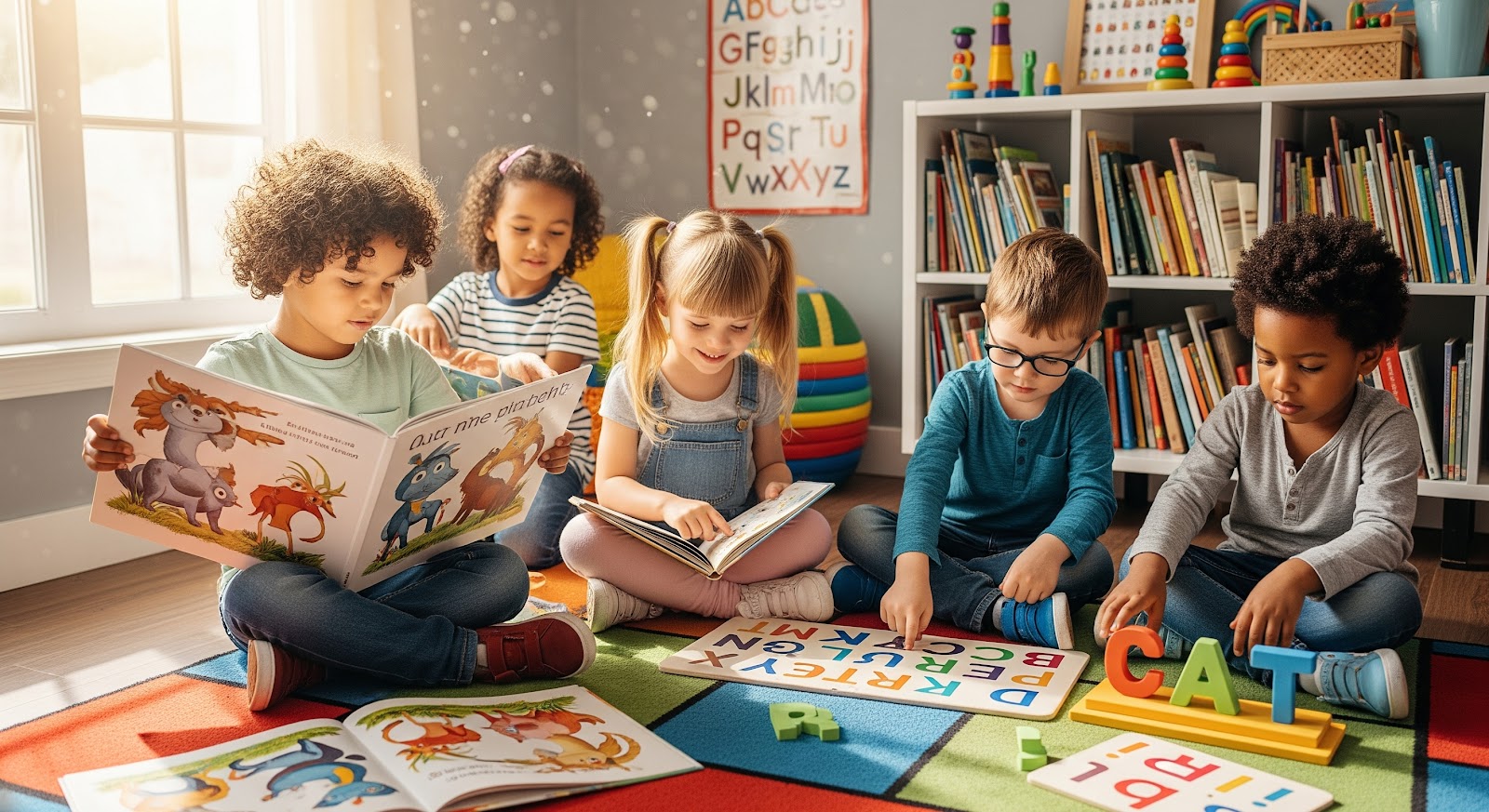
Reading doesn’t begin with the first day of school or the first time a child opens a book. It starts much earlier, through everyday moments like pointing to signs at the grocery store, singing songs in the car, or listening to a bedtime story. These early experiences help children build what educators call pre-reading skills, the foundational abilities that prepare their brains to understand, decode, and eventually master written language.
For many parents, these invisible steps toward literacy can be easy to overlook. It may seem like “learning to read” begins only once letters and phonics lessons are introduced. But in truth, early exposure to language, sound play, storytelling, and print awareness lays the groundwork for everything that comes next, phonics, fluency, vocabulary, and comprehension.
Research from the National Reading Panel Report and the Science of Reading confirms that children with strong pre-reading skills enter kindergarten not only more confident, but more prepared to become fluent readers. These early skills help students avoid frustration later on and make the process of learning to read smoother, more enjoyable, and more successful.
In this guide, we’ll walk you through:
- What pre-reading skills are,
- Why they matter,
- And how you, right now, at home, can help your child develop them through simple, joyful interactions.
We’ll also show you how Readability supports these foundational skills using research-backed strategies, real-time speech feedback, and adaptive learning tools, setting your child up for reading success from day one.
What Are Pre-Reading Skills?
Pre-reading skills are the essential abilities children develop before they begin formal reading instruction. These skills don’t involve reading words on a page yet, instead, they prepare a child’s brain to understand how language works. From recognizing sounds in spoken words to understanding that print carries meaning, pre-reading skills form the foundation that makes learning to read possible.
In other words, long before a child can decode letters or read a sentence, they are learning how reading works.
Connection to the Science of Reading
According to the Science of Reading, successful reading instruction is built on a strong foundation of early language skills. Pre-reading skills fall primarily under three critical areas:
- Phonemic Awareness – the ability to hear and work with individual sounds in spoken words
- Oral Language – vocabulary development, sentence structure, and expressive language
- Print Awareness – understanding how books, letters, and words function in written language
These skills develop naturally through conversation, play, reading aloud, and everyday interactions, but they can also be intentionally supported. Research consistently shows that children who enter school with strong abilities in these areas are better equipped to master phonics, fluency, vocabulary, and comprehension later on.
Why Pre-Reading Skills Matter
Pre-reading skills are more than just “nice to have”, they are predictors of future reading success. Children who build these skills early are more likely to:
- Learn phonics more easily
- Read with greater fluency
- Understand what they read
- Feel confident instead of frustrated
Without strong pre-reading foundations, learning to read can feel overwhelming, leading to anxiety, avoidance, or struggles that compound over time. With them, reading becomes a process that feels achievable, engaging, and even joyful.
The good news? Parents play a powerful role in developing these skills, and you don’t need teaching credentials or special materials. Simple, intentional interactions at home can make a lifelong difference in your child’s literacy journey.
The 5 Core Pre-Reading Skills Parents Should Know
Before children can read words on a page, they need to develop a set of underlying skills that help them understand how language and reading work. These are the pre-reading skills that form the foundation for future reading success. Here are the five most important ones parents should focus on, and easy ways you can support them at home.
1. Print Awareness
Print awareness is a child’s understanding that written words represent spoken language and that print carries meaning.
What it looks like:
- Knowing that books are read from left to right and top to bottom.
- Recognizing letters, logos, or familiar words in the environment, like stop signs, cereal boxes, or store names.
- Understanding that the words on a page, not the pictures, tell the story.
Why it matters:
Print awareness helps children understand how books work. Before they can sound out a word, they need to understand what a word is and where to find it on a page.
Try this at home:
- Point to words as you read them aloud.
- Talk about what signs say when you’re out and about.
- Let your child “pretend to read” books by turning pages and telling the story in their own words.
2. Phonological Awareness
Phonological awareness is the ability to hear and play with the sounds of spoken language. It includes skills like recognizing rhymes, clapping out syllables, and identifying beginning sounds.
What it looks like:
- Singing nursery rhymes or clapping to syllables in names ("Ja-son = 2 claps").
- Playing with silly rhymes: “The cat wore a hat and sat on a mat!”
- Noticing alliteration: “Sally sells seashells…”
Why it matters:
This skill lays the groundwork for phonics and decoding. Children who can hear and manipulate sounds in words are better prepared to match those sounds to letters.
Try this at home:
- Play rhyming games: “What rhymes with dog?”
- Clap out syllables in everyday words (e.g., “ap-ple” or “bath-room”).
- Read books with predictable patterns and rhyming structures.
3. Phonemic Awareness
Phonemic awareness is a specific type of phonological awareness. It focuses on hearing and working with the individual sounds in words, called phonemes.
What it looks like:
- Identifying that “cat” is made of three sounds: /k/ /a/ /t/
- Blending sounds: “What word do these sounds make, /s/ /u/ /n/?”
- Segmenting sounds: “What’s the first sound in ‘dog’?”
Why it matters:
Phonemic awareness is one of the strongest predictors of future reading success. Children who can isolate and manipulate sounds can more easily learn to decode words when they start reading.
Try this at home:
- Say a word and ask your child to tell you the first or last sound.
- Stretch words out slowly: “sssssun” and have your child guess the word.
- Play “I Spy” with sounds instead of letters: “I spy something that starts with /b/.”
4. Oral Language Development
Oral language is the ability to understand and use spoken language. It includes vocabulary, sentence structure, grammar, and storytelling skills.
What it looks like:
- Using a growing vocabulary to express needs, thoughts, and emotions.
- Retelling stories or describing events with beginning, middle, and end.
- Asking and answering “why” and “how” questions.
Why it matters:
Oral language is directly tied to reading comprehension. Children need strong speaking and listening skills to make sense of the stories and information they’ll eventually read.
Try this at home:
- Have regular conversations at meals or in the car.
- Ask open-ended questions like, “What was your favorite part of the story?”
- Tell stories about your day and encourage your child to do the same.
5. Listening Comprehension
Listening comprehension is the ability to understand and make meaning from spoken language, especially when it’s part of a story or set of instructions.
What it looks like:
- Following multi-step directions: “Pick up your shoes and put them by the door.”
- Answering questions about a story read aloud.
- Making predictions or inferences while listening.
Why it matters:
Listening comprehension prepares children for reading comprehension. The ability to understand spoken language comes before understanding written text, and it builds the mental processes children need to become thoughtful, reflective readers.
Try this at home:
- Read aloud daily and ask questions like, “What do you think will happen next?”
- Pause during a story and ask, “Why do you think the character did that?”
- Give fun instructions with multiple steps to build listening memory.
Tip from Readability
The Readability app builds all five pre-reading skills using real-time voice interaction, engaging stories, and adaptive scaffolding. Children don’t just passively listen, they engage, respond, and receive personalized feedback as they build confidence in the skills that matter most.
How Parents Can Support Pre-Reading Skills at Home
You don’t need to be a reading specialist or have a teaching degree to help your child build strong pre-reading skills. In fact, the most powerful literacy experiences often come from simple, everyday moments shared between parents and children.Here are five research-backed, parent-tested ways you can support your child’s early literacy development, starting right now, right at home:
1. Talk Often: Narrate Daily Routines
Children learn language by hearing it a lot. Engaging in rich, frequent conversation helps build vocabulary, grammar, and comprehension.
How to do it:
- Narrate what you're doing: “Now I’m slicing apples. Look how red and shiny they are!”
- Describe your child’s actions: “You’re stacking blocks, what a tall tower!”
- Ask open-ended questions like, “What should we do next?” or “Why do you think that happened?”
Why it works:Oral language is a cornerstone of pre-reading development. The more words children hear, the more language they have to draw from when they begin reading.
2. Read Aloud Daily: Use Expression and Ask Questions
Reading aloud is one of the most powerful ways to grow a child’s language and comprehension skills. Make it a joyful routine, even just 10 minutes a day can have a lasting impact.How to do it:
- Choose books with rhythm, rhyme, or repetition.
- Use different voices and dramatic expressions to bring characters to life.
- Ask questions like:
- “What do you think will happen next?”
- “Why do you think she’s sad?”
- “What was your favorite part?”
Why it works:Reading aloud strengthens listening comprehension, vocabulary, and narrative understanding, all critical pre-reading foundations.
Tip: Readability’s interactive stories prompt children with verbal comprehension questions and guide them through expressive reading.
3. Sing Songs and Rhymes: Build Phonological Awareness
Songs, nursery rhymes, and chants naturally teach children about the sounds and rhythm of language.How to do it:
- Sing classic rhymes like “Twinkle, Twinkle” or “The Itsy Bitsy Spider.”
- Make up silly rhymes using your child’s name: “Logan likes to hop on a purple mop!”
- Clap or tap along to the beat of syllables.
Why it works:Rhyme and rhythm help children hear the building blocks of words, an essential early skill for decoding later on.
4. Play Sound Games: “What’s the First Sound in ‘Dog’?”
Helping children listen to and manipulate individual sounds in words (phonemes) builds phonemic awareness, a major predictor of reading success.
How to do it:
- Play “I Spy” with sounds: “I spy something that starts with /s/.”
- Ask, “What’s the first sound in ‘ball’?” or “What rhymes with ‘cat’?”
- Stretch words out slowly and have your child guess them: “Ssss-uuu-nnn... what’s that?”
Why it works:These playful exercises train your child’s ear to notice and work with sounds, a skill essential for phonics and decoding.
5. Point Out Print: Signs, Menus, Packaging
Show your child that print is everywhere, and it all has meaning.How to do it:
- Point to words on cereal boxes, store signs, menus, or recipes.
- Say the name of a letter when you see it: “Look, there’s an M on the milk!”
- Let your child “read” familiar labels or signs aloud with you.
Why it works:This builds print awareness, helping children understand that words are made of letters and that those letters represent sounds and ideas.
Bonus Tip: Let Technology Support You
Apps like Readability offer guided, interactive reading practice with real-time feedback. While you're cooking dinner or doing laundry, your child can still be engaging with:
- Speech-based support to reinforce phonemic awareness
- Listening comprehension through read-aloud questions
- Interactive stories that encourage reading out loud, without pressure
It’s like having a reading tutor at home, without the high cost.
How Readability Helps Build Pre-Reading Foundations
Readability isn’t just a reading app, it’s a powerful, research-based platform designed to meet children where they are in their literacy journey, including those who haven’t yet started reading. With technology grounded in the Science of Reading, Readability actively supports the development of critical pre-reading skills that form the gateway to lifelong literacy.
Here’s how Readability helps children build these foundational skills, especially in the earliest stages of learning:
1. Real-Time Speech Feedback Develops Phonemic Awareness
When children read aloud using Readability, the app listens in real time and provides immediate, supportive corrections. This technology trains the brain to recognize the individual sounds in words, building phonemic awareness, one of the strongest predictors of future reading success.
How it helps pre-readers:
- Encourages children to say words out loud, even if they’re still guessing or exploring sounds.
- Corrects mispronunciations gently, helping children self-correct and build confidence.
- Reinforces sound-symbol relationships naturally and repeatedly, without drilling.
This is like having a patient, non-judgmental tutor sitting beside your child, every time they read.
2. Interactive Questions Build Listening Comprehension
After reading each story or passage, Readability asks interactive, voice-based comprehension questions that children answer out loud. This supports both listening comprehension and oral expression, critical components of pre-reading and future reading success.
How it helps pre-readers:
- Strengthens attention and focus as children listen and respond to stories.
- Builds the habit of reflecting on what was read (or heard).
- Lays the groundwork for future reading comprehension skills by developing auditory memory and verbal reasoning.
3. Child-Friendly Voice Prompts Scaffold Oral Language Development
Readability uses natural, encouraging voice prompts that guide children through stories and questions. These prompts are designed to model rich, expressive language and encourage children to speak in complete sentences.
How it helps pre-readers:
- Enhances vocabulary by introducing new words in context.
- Models sentence structure and grammar in a way children can easily imitate.
- Encourages storytelling and expressive speech, building confidence with spoken language.
4. Adaptive Content Supports ELLs, Students with Dyslexia, ADHD, Autism
Every child learns differently, and Readability is built to meet those diverse needs with adaptive AI that customizes the reading experience in real time.
How it helps diverse learners:
- ELL students receive pronunciation support and repeated exposure to vocabulary in context.
- Students with dyslexia benefit from error-tolerant voice recognition that understands speech differences and gently corrects.
- Kids with ADHD or autism experience a low-pressure reading environment with visual and audio cues that reduce cognitive overload.
- The app adjusts story difficulty, pacing, and feedback style based on the learner’s behavior and progress.
“Readability makes it possible for my daughter with speech apraxia to feel successful. The app understands her speech, and that changed everything.” , Parent testimonial
5. The Parent Dashboard Tracks Growth, Even in the Pre-Reading Stage
As your child interacts with the app, Readability captures real-time data and displays it clearly in a parent dashboard. You’ll see insights into your child’s progress, even before they’re reading independently.
How it helps parents:
- Monitors reading time, comprehension accuracy, and oral responses.
- Tracks vocabulary development and fluency metrics over time.
- Offers peace of mind, so you don’t have to wonder if your child is improving, you can see it happening.
Parents report a 92% increase in reading confidence after using Readability with their child.In short, Readability transforms pre-reading practice into a joyful, personalized, and measurable experience, empowering parents, supporting educators, and helping children build the core skills they need to thrive as readers.
Strong pre-reading skills are more than just a developmental milestone, they are the gateway to lifelong literacy. When children build a solid foundation in print awareness, phonemic awareness, oral language, and listening comprehension, they’re not just learning to read, they’re learning to love reading.
The good news? You don’t need to be a reading expert to make a meaningful impact. As a parent, you are already your child’s most important teacher. Through simple, consistent interactions, talking, singing, playing sound games, and reading aloud, you are giving your child the tools they need to become a confident, capable reader.
And when you want support, Readability is here to help. The app was designed with parents in mind, offering expert-backed, research-aligned literacy development that meets your child where they are, even in the pre-reading stage. With interactive voice feedback, engaging stories, and progress you can see, Readability makes it easier than ever to build pre-reading skills at home.