
Your child can read every word in a story, but when you ask what happened, they might struggle to explain. Maybe they remember specific details but miss the bigger picture. Or perhaps they can tell you exactly what a character said but aren't sure why the character acted a certain way.
If this sounds familiar, you're not alone. Autism and reading comprehension can involve different strengths and challenges, and understanding a story is a separate skill from reading the words on the page.
The good news is that there are simple, practical ways to help your child connect the words they read with the meaning behind them. From asking clear questions to using pictures and familiar routines, small changes can make reading together more accessible and enjoyable.
Autism and Reading: Knowing the Words vs. Understanding the Story
Reading involves more than recognizing letters and sounding out words. Children also need to connect ideas, remember important details, understand vocabulary, and make sense of what characters are thinking or feeling.
These skills are often described as two parts of reading:
- Decoding: Recognizing written words and connecting letters with their sounds.
- Reading comprehension: Understanding what those words mean together, including events, relationships, and ideas in a story.
Some autistic children develop strong word-reading skills early. A child might read fluently, recognize complex words, or show an especially strong interest in letters and books, while still needing support understanding what they've read.
This pattern is sometimes associated with hyperlexia, although not every autistic child who reads well has hyperlexia. Other autistic children may find decoding challenging, while some demonstrate strong comprehension skills.
There is no single pattern of autistic reading development. The important thing is to look at your child's individual strengths and where they may need extra support.
P.S. Wondering if dyslexia could be a factor? Our free dyslexia test for kids can help you explore potential signs and decide whether to seek further support:
Why Can Reading Comprehension Be Challenging for Some Autistic Children?
Autistic reading comprehension can be influenced by several skills that work together when we read. For example, a child may understand the literal meaning of a sentence but find it harder to interpret an implied message. Another child may understand individual events but have trouble connecting them into a complete story.
Some areas that may need additional support include:
- Making inferences: Understanding information that isn't directly stated, such as why a character made a decision.
- Understanding emotions and intentions: Using story clues to figure out what characters might be feeling or thinking.
- Connecting events: Recognizing how one event leads to another.
- Understanding unfamiliar language: Making sense of figurative expressions, new vocabulary, or words with multiple meanings.
- Identifying important details: Distinguishing the main idea from smaller pieces of information.
Some autistic children also have ADHD, which can bring additional challenges with attention and keeping track of information while reading. If your child experiences both, explore how Readability Tutor supports children with ADHD through personalized reading settings and guided practice.
These aren't difficulties every autistic child experiences. Some children are particularly skilled at noticing details, remembering facts, or understanding certain types of stories.
Rather than assuming what your child finds difficult, pay attention to how they respond to different reading activities. Their interests and strengths can help guide the support you provide.
7 Practical Ways to Help Your Autistic Child With Reading Comprehension
Reading comprehension doesn't have to mean completing worksheets or answering a long list of questions. Short, predictable activities during everyday reading can help your child practice understanding stories in manageable ways.

1. Introduce a Few Important Words Before Reading
Unfamiliar vocabulary can make it harder to follow a story, especially when several new words appear at once.
Before opening a book, choose two or three words that are important to understanding what happens.
For example, if the story is about a garden, you might introduce seed, sprout, and water.
Explain each word simply, show a picture if helpful, and connect it to something your child already knows.
You don't need to explain every unfamiliar word in advance. Focus on the ones that will make the story easier to understand.
2. Start With Simple, Literal Questions
Literal comprehension questions ask about information directly stated in the text.
For example, after reading "Mia put her shoes beside the door," you could ask:
"Where did Mia put her shoes?"
Your child can look back at the sentence to find the answer.
Once literal questions become more comfortable, you can gradually introduce questions that require connecting information or thinking beyond what's written.
Try modeling an answer first:
"The story says Mia put her shoes beside the door. So the answer is beside the door."
This shows your child how to use the text to find meaning rather than relying on guessing.
3. Use Pictures to Retell What Happened
Retelling helps children practice remembering events and organizing them in a meaningful order.
After reading a short story, choose three important moments: what happened at the beginning, middle, and end.
You might draw simple pictures, use illustrations from the book, or write a few words on separate cards.
Ask your child to put the events in order, or work through them together.
Helpful prompts include:
- "What happened first?"
- "What happened next?"
- "How did the story end?"
If your child has difficulty explaining the story aloud, they may be able to show their understanding by arranging pictures, pointing, or using their usual communication method during the activity.

4. Practice Making One Inference at a Time
An inference is something we figure out using clues, even when the story doesn't tell us directly.
For example:
"Leo looked outside and saw dark clouds. He picked up his umbrella before leaving."
You might ask:
"Why do you think Leo brought his umbrella?"
Then help your child connect the clues:
"The clouds were dark, and umbrellas help us stay dry. Maybe Leo thought it was going to rain."
Start with familiar situations where the connection is fairly clear. As your child becomes more comfortable, try questions about character decisions, emotions, or events with more than one possible interpretation.
It's also okay if your child offers an unexpected answer. Ask what clues helped them reach that conclusion.
5. Connect Stories to Your Child's Interests
A familiar or favorite topic can provide a helpful starting point for reading comprehension practice.
If your child loves trains, animals, space, or cooking, look for books and short passages about those interests.
Familiar topics may make it easier to connect new information with things your child already understands.
For example, a child who knows a lot about animals might enjoy comparing two characters' habitats or explaining why an animal behaved a certain way.
You can gradually introduce new topics while keeping familiar elements in the reading routine.
6. Keep Reading Routines Predictable
A consistent reading routine can help your child know what to expect.
You might follow the same simple pattern each time:
- Look at the cover and introduce a few words.
- Read a short passage together.
- Ask one question about what happened.
- Retell the main events or discuss one idea.
The routine doesn't need to be long. A short, comfortable reading session can provide meaningful opportunities to practice comprehension.
You can also tell your child what comes next: "We'll read one page, talk about it, and then finish."
Adjust the routine to your child's preferences, energy, and communication needs.
7. Give Your Child Different Ways to Show Understanding
Reading comprehension and spoken language are related, but they aren't the same skill.
A child might understand a story yet find it difficult to explain their answer aloud.
During parent-led activities, consider offering different response options, such as pointing to a picture, choosing between two answers, arranging event cards, writing, or using an established augmentative and alternative communication (AAC) system.
For example, instead of asking only, "Where did the dog go?" you could show two pictures and invite your child to indicate the correct location.
These approaches can help you explore what your child understands without making spoken answers the only measure.
Try This Reading Comprehension Activity Together
Here's a short story you can use to practice three important comprehension skills: remembering details, understanding sequence, and making an inference.

The Missing Water Bottle
Sam took a blue water bottle to the park. After playing on the swings, Sam sat on a bench to eat a snack. When it was time to leave, Sam couldn't find the water bottle.
Sam looked under the bench and beside the swings. Then Sam spotted something blue near a tree. It was the missing water bottle! Sam picked it up and smiled.
Ask These Three Questions
1. Literal question: What color was Sam's water bottle?
Example answer: Blue.
2. Sequencing question: What did Sam do before finding the water bottle?
Example answer: Sam looked under the bench and beside the swings.
3. Inference question: How might Sam have felt after finding the water bottle?
Example answer: Sam might have felt happy or relieved because the story says Sam smiled after finding it.
Make the Activity Work for Your Child
You can read the story aloud, take turns reading, or let your child read independently. If answering aloud is difficult, try offering pictures of a blue and red bottle, arranging simple illustrations of the story's events, or inviting your child to point to an emotion picture.
Children who use AAC can respond through their established communication system. For the inference question, explain that more than one answer may make sense when supported by story clues.
How to Tell Whether Your Child Understands What They Read
Reading comprehension can look different depending on the story, the questions, and how your child is asked to respond. Instead of focusing on whether your child answers every question correctly, observe patterns over time.
Consider whether your child can:
- Recall important details after reading.
- Explain or show what happened first, next, and last.
- Connect events and recognize simple cause-and-effect relationships.
- Answer questions using information from the story.
- Use clues to make reasonable predictions or inferences.
- Demonstrate understanding through speech, pictures, writing, or another communication method.
You might also notice your child losing their place or skipping words while reading. These challenges can affect how easily they follow a story. Learn more about why children skip words when reading and what you can do to help.
You may notice that your child understands factual information well but needs more support with inferences. Or they might follow stories about familiar interests more easily than unfamiliar topics. These observations can help you choose what to practice next.

When to Ask for Additional Reading Support
If your child consistently struggles to understand age-appropriate or appropriately leveled stories, becomes frustrated during reading, or has difficulty demonstrating comprehension across different activities, consider discussing your observations with their teacher or a reading specialist.
A speech-language pathologist may also help evaluate language comprehension and communication needs. A professional can look at your child's decoding, vocabulary, language comprehension, and other relevant skills to identify which kinds of support may be helpful.
How Readability Tutor Supports Reading Comprehension Practice
Alongside parent-led reading activities, Readability Tutor offers different ways for children to engage with stories and practice understanding what they read.
With Storytime, your child can listen to stories read aloud while words are highlighted in sync with the narration. Colorful illustrations provide visual context, giving your child another way to follow story events and connect words with meaning.
For children practicing reading aloud, Readability Tutor also follows along as they read, highlights words, and offers help when they get stuck. After each story, voice-based comprehension questions give children an opportunity to practice thinking about what they've read.
Reading Without the Rush
Some children need a little more time to read words aloud. Readability Tutor's Patient and Extra Patient timing options let parents adjust how long the tutor waits before stepping in when a child hesitates. This gives your child more time to try words independently without feeling rushed.
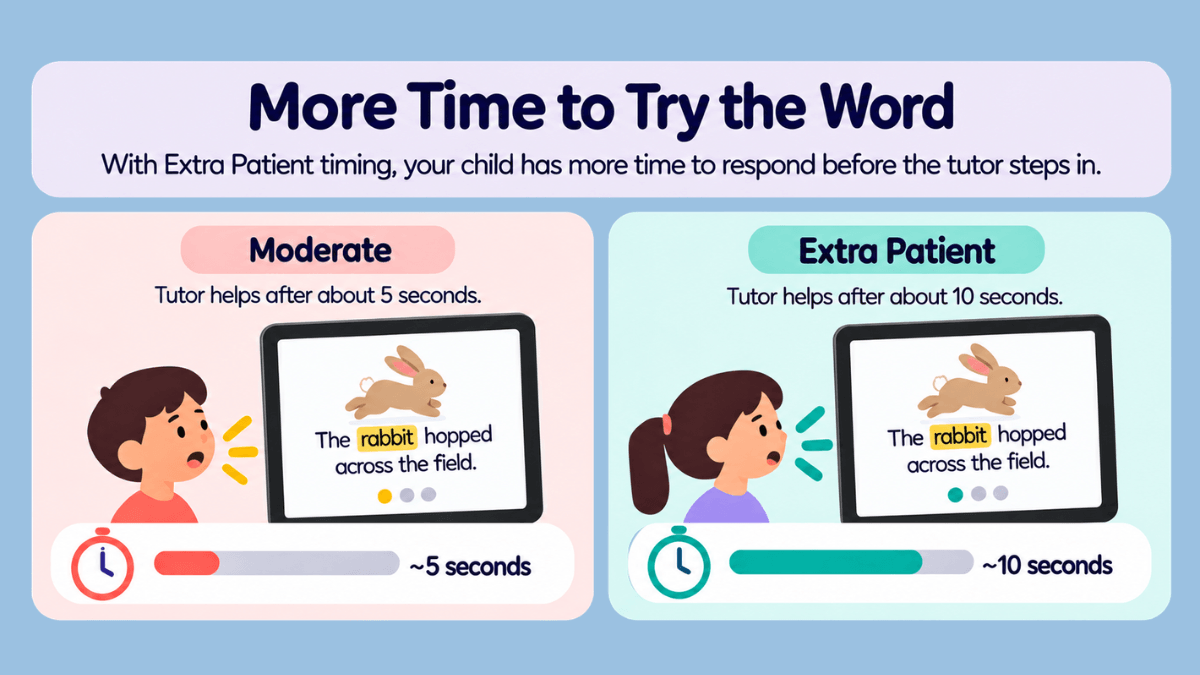
Parents can also personalize the reading experience with slower tutor reading speeds, adjustable text settings, and softer page colors. When autism support is selected, Readability Tutor applies a more patient correction pace and a soft sage-colored page with reduced brightness, all of which can be adjusted to suit your child's preferences.
Explore Readability Tutor's personalized reading support and see whether its reading experience is a good fit for your child:
Frequently Asked Questions About Autism and Reading Comprehension
Can autistic children read well but struggle with comprehension?
Yes. Some autistic children can recognize words and read aloud fluently while needing additional support understanding story events, making inferences, or connecting ideas. However, reading profiles vary widely. Some autistic children have strong comprehension skills, while others may need support with both decoding and understanding.
Why does my autistic child understand words but struggle with stories?
Understanding individual words is only one part of reading comprehension. Following a story also involves connecting events, remembering information, understanding vocabulary in context, and interpreting ideas that aren't directly stated. Your child may benefit from explicit questions, visual retelling, and practice connecting story clues.
How can I improve my autistic child's reading comprehension at home?
Start with short, familiar stories and introduce a few important words before reading. Ask simple questions about what happened, use pictures to retell events, and gradually practice making inferences. You can also explore reading comprehension apps for kids for additional guided practice at home.
What reading comprehension activities work well for autistic children?
Activities such as sequencing picture cards, matching questions to story details, retelling short passages, and discussing simple inferences can provide useful practice. The best activity depends on your child's interests, language skills, and individual strengths. Begin with manageable tasks and adjust the level of support as needed.
Can visual supports help autistic children understand what they read?
Visual supports can help some children organize information and connect events in a story. Pictures, story maps, and sequencing cards make important details easier to revisit. They can also provide alternative ways to demonstrate understanding when explaining an answer aloud is difficult.
When should I seek professional help for my child's reading comprehension?
Consider asking for support when comprehension difficulties persist, interfere with schoolwork, or cause significant frustration. Your child's teacher, a reading specialist, or a speech-language pathologist can help identify whether the main challenges involve word reading, language comprehension, or other skills and recommend appropriate support.