Reading App for Dyslexia
Looking for a reading app for kids that have Dyslexia? Here's a list of resources about why Readability is the Top Reading App for Kids that suffer from Dyslexia
Try 30 Days Free!
Looking for a reading app for kids that have Dyslexia? Here's a list of resources about why Readability is the Top Reading App for Kids that suffer from Dyslexia
Try 30 Days Free!
All new readers struggle at some point in the learning process. Learning to read for the first time can be very difficult, but some students struggle even more than others. Millions of students who struggle with reading often have dyslexia. An estimated one in five students has a learning disability, with dyslexia being the most common.This does not mean it will be impossible for them to read.
Your child with dyslexia just needs more tools and support on their journey. Using an online reading program can help them improve their reading skills at home. These are the best reading programs for dyslexia and can be a great way to supplement your child’s reading instruction.
Read More
Reading is a foundational skill, but for children with dyslexia, it can feel like an uphill battle from the very beginning. Dyslexia is a neurobiological learning difference that affects how the brain processes written language. It’s not a sign of low intelligence or lack of effort; in fact, many children with dyslexia are bright and creative thinkers, but they often struggle with decoding words, fluency, and comprehension. This makes dyslexia reading especially challenging.
A child who battles to read even a simple sentence may begin to feel frustrated, anxious, or ashamed. For families, watching their child fall behind despite their best efforts and support can be heartbreaking. But there’s good news: reading for dyslexics doesn’t have to be a constant source of stress. With the right tools and approaches, reading can become not just manageable but enjoyable.
Read More
Dyslexia is a common learning difficulty that primarily affects reading, spelling, and word recognition. Unlike some misconceptions, dyslexia is not a sign of low intelligence or a lack of effort. Rather, it is a neurological condition that affects the way the brain processes written language, often involving challenges with phonological awareness, the ability to recognize and work with sounds in spoken language.
Children struggling with reading difficulties, such as dyslexia, often find decoding words a significant obstacle, which can impact reading fluency and comprehension. Studies have shown that children with dyslexia often struggle with reading speed and accuracy, which can lead to difficulties in all academic areas. This impact can be especially significant in early education, where literacy skills are critical for future academic success.
Read More
Dyslexia, a prevalent learning disorder, impacts reading and language abilities. Early identification plays a pivotal role in enabling interventions and support that can positively influence a child’s development. Understanding the initial signs of dyslexia is vital for parents, educators, and healthcare professionals to take timely action.
Identifying dyslexia in young children can be challenging, as developmental milestones vary widely from child to child. Some children may develop early literacy skills without difficulty, while others may exhibit delays in phonemic awareness, language processing, and memory recall. Recognizing early warning signs is crucial, as early intervention can help children develop the skills they need to succeed in reading, writing, and comprehension.
Read More
A diagnosis of dyslexia impacts around one out of five individuals (or 20 percent of the population), according to Yale University. Dyslexia causes reading struggles, and children with dyslexia have difficulties with letter sounds and blends (i.e. phonological processing). Yale explains that contrary to popular belief, dyslexia does not cause letters to appear backwards; they will have difficulty with spelling and learning letters, though.
While phonological understanding is impacted, children and adults with dyslexia often comprehend text well through auditory means. When helping children with dyslexia with reading, certain fonts also are easier to read than others.
Read More
Dyslexia is a common learning disorder that impacts an individual’s ability to read and decode. According to the Yale Center for Dyslexia and Creativity, a diagnosis of dyslexia impacts 20 percent of Americans. Yale explains that the disorder does not correlate to an individual’s intelligence; in fact, the struggle to read could be curious to parents as the child’s IQ could be average, above average, or even gifted.
While learning to read could be a struggle for children who have been diagnosed with dyslexia, Yale explains that learning to read is not impossible. Using a dyslexia reading program simplifies the learning process and provides children with additional literacy support in school or at home. Some children diagnosed with dyslexia receive additional reading intervention in school, and others qualify for an IEP that provides more immersive educational services.
Read More
Navigating special education, IEPs (Individualized Education Programs), and finding the right support for a dyslexic student can feel overwhelming for parents. But with the right strategies and resources, you can take an active role in ensuring your child gets the support they need to thrive. Let’s break down the process and share practical tips to help you support your child at home.
If your child has dyslexia, you’ve likely wondered how to ensure they get the support they need to thrive in school. One key resource is an Individualized Education Program. An IEP is a plan developed by your child’s school to provide specialized instruction and accommodations for their unique learning needs. Here’s an approachable guide to help you understand the qualification process, what to expect, and how to advocate effectively.
Read More
Dyslexia is a common learning difficulty that primarily affects the skills involved in accurate and fluent reading and spelling. Characterized by difficulties with phonological processing, verbal memory, and verbal processing speed, dyslexia is not an intellectual disability; individuals with dyslexia have a normal range of intelligence. It is important to recognize that dyslexia is a specific learning difference, which means that it causes issues with certain abilities used for learning, such as reading and writing.
Reading is a complex cognitive process that involves the decoding of symbols to derive meaning and the ability to read quickly and fluidly. For those with dyslexia, these processes are affected in several ways.
Read More
Dyslexia, often misunderstood, is a widespread learning disability affecting one in five individuals worldwide. It's a term that has seen numerous definitions but fundamentally, it describes a distinct learning difficulty that primarily impacts the skills required for accurate and fluent reading and spelling. Although it's often associated with educational difficulties, it's essential to understand dyslexia is not a reflection of a person's intelligence.
One key feature of dyslexia is the difficulty with phonological awareness, which involves the recognition and manipulation of sounds in spoken words. This critical aspect of reading involves understanding the way words are made up of individual sounds, also known as 'phonemes'. People with dyslexia often struggle to identify and work with these phonemes, which is a crucial step in developing reading skills.
Read More
There are many ways you can support students with dyslexia. We look to best practices from research*, but the struggle oftentimes is having enough time and resources to support in the classroom and at home. It is also important to note that for learners with dyslexia, challenges can vary from person to person. So having a personalized approach is critical for student learning.
What if technology could be an answer? Artificial intelligence and speech recognition are being used to support students and even adults. When used for students with disabilities, AI can provide tremendous support by providing personalized practice.
Read More
"My 9-year-old daughter has severe dyslexia. In just a few weeks, she went from tears to triumphs, moving up two reading levels. For the first time, she enjoys reading and looks forward to her sessions. Thank you, Readability!"
– Julia H., Parent
Learn how to build reading confidence in children with dyslexia using supportive strategies, real-time feedback, and tools that improve fluency and self-esteem.
Read More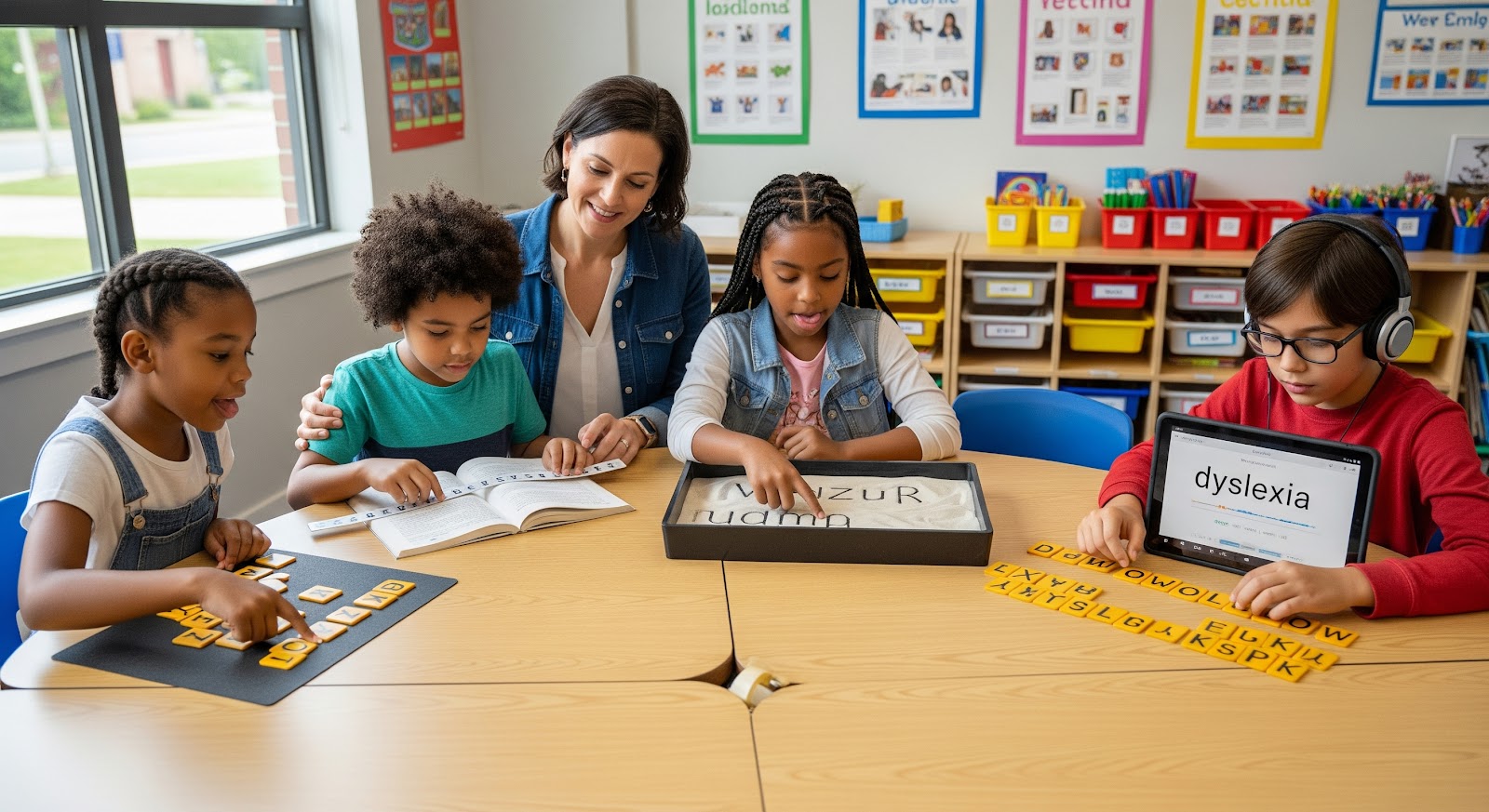
Discover effective home strategies for dyslexia reading. Learn how to use friendly fonts, multisensory routines, and AI tools like Readability.
Read More
Explore fun reading ideas for kids with ADHD, autism, or dyslexia. Support literacy with real-time feedback and gamified learning.
Read More