It is one of the most common questions parents and caregivers ask as their little ones grow: when do kids start reading? It is entirely natural to wonder if your child is on track or if there are ways you can better support their literacy journey. The truth is that reading is not a single milestone but a complex, unfolding process that develops in stages. From the early listening skills of infancy to the fluent, independent reading of elementary school, every child progresses along a unique timeline.
This guide is designed to provide you with a comprehensive, age-by-age roadmap. We will explore the building blocks of literacy, the typical milestones you can expect at different ages, and simple, research-aligned ways to help at home. Whether your child is just beginning to babble or is already attempting to sound out words, you will find practical tips to nurture their confidence and skills.
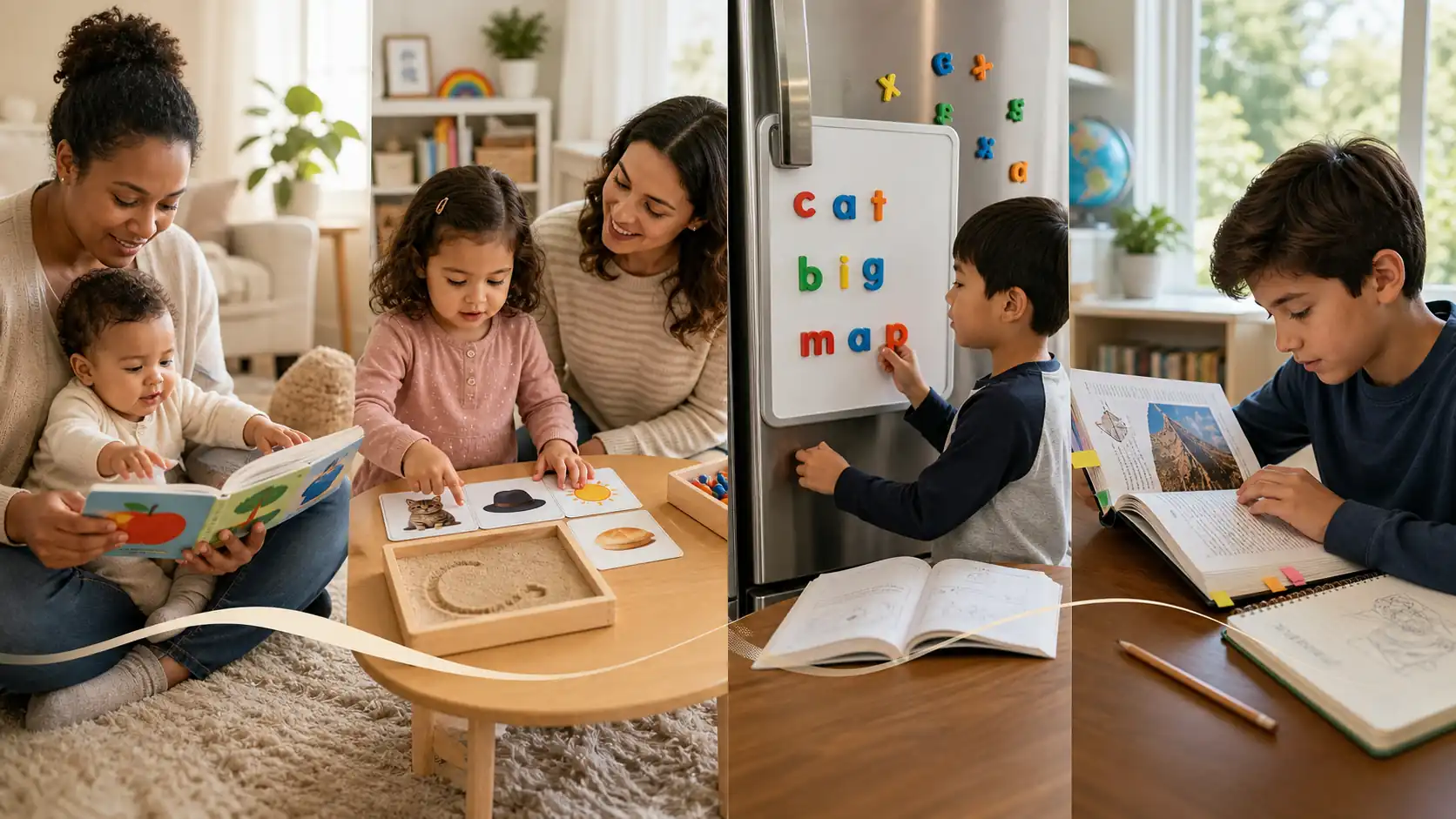
What Age Do Children Start Reading?
If you are looking for a quick, direct answer to the core question: most kids start reading simple words between the ages of 5 and 7. However, the foundation for reading begins much earlier. Many children start developing critical pre-reading skills between birth and age 4, while others may experience their "reading click" a bit later in early elementary school.
In the United States, the typical age range for reading simple words maps to Kindergarten through Grade 2. It is important to emphasize that there is a wide normal range for reading readiness. A child's progress depends heavily on their exposure to language, the type of instruction they receive, their linguistic background, and their own individual cognitive differences.
Reading Milestones by Age Overview
- Ages 0 to 2: Building language foundations through talk, play, and early book exposure.
- Ages 3 to 4: Developing print awareness, recognizing rhymes, and identifying first sounds.
- Age 5 (Kindergarten): Beginning to decode simple words and mastering letter-sound knowledge.
- Ages 6 to 7 (Grades 1 and 2): Growing reading independence, fluency, and automaticity.
- Ages 8 to 10 (Grades 3 to 5): Shifting from learning to read to reading to learn, with deeper comprehension.
How Do Early Reading Skills Develop From Sounds to Meaning?
To fully understand the timeline of reading, it is helpful to recognize what "reading" actually entails. It is far more than simply sounding out letters on a page. The development of reading skills involves several interconnected building blocks that work together to bridge the gap between recognizing sounds and understanding meaning.
The first critical building block is phonological and phonemic awareness. This involves noticing rhymes, counting syllables, and identifying the individual sounds within spoken words. Phonemic awareness is entirely auditory, but it is the essential prerequisite for decoding written text.
Next comes phonics and decoding, which is the process of mapping specific letters to their corresponding sounds and blending those sounds together to form words. As children practice decoding, they also begin to develop sight recognition. This allows them to read high-frequency words automatically, without needing to sound them out every time.
Vocabulary and background knowledge serve as the fuel for comprehension. A child cannot understand a sentence if they do not know what the words mean, even if they can decode them perfectly. Finally, reading fluency and prosody tie everything together. Fluency is the ability to read with accuracy, an appropriate pace, and natural expression. It acts as the bridge to meaning, allowing the brain to focus on understanding the text rather than struggling to decode individual words.
The Building Blocks of Reading Development
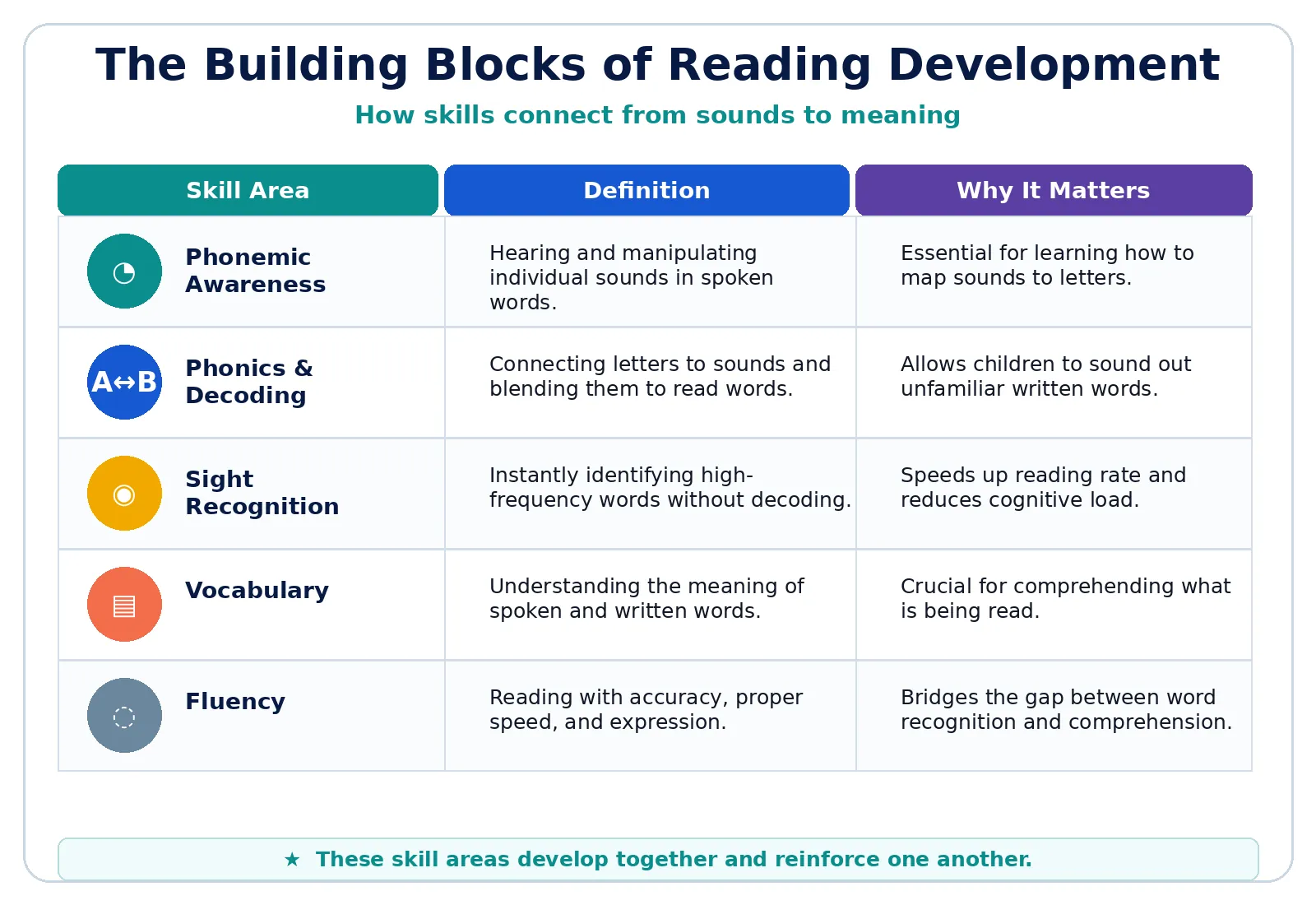
Skill AreaDefinitionWhy It MattersPhonemic AwarenessHearing and manipulating individual sounds in spoken words.Essential for learning how to map sounds to letters.Phonics & DecodingConnecting letters to sounds and blending them to read words.Allows children to sound out unfamiliar written words.Sight RecognitionInstantly identifying high-frequency words without decoding.Speeds up reading rate and reduces cognitive load.VocabularyUnderstanding the meaning of spoken and written words.Crucial for comprehending what is being read.FluencyReading with accuracy, proper speed, and expression.Bridges the gap between word recognition and comprehension.
What Are the Reading Milestones for Babies and Toddlers?
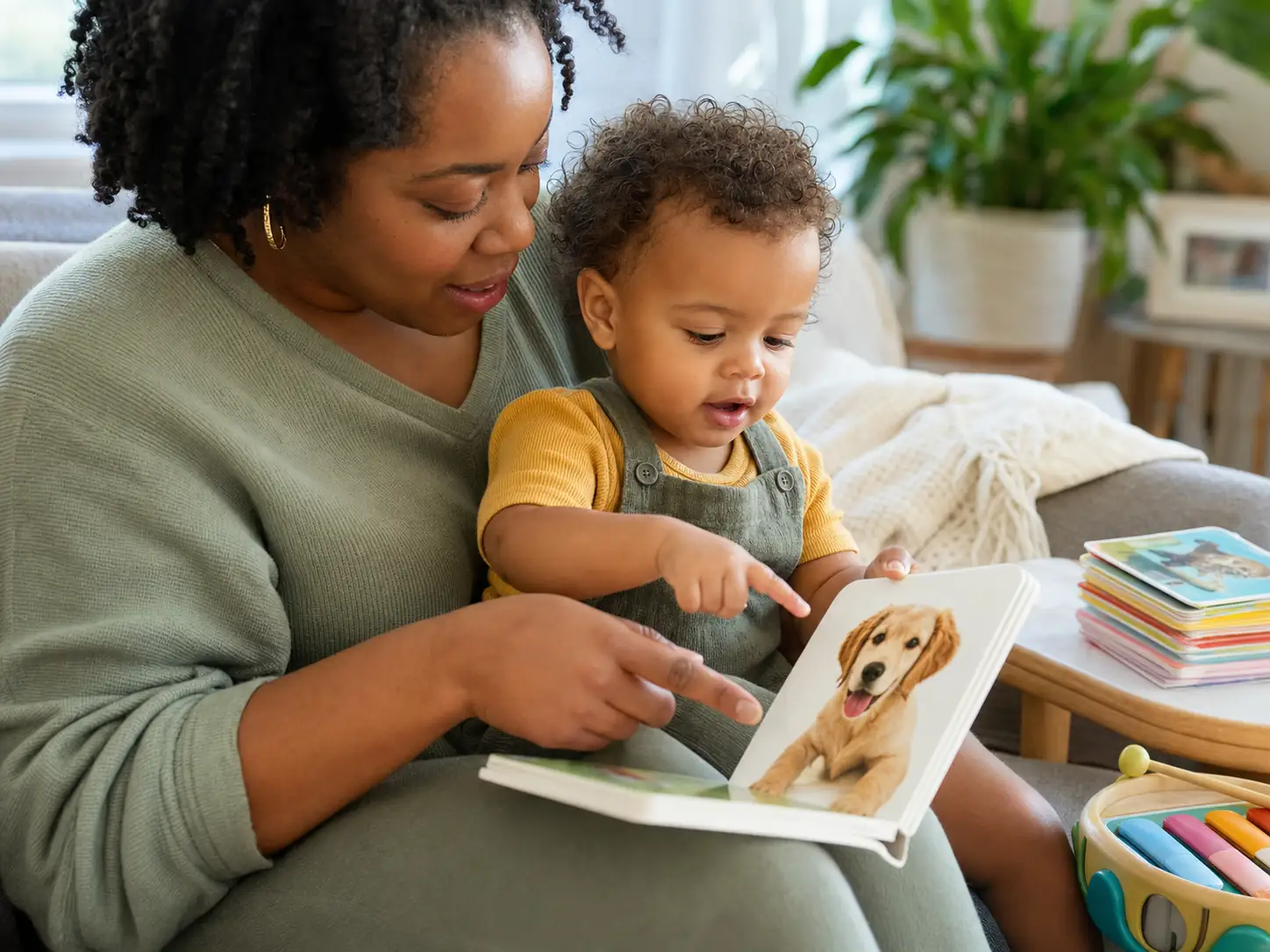
During the first two years of life, the foundation for reading is laid through everyday talk and play. While babies and toddlers are not reading words, they are rapidly absorbing the rhythms, sounds, and structures of language. The National Reading Panel and decades of literacy research confirm that the language experiences children accumulate in their earliest years directly shape the neural pathways that will later support decoding and comprehension. In other words, reading readiness does not begin on the first day of Kindergarten; it begins the first time a parent sings a lullaby or reads a picture book aloud.
What You Will Likely See in Ages 0 to 2
In these early months, you will likely notice your child showing an interest in songs, rhymes, and the natural rhythm of speech. They will begin babbling and engaging in back-and-forth "conversations" with you, taking turns making sounds.
As they grow into toddlers, they will start pointing at pictures in books and naming or labeling familiar objects. You will also see the emergence of book-handling behaviors. They might enjoy turning the pages of sturdy board books, carrying their favorite books around the house, and frequently requesting that you read the same story over and over again.
How to Support Early Language at Home
You can support these vital early skills by making reading and singing a daily habit. Describe your daily routines aloud, narrating what you are doing as you cook, clean, or get dressed. Label feelings and actions to help build their vocabulary.
Use sturdy board books that can withstand eager little hands, and always follow your child's lead. If they want to skip pages or focus on a single picture, that is perfectly fine. Keep your reading sessions short and frequent. You can build joint attention by using the point-and-name technique, asking questions like "Where is the dog?" and enthusiastically celebrating their attempts to communicate. Reading aloud to children from birth helps children with reading proficiency later on.
Research from the American Academy of Pediatrics highlights that children who are read to daily from birth enter school with significantly larger vocabularies and a stronger understanding of narrative structure. Even a few minutes of shared book time each day creates a cumulative advantage that compounds over months and years. The goal at this stage is not instruction; it is immersion in the joy of language.
What Are the Signs of Reading Readiness in Preschoolers?
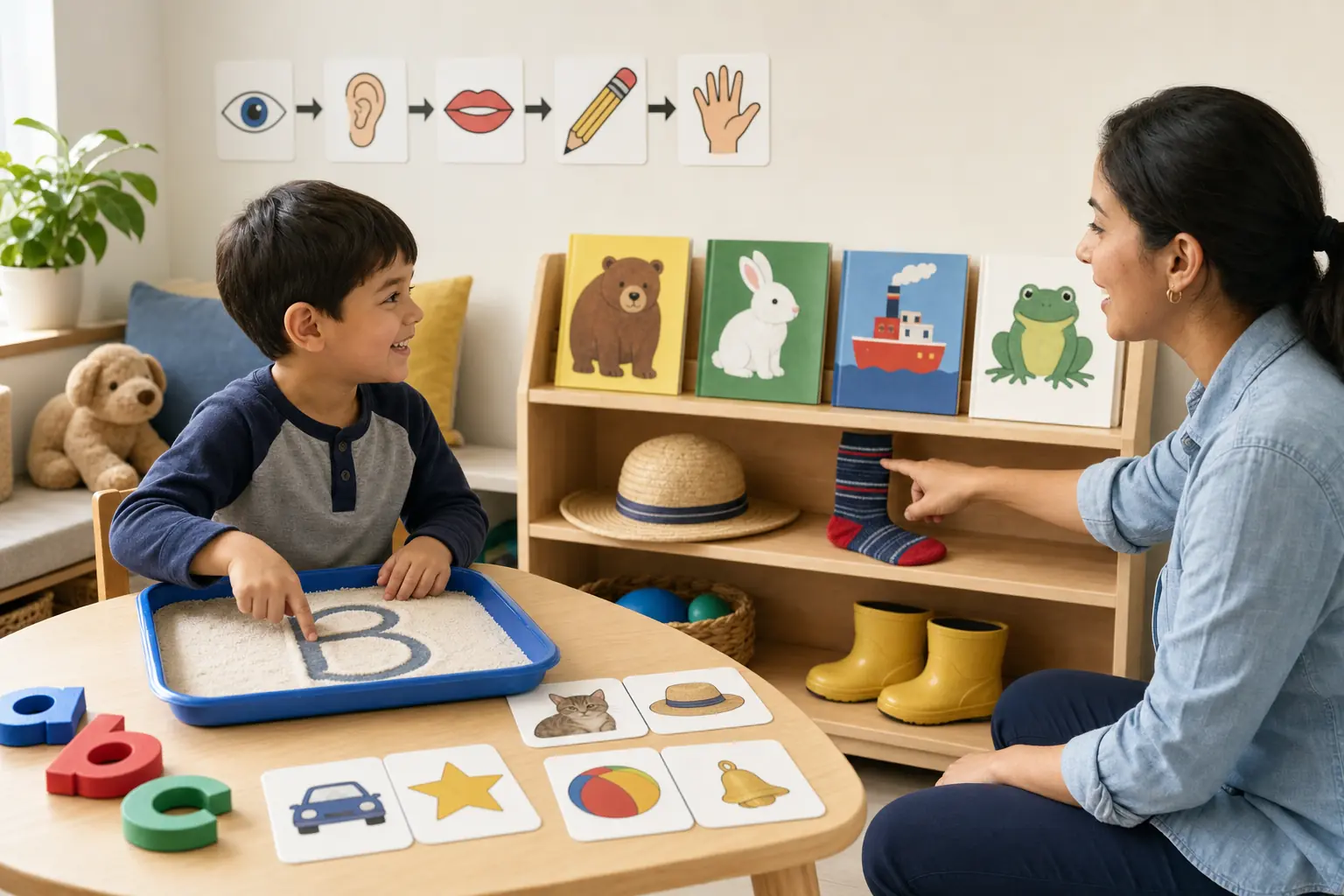
Between the ages of 3 and 4, children begin to develop the specific pre-reading skills that strongly predict their future decoding success. This stage is all about rhyme, recognizing first sounds, and developing print awareness. Understanding the stages of reading development helps parents recognize that preschool is not too early to begin nurturing these foundational skills in a playful, low-pressure way.
What You Will Likely See in Ages 3 to 4
Preschoolers typically show a strong enjoyment of rhymes and rhyming games. They start noticing the first sounds in words, such as recognizing the /s/ sound at the beginning of "sun."
You will likely see them begin to recognize some letters, especially the letters that make up their own name. They also start to understand the basic concepts of print, such as the fact that we read from left to right and top to bottom, and that there are spaces between words. Furthermore, preschoolers often enjoy retelling simple stories and using the pictures in a book to infer what is happening in the narrative.
How to Help a Child Learn to Read Before Kindergarten
Play sound games together to build their auditory skills. A simple game of "I spy something that starts with the /m/ sound" can be highly effective. Point out letters in your everyday environment, such as on street signs, cereal boxes, or store logos.
For a multisensory approach, encourage them to trace letters with their fingers in sand, salt, or shaving cream. When you are reading aloud, occasionally run your finger under the words. This simple action helps them connect the spoken speech they hear to the printed text they see on the page. Research consistently shows that strong phonological awareness during the preschool years is a powerful predictor of later decoding ability. Utilizing multisensory reading activities can greatly enhance these early learning experiences.
It is also worth understanding the important distinction between phonological awareness and phonics at this stage. Phonological awareness is entirely sound-based, involving the ability to hear and play with the sounds in spoken language. Phonics, on the other hand, connects those sounds to written letters. Preschoolers are primarily building phonological awareness, which sets the stage for phonics instruction in Kindergarten. Understanding the relationship between phonics and phonological awareness can help you provide more targeted support at home.
What Are the Age 5 Reading Milestones When Decoding Begins?
Around age 5, as children typically enter Kindergarten, formal reading instruction begins, and they start decoding simple words and sentences. This is a thrilling time when the abstract concepts of letters and sounds start to click together into recognizable words. It is also the stage where the early literacy skills developed during the preschool years begin to pay clear dividends.
What You Will Likely See at Age 5
Kindergarteners usually develop solid letter-sound knowledge for many consonants and short vowels. They begin the crucial work of blending sounds together to read simple consonant-vowel-consonant (CVC) words, such as "cat," "sit," and "hop."
They will also start to build a small set of high-frequency sight words that they can recognize automatically. In terms of comprehension, they should be able to retell the main events of a story they have heard and answer basic who, what, and where questions about the text.
How to Support Kindergarten Reading Skills
Practice sound blending at home using magnetic letters on the refrigerator or letter tiles. Provide them with decodable texts that align with the phonics patterns they are currently learning in school.
It is also vital to keep your own read-aloud sessions rich and engaging. Continue reading books to them that are above their independent reading level. This exposes them to advanced vocabulary and complex sentence structures that they cannot yet read on their own. During these read-alouds, ask open-ended questions. Encourage them to predict what will happen next, connect the story to their own lives, and discuss the motivations of the characters. This helps ensure that kindergarteners are reading with confidence.
Vocabulary development at this stage is also critical. Children who hear and discuss a wide range of words during read-alouds are far better equipped to understand what they eventually read on their own. Intentional vocabulary instruction for kids does not have to be formal; it can happen naturally through conversation, storytelling, and the shared exploration of books.
What Are the First Grade Reading Expectations for Growing Independence?
Ages 6 to 7, encompassing Grades 1 and 2, mark a period of growing independence and fluency. Many children transition from laboriously sounding out words to reading more smoothly and tackling more complex spelling patterns. This is one of the most dynamic periods in a child's reading development, and it is also the time when parents often become most aware of differences between their child and their peers. It is important to hold space for that variation while continuing to provide consistent support.
What You Will Likely See in Ages 6 to 7
During these years, children typically master more complex phonics concepts, including consonant digraphs (like sh, ch, th), consonant blends (like st, bl), long vowel patterns, and the silent 'e' rule.
You will notice an increasing automaticity with common words, leading to improved fluency and reading expression. They are no longer just reading words; they are tracking the plot across a full story and beginning to summarize what they have read.
How to Build Fluency and Comprehension at Home
Encourage daily reading aloud practice for about 10 to 15 minutes. It is better to have short, regular reading sessions than occasional, long, frustrating ones. Help them choose "just-right" texts that build their confidence, and occasionally select slightly harder books to read together.
Model effective decoding strategies for them. When they make an error, prompt them to re-read the sentence and ask if it makes sense, encouraging them to monitor their own comprehension. You can also begin to build their morphology awareness by discussing simple prefixes, suffixes, and root words. For example, explaining how adding "-ed" changes a verb to the past tense. Focus on developing fluent readers by providing a supportive environment.
Research from the National Reading Panel consistently demonstrates that guided oral reading with immediate feedback is one of the most effective strategies for building fluency. When children read aloud and receive gentle, real-time corrections, they develop automaticity far more quickly than through silent reading alone. This is why daily read-aloud practice at home is so valuable, even when children are beginning to read independently at school.
Typical Reading Fluency Benchmarks (Words Correct Per Minute)
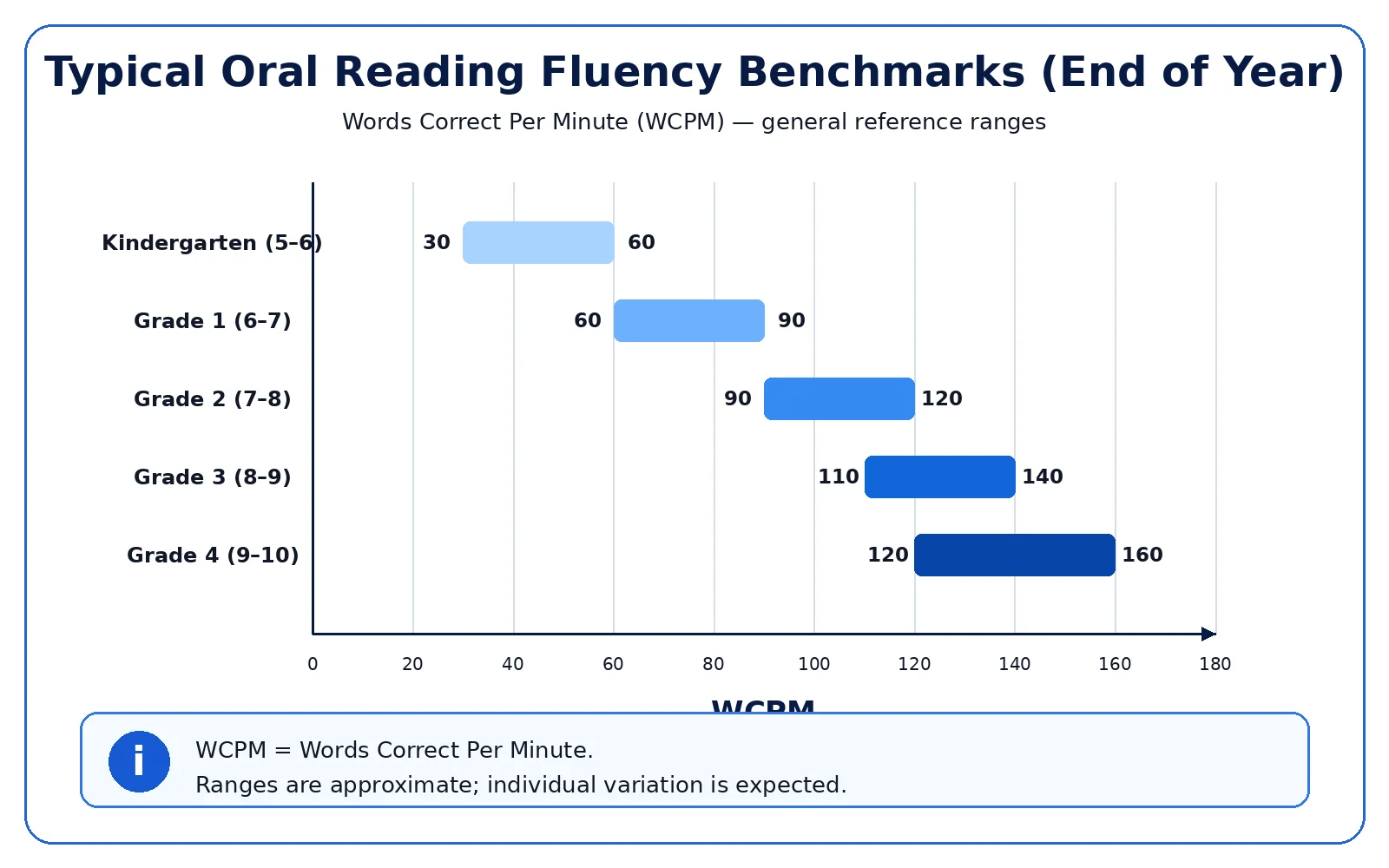
The following table provides a general reference for typical oral reading fluency rates by grade level. These benchmarks are commonly used by educators to gauge whether a child's fluency is on track.
Grade LevelApproximate AgeTypical Oral Reading Fluency (WCPM)Kindergarten (End of Year)5-630-60 words per minuteGrade 1 (End of Year)6-760-90 words per minuteGrade 2 (End of Year)7-890-120 words per minuteGrade 3 (End of Year)8-9110-140 words per minuteGrade 4 (End of Year)9-10120-160 words per minute
Note: WCPM = Words Correct Per Minute. These are general reference ranges; individual variation is normal and expected.
When Do Kids Start Reading to Learn Beyond Age 7?
Beyond age 7, typically around ages 8 to 10 (Grades 3 to 5), there is a fundamental shift in literacy development. Children move away from "learning to read" and transition toward "reading to learn." They begin using their reading skills to acquire new knowledge, and the texts they encounter become significantly more complex. This transition is sometimes referred to as the "fourth-grade slump" when it does not go smoothly, as children who have not fully consolidated their decoding skills may struggle when the academic demands of reading increase sharply.
What You Will Likely See in Ages 8 to 10
Older elementary students begin using multi-syllable decoding strategies, breaking down long words using syllable types and familiar morphemes. They are reading for different purposes across various genres, including fiction, informational texts, and poetry, and they are steadily growing their reading stamina.
Their comprehension skills deepen significantly. They start analyzing themes, making complex inferences, tracking character changes over time, and citing evidence from the text to support their thoughts.
How to Support Advanced Reading Comprehension
Allow your children to choose their own reading topics to encourage a high volume of reading. Discuss the themes of the books they are reading and ask them to consider the author's purpose.
Teach them basic note-taking skills and how to navigate the text features commonly found in nonfiction books, such as glossaries, indexes, and captions. Discuss how to compare information across different sources. Most importantly, continue reading aloud together. This remains an excellent way to introduce them to advanced language structures and complex ideas that spark meaningful conversations. You can find more tips on how to improve reading comprehension on our blog.
At this stage, it is also worth exploring how kids learn to read in more depth, particularly the role of background knowledge and vocabulary in driving comprehension. A child who reads widely across many topics builds a rich store of knowledge that makes future reading easier and more meaningful. Understanding how kids learn to read through the lens of the science of reading can help parents make more informed decisions about the books and activities they provide.
Comparing Reading Focus by Age Group
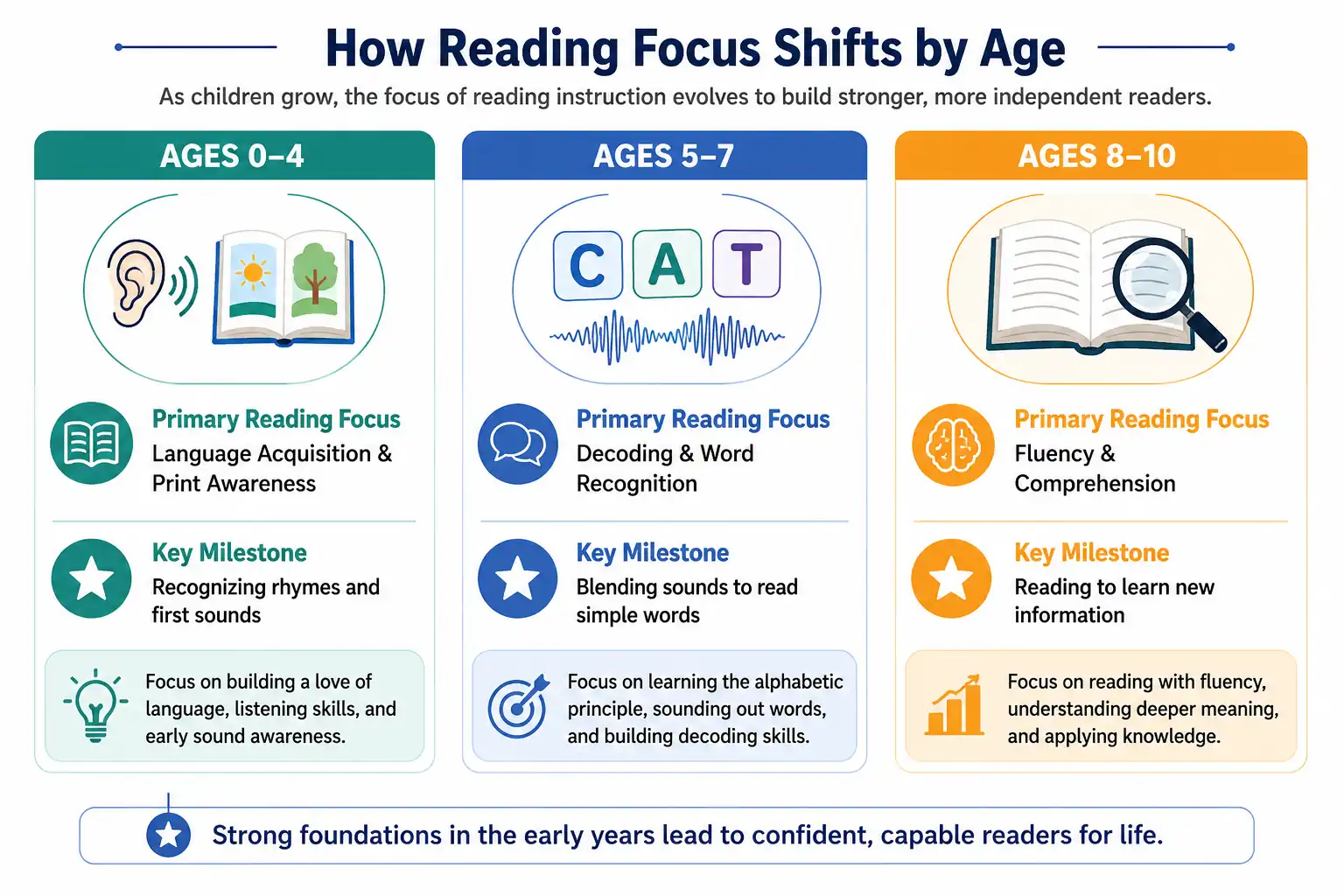
Age GroupPrimary Reading FocusKey MilestoneAges 0-4Language Acquisition & Print AwarenessRecognizing rhymes and first sounds.Ages 5-7Decoding & Word RecognitionBlending sounds to read simple words.Ages 8-10Fluency & ComprehensionReading to learn new information.
What Happens When a Child is Off the Typical Reading Timeline?
It is crucial to remember that the milestones outlined above represent typical progress, but there is a wide range of normal when it comes to reading development. Some children learn to read earlier, while others take a little longer to put the pieces together. Multilingual learners, for instance, may follow different trajectories as they navigate multiple language systems. Understanding the difference between a temporary delay and a persistent difficulty is one of the most important things a parent can do to support their child's literacy journey.
What is Within the Wide Range of Typical
Not all 5-year-olds are ready to decode words, and that is often perfectly fine. Some children need more time to develop their phonological awareness before phonics instruction clicks. It is important not to panic if your child is slightly behind a specific milestone, but rather to continue providing a supportive, language-rich environment.
Signs to Discuss With a Teacher or Clinician
While variation is normal, there are certain red flags that warrant a conversation with your child's teacher or a literacy specialist. If your child has persistent trouble recognizing letters or rhymes by late preschool, it is worth investigating.
Similarly, if they show little to no progress with letter-sound mapping or blending by the end of Grade 1, they may need additional support. A family history of reading difficulties, such as dyslexia, or strong avoidance and emotional distress around print, are also signs that early intervention could be beneficial.
Early identification is one of the most powerful tools available to families. Research consistently shows that children who receive targeted reading intervention in the early grades are far more likely to reach grade-level proficiency than those who receive support later. Waiting to see if a child "grows out of it" is rarely the most effective strategy. If you suspect your child may be struggling, the kindest and most productive step is to seek a professional assessment as soon as possible.
Practical Next Steps for Struggling Readers
If you have concerns, request a skills-focused screening from your child's school to pinpoint exactly where they are struggling. Collaborate with the educational team to create a targeted support plan. Ask about explicit, systematic phonics instruction and whether small-group support is available.
At home, keep reading aloud to them to preserve their love of stories and vocabulary development. Protect their self-confidence by providing strengths-based feedback and celebrating their efforts, not just their accuracy. Education for dyslexic students and those with other reading challenges requires patience and specialized approaches.
Fostering a Lifelong Love of Reading
The journey of reading unfolds across many years. It begins with the simple exchange of language, moves through the complex cognitive process of decoding, and eventually matures into fluent, purposeful reading. Every stage matters, and every stage is built upon the one that came before.
The most important insight for parents is to meet your child exactly where they are today. Small, consistent home routines, like a 10-minute read-aloud before bed or a quick word game in the car, make a meaningful, lasting difference. Remember that the frequency of reading and the joy associated with it matter just as much as the reading level. By providing a supportive, encouraging environment, you are giving your child the tools they need to succeed.
As you continue to support your child's reading journey, remember that you do not have to navigate it alone. There are many resources available to help you understand how to help a child struggling with reading, from practical home strategies to professional assessments. Whether your child is thriving or facing challenges, your consistent presence and enthusiasm for books is one of the most powerful gifts you can give them.
Frequently Asked Questions: When Do Kids Start Reading?
What age should my child know all their letters?Most children can recognize and name all the uppercase and lowercase letters of the alphabet by the end of Kindergarten, typically around age 5 or 6. However, exposure through play and reading in the preschool years helps build this foundational knowledge early.
When do kids start reading simple sentences?Children generally start reading simple, decodable sentences between the ages of 5 and 7 (Kindergarten to Grade 1), once they have mastered basic letter sounds and can blend them together.
Is it normal if my 6-year-old isn’t reading yet?Yes, there is a wide range of normal. While many 6-year-olds are beginning to decode words, some need more time to develop their phonological awareness and phonics skills. If you are concerned about their progress, it is always a good idea to speak with their teacher.
How long should my child read each day?For early elementary students, 15 to 20 minutes of daily reading practice is highly effective. Short, consistent sessions build stamina and fluency without causing frustration or burnout.
Which comes first: phonemic awareness or phonics?Phonemic awareness comes first. It is the auditory ability to hear and manipulate sounds in spoken language, which must be developed before a child can connect those sounds to written letters (phonics). You can learn more about foundational reading skills to support this progression.
Are sight words still important if we focus on phonics?Yes. While phonics provides the tools to decode new words, learning high-frequency sight words helps children read more fluently, as they do not have to stop and sound out every common word they encounter.
How can I tell if a book is the right level?Use the "five-finger rule": have your child read a page, and hold up one finger for every word they do not know. If they hold up five fingers before the end of the page, the book is likely too challenging for independent reading right now.
What are signs of dyslexia in early readers?Early signs can include persistent difficulty recognizing rhyming words, trouble remembering letter names and sounds, difficulty blending sounds to make words, and a family history of reading challenges. If you suspect an issue, seek a professional screening and explore comprehension strategies for struggling readers.
Should I keep reading aloud once my child can read?Absolutely. Reading aloud exposes children to more complex vocabulary and sentence structures than they can read on their own, and it remains a wonderful way to bond and discuss advanced ideas.
References
[1] National Reading Panel. (2000). Teaching Children to Read: An Evidence-Based Assessment of the Scientific Research Literature on Reading and Its Implications for Reading Instruction.[2] American Speech-Language-Hearing Association (ASHA). Literacy Milestones.[3] Readability Tutor. "Reading Milestones by Age: A Parent's Guide From Infancy to 12." https://www.readabilitytutor.com/blog/reading-milestones-by-age[4] Readability Tutor. "Understanding Dyslexia: A Common Learning Difficulty." https://www.readabilitytutor.com/blog/understanding-dyslexia