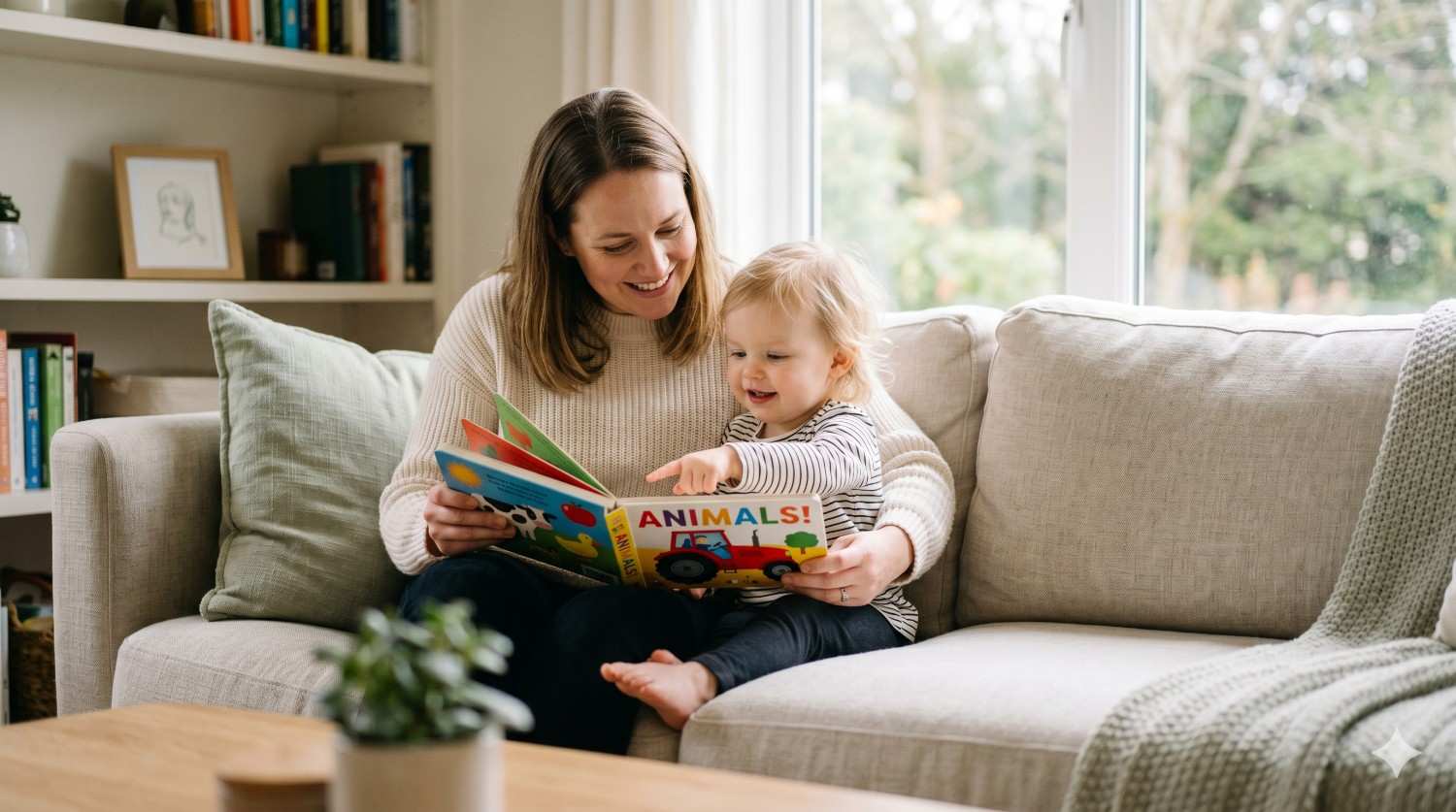
Every child's path to reading is unique, yet families often find it helpful to understand typical reading milestones by age. This comprehensive guide walks parents and caregivers through the journey from infancy through age 12, showing how essential skills like phonological awareness, phonics, vocabulary, fluency, and comprehension develop over time. You'll find a quick-reference chart, age-by-age milestones with practical activities, and research-aligned strategies to try at home.
Remember that these ranges represent typical development, not prescriptive timelines, children develop at their own pace, and pediatricians and school teams can guide families who have concerns. This guide emphasizes that reading is not a natural ability but a complex skill taught and refined over years through explicit instruction, practice, modeling, and exposure to rich, varied print experiences.
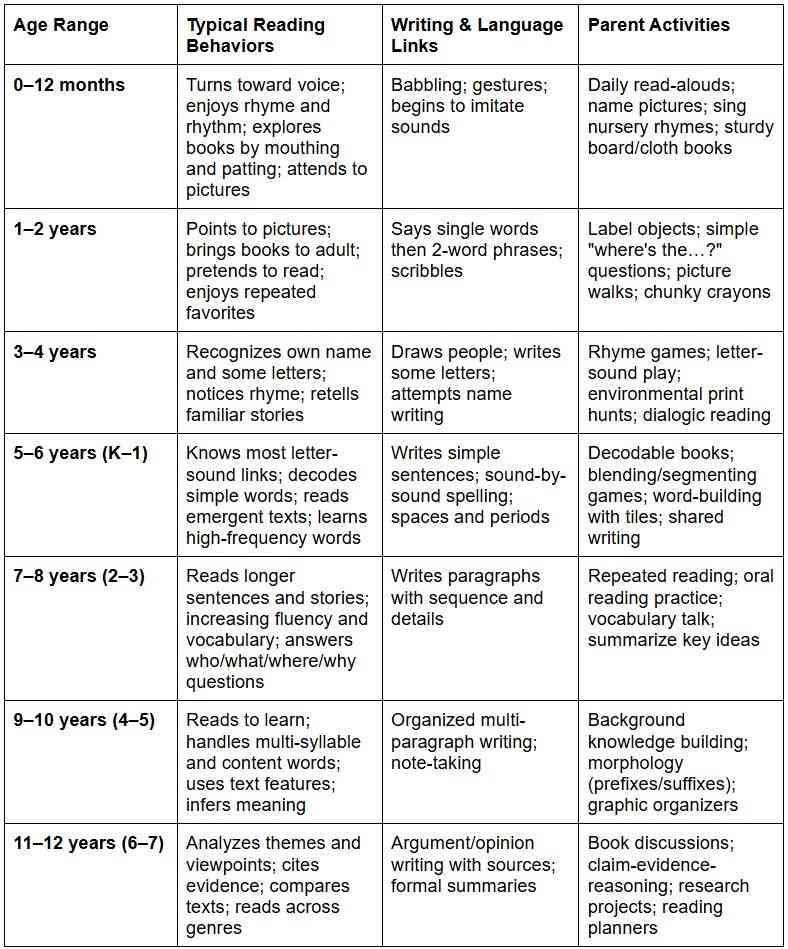
Reading Milestones by Age Chart: Quick Reference Guide
The following chart summarizes typical reading milestones by age chart across seven developmental stages, from birth through age 12. This chart acknowledges normal variability among children while providing a clear snapshot of expected skills and behaviors. Each age band includes typical reading behaviors, writing and language connections, and parent activities that support development. Use this chart as a reference point to gauge your child's progress, but remember that individual timelines vary based on exposure to literacy, language background, cognitive development, and learning differences.
How Do Childhood Reading and Writing Milestones by Age Connect and Support Each Other?
Childhood reading and writing milestones by age are tightly interconnected. Early writing attempts, drawing, scribbling, and invented spelling, directly support phonological awareness, decoding, vocabulary growth, fluency development, and comprehension at each age. When children attempt to write, they engage with letter formation, sound sequencing, and spelling patterns, which reinforces their understanding of how print works. This reciprocal relationship strengthens literacy development across both domains.
From birth to age two, oral language and print awareness form the foundation for later decoding and comprehension. Babies who hear rich language and see adults engaging with books develop stronger phonological awareness and vocabulary. Between ages three and four, letter knowledge, rhyme recognition, and pretend reading are linked with emergent writing attempts and name writing. Children who play with letters and sounds are more likely to write letters and attempt words.
From ages five to eight, systematic phonics instruction, decoding practice, and high-frequency word learning directly support sentence-level writing and spelling development. Children who decode fluently can focus cognitive resources on composing meaningful sentences. Finally, from ages nine to twelve, morphology study (prefixes, suffixes, roots), comprehension strategies, and text analysis connect to multi-paragraph writing with evidence. Older children who understand word structure can spell more complex words and construct sophisticated arguments supported by textual evidence.
How Can Parents Support Infants (0–12 Months) in Building Print and Language Awareness?
During infancy, the foundation for literacy is laid through oral language exposure and print awareness. Typical milestones include attending to voices and rhythms, exploring books through touch, tracking pictures, and beginning joint attention with caregivers during read-alouds. Infants do not yet understand that print carries meaning, but they are building crucial neural pathways through language exposure.
Practical Activities: Read aloud daily using high-contrast and photo books designed for infants. Label objects in the environment ("That's a dog!") and point to pictures while naming them. Sing nursery rhymes and recite rhythmic verses to build phonological awareness. Follow your baby's gaze and interests, allowing them to lead exploration. Keep books accessible and use a warm, expressive voice. Repeat favorite books frequently to strengthen pattern recognition and predictability.
Tips: Infants learn through repetition and multisensory engagement. Board books and cloth books are ideal because they withstand mouthing and handling. The goal is to create positive associations with books and language, not to teach reading skills.
How Can Parents Help Toddlers (1–2 Years) Grow Vocabulary and Book Habits?
Toddlers are emerging communicators who begin to point and name pictures, imitate reading behaviors, bring books to adults, and enjoy repetition. They are building vocabulary rapidly and developing an understanding that books are sources of joy and information. Typical milestones include pointing to named objects, responding to simple questions ("Where's the cat?"), and requesting favorite books repeatedly.
Practical Activities: Use interactive read-aloud prompts such as "Find the cat" or "What does the dog say?" to encourage engagement. Take environmental print hunts around your home and neighborhood, pointing out familiar words on signs and labels. Introduce simple motion songs that pair language with movement. Provide chunky crayons and paper for scribbling, which builds fine motor skills and introduces writing. Use dialogic reading techniques, ask open-ended questions, wait for responses, and expand on what your child says.
Tips: Toddlers learn through interaction and repetition. Keep reading sessions short and follow your child's lead. Celebrate attempts at communication, even if pronunciation is unclear.
What Strategies Help Preschoolers (3–4 Years) Strengthen Phonological Awareness and Letter Knowledge?
Preschoolers are developing phonological awareness, the ability to recognize and manipulate sounds in language, and beginning letter knowledge. Typical milestones include recognizing some letters (often in their own name), noticing rhyme and alliteration, retelling story episodes, and understanding book handling and directionality (left to right, top to bottom). These skills are crucial precursors to phonics instruction.
Practical Activities: Play rhyme and syllable-clapping games ("Clap the sounds in 'but-ter-fly'"). Engage in letter-sound games where you point to letters and make their sounds. Practice name writing together, starting with tracing and moving toward independent writing. Sort pictures by beginning sounds. Use puppets for pretend reading and story retelling. Create a print-rich environment with labels on objects, charts, and signs throughout your home.
Tips: Keep activities playful and multisensory. Preschoolers learn best through games, movement, and hands-on exploration. Avoid pressure or formal instruction; the goal is to build foundational skills through joyful engagement.

How Can Parents Help Early Readers (5–6 Years) Launch Decoding and High-Frequency Word Recognition?
Early readers in kindergarten and first grade are mastering letter-sound correspondences and beginning to decode simple words. Typical milestones include blending and segmenting sounds, decoding consonant-vowel-consonant words and simple vowel-consonant-silent-e words, learning high-frequency words, and reading simple decodable texts. This is the critical period when children shift from "learning to read" to beginning independent reading.
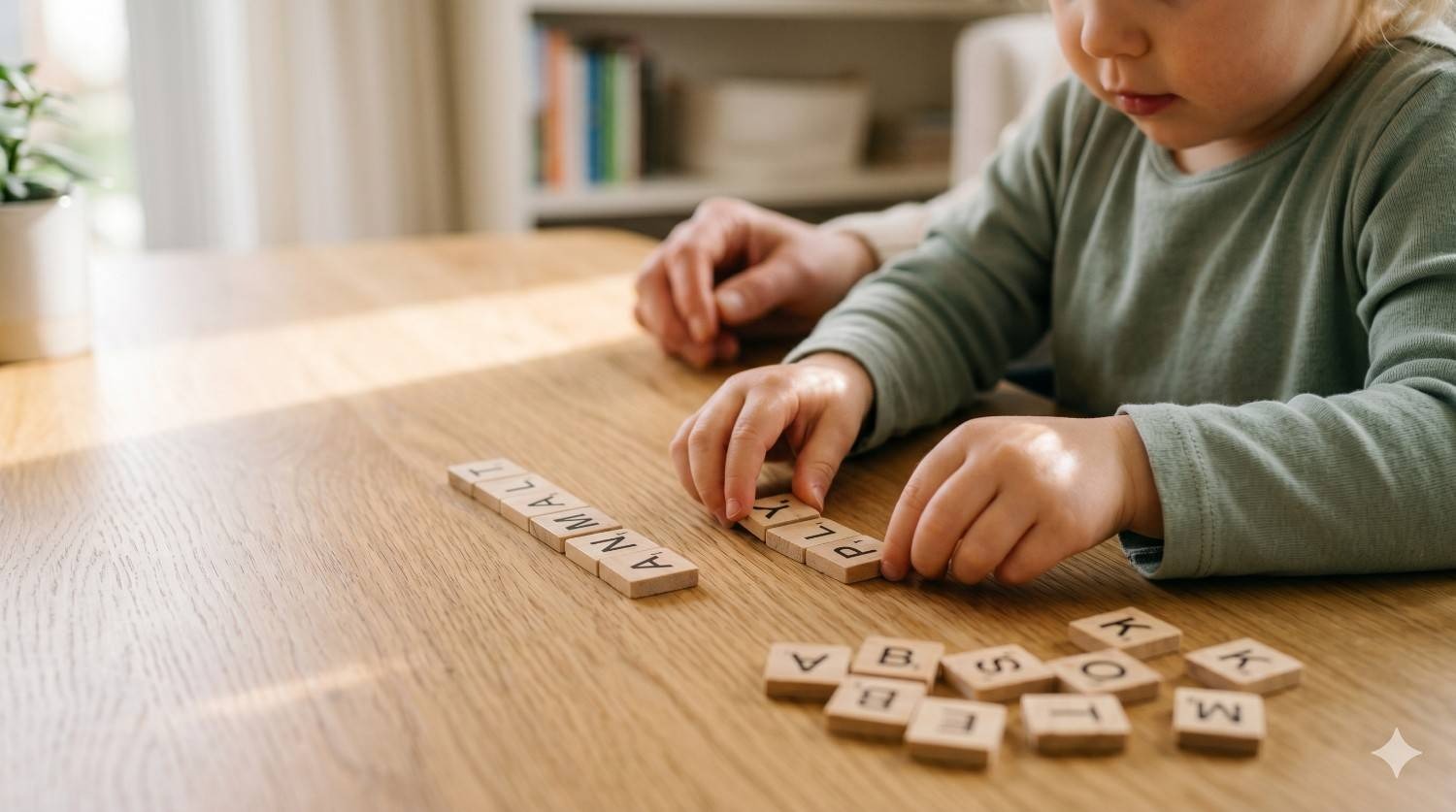
Practical Activities: Use word-building tiles to create and manipulate words ("Change the 'c' in 'cat' to 'm' to make 'mat'"). Play phoneme manipulation games where children delete or substitute sounds. Practice orthographic mapping for high-frequency words by writing them repeatedly and discussing their letter patterns. Read decodable books together that match your child's current phonics knowledge. Engage in shared and guided reading, where you read together and discuss the text.
Tips: Keep practice sessions short (10–15 minutes daily) and celebrate effort over perfection. Monitor for persistent struggles with letter names, sounds, or blending, these may indicate a need for additional support or evaluation. Use decodable books that align with phonics instruction for maximum effectiveness.
What Activities Build Fluency, Vocabulary, and Literal Comprehension in Developing Readers (7–8 Years)?
By grades two and three, children are developing greater accuracy and reading rate. Typical milestones include reading leveled storybooks with increasing independence, answering who/what/where/why questions about texts, and summarizing key ideas. Fluency, the ability to read with accuracy, appropriate rate, and expression, is developing rapidly during this stage.
Practical Activities: Engage in repeated reading of familiar passages to build fluency and confidence. Try partner reading where you and your child take turns reading pages or paragraphs. Use phrase-cued texts (texts with slash marks showing natural phrase breaks) to support expression. Have vocabulary conversations using real examples and multiple meanings of words. Create story maps that organize plot elements visually.
Tips: Mix choice reading (books your child selects) with guided practice (books you select for skill-building). Discuss word meanings and explore multiple meanings of familiar words. Record your child reading aloud occasionally so they can self-assess rate, accuracy, and expression.
How Can Parents Support Transitional Readers (9–10 Years) in Reading to Learn and Inferring Meaning?
Grades four and five mark a significant shift from "learning to read" to "reading to learn." Transitional readers handle multi-syllable words, use prefixes, suffixes, and roots to decode unfamiliar words, infer unstated ideas, and integrate text features in nonfiction. Comprehension becomes increasingly important as reading is used as a tool for learning in content areas.
Practical Activities: Study morphology (word parts) by exploring prefixes, suffixes, and roots. Build background knowledge through videos, field trips, and discussions before reading. Use graphic organizers to track information and relationships. Implement reciprocal teaching strategies: predict what will happen next, ask questions about the text, clarify confusingparts, and summarize key ideas. Encourage note-taking while reading.
Tips: Set a purpose before reading ("Find three facts about polar bears"). Compare information across multiple sources. Encourage your child to ask questions and think critically about what they read.
What Strategies Help Preteens (11–12 Years) Analyze and Argue With Evidence?
By grades six and seven, readers are analyzing themes and tone, comparing texts and perspectives, citing textual evidence, and sustaining independent reading. These advanced comprehension skills prepare children for secondary school and lifelong learning. Writing becomes more sophisticated, with argument and opinion writing supported by textual evidence.
Practical Activities: Conduct Socratic seminars where children discuss texts and defend their interpretations using evidence. Teach claim-evidence-reason writing where children state an opinion, provide textual evidence, and explain their reasoning. Assign research projects that require finding, evaluating, and synthesizing information from multiple sources. Encourage reading journals and planners where children set goals and reflect on their reading. Explore different genres, fantasy, realistic fiction, biography, poetry, nonfiction, to broaden reading experiences.
Tips: Offer choice plus challenge; allow children to select books within guided parameters. Set reasonable reading goals and provide reflection prompts. Celebrate sustained engagement with complex texts.

How to Support Phonological Awareness and Phonics Development at Home
Phonological awareness and phonics are foundational to reading success. Phonological awareness is the ability to recognize and manipulate sounds in spoken language (rhyming, syllable clapping, sound isolation). Phonics is the understanding that letters represent sounds and that these sound-letter correspondences can be used to decode words.
Evidence-Based Strategies:
- Engage in daily blending and segmenting practice using 10-minute games. Start with simple two-sound words ("cat" = /c/ + /at/) and progress to more complex patterns.
- Progress from phoneme isolation ("What's the first sound in 'sun'?") to manipulation (deleting or substituting sounds: "Say 'sun' without the /s/").
- Teach common grapheme-phoneme correspondences (letter-sound relationships) systematically, then advance to more complex patterns like vowel teams (ee, oa, ai) and r-controlled vowels (ar, er, or).
How to Build Vocabulary and Support Word Learning
Vocabulary knowledge is strongly correlated with reading comprehension. Children who know more words understand more of what they read.
Effective Strategies:
- Pre-teach key words before reading using kid-friendly definitions and concrete examples.
- Discuss morphology (word parts) from grade three onward. Understanding that "unhappy" = "un" + "happy" helps children decode and understand unfamiliar words.
- Use concept maps and personal connections to deepen word understanding. Ask, "Have you ever felt unhappy? When?"
How to Develop Reading Fluency and Expression
Fluency is the ability to read with accuracy, appropriate rate, and expression. Fluent readers can focus cognitive resources on comprehension rather than decoding.
Fluency Benchmarks by Grade (Hasbrouck & Tindal, 2017):

WCPM = Words Correct Per Minute; 50th percentile (median performance)
Strategies to Build Fluency:
- Model expressive reading by reading aloud with appropriate pacing, phrasing, and intonation.
- Use short, repeated passages for practice. Repeated reading builds automaticity and confidence.
- Record your child reading aloud to assess rate, accuracy, and expression. Self-assessment builds metacognitive awareness.
- Use poetry and scripts for phrasing and intonation practice. Poetry's rhythm naturally supports fluent reading.
How to Develop Comprehension Skills Across Reading Stages
Reading comprehension is the ultimate goal of reading instruction. Comprehension involves understanding words, sentences, and the overall meaning and purpose of a text.
Comprehension Strategy Framework:
Before Reading: Set a purpose for reading ("Find out why the character was scared"). Activate prior knowledge ("What do you know about forests?").
During Reading: Ask questions to check understanding. Visualize scenes described in the text. Annotate or mark important information. Clarify confusing parts by rereading or asking questions.
After Reading: Summarize the main idea and key details. Infer themes and author's purpose. Discuss author choices and how they affect the reader. Connect ideas across texts and to personal experiences.
How to Foster Independent Reading and Motivation
Independent reading, reading for pleasure and information without adult support, is essential for literacy development. Children who read independently develop stronger vocabulary, fluency, and comprehension.
Strategies to Encourage Independent Reading:
- Offer choice across genres and difficulty levels. Allow children to select books that interest them.
- Support series reading. Once children find a series they love, they're motivated to read multiple books.
- Establish cozy reading spaces with good lighting and comfortable seating.
- Create consistent reading routines (bedtime reading, weekend reading time).
- Track reading with journals or simple logs and celebrate progress.
Special Considerations and When to Seek Help
While this guide describes typical development, some children may need additional support. Understanding special considerations helps parents advocate effectively for their children.
Multilingual Learners: Children learning to read in more than one language benefit from reading in their home language and in English. Skills like phonological awareness and vocabulary transfer across languages, supporting reading development in both. Bilingualism is an asset, not a barrier, to reading success.
Neurodiversity and Dyslexia: Dyslexia is a specific learning disability affecting phonological processing and decoding. Signs may include difficulty learning letter-sound correspondences, slow and labored decoding despite adequate instruction, poor spelling despite strong reasoning abilities, and difficulty with rhyming or syllable manipulation. If you notice these patterns, seek evaluation through your school or pediatrician.
Red Flags for Reading Difficulties:
- Limited progress after months of explicit, systematic instruction
- Avoidance of print or resistance to reading
- Persistent guessing at words rather than attempting to decode
- Poor comprehension despite fluent oral language skills
- Significant discrepancy between listening comprehension and reading comprehension
Next Steps: Partner with school teams to request screening and progress monitoring. Ask about evidence-aligned interventions and supports. Early intervention is key to preventing reading difficulties from compounding.
Understanding reading milestones by age empowers parents to support their children's literacy development with confidence and clarity. Remember that development is not linear, children progress at their own pace, influenced by exposure to language, instruction quality, practice opportunities, and individual learning differences. Use this guide as a reference, not a prescription.
Celebrate your child's progress, provide engaging literacy experiences, and partner with teachers and specialists when concerns arise. Early intervention and consistent support make a significant difference in reading outcomes. By creating a literacy-rich home environment filled with books, conversation, and joyful reading experiences, you're laying the foundation for lifelong learning and success.
Frequently Asked Questions About Reading Milestones by Age
Q: At What Age Do Most Children Learn to Read Independently?
A: Most children begin reading simple texts independently around age five to six (kindergarten to early first grade), though the pace varies widely. By the end of first grade, typical readers can decode simple decodable texts. However, "independent reading" for pleasure typically develops around ages seven to eight when fluency increases and comprehension becomes easier.
Q: What Are the Most Important Reading Milestones to Track From Birth to Age 12?
A: Key milestones include: birth–12 months (language exposure and print awareness), 1–2 years (vocabulary growth and book engagement), 3–4 years (letter knowledge and phonological awareness), 5–6 years (phonics and decoding), 7–8 years (fluency and comprehension), 9–10 years (reading to learn and inference), and 11–12 years (analysis and evidence-based thinking).
Q: How Can I Tell If My Child Is Ready to Learn Phonics?
A: Children are typically ready for phonics instruction around age four to five if they can identify some letters, recognize rhyming words, and manipulate sounds in words (syllable clapping, sound isolation). However, readiness varies. If your child shows strong phonological awareness and letter knowledge, they may be ready for phonics. Talk to your child's teacher about readiness assessments.
Q: What Are the Signs of Reading Difficulties or Dyslexia in Young Children?
A: Early signs include difficulty learning letter names and sounds despite instruction, trouble rhyming or clapping syllables, slow progress in decoding, poor spelling despite strong reasoning, and avoidance of reading. If you notice these patterns, request evaluation through your school or pediatrician.
Q: How Much Should My Child Read Each Day by Grade?
A: General recommendations: preschool (15–20 minutes of read-alouds daily), kindergarten–grade 1 (20–30 minutes including read-alouds and guided reading), grades 2–3 (30–45 minutes including independent reading), grades 4–6 (45–60 minutes including independent reading). These are guidelines; adjust based on your child's engagement and needs.
Q: How Can Parents Help With Reading Fluency at Home?
A: Support fluency through repeated reading of familiar texts, modeling expressive reading, using phrase-cued texts, and recording your child reading to assess progress. Keep practice sessions short and positive. Celebrate improvement in rate, accuracy, and expression.
Q: What Reading Level Should a 7-Year-Old Be At?
A: By age seven (second grade), typical readers are reading leveled texts at a rate of approximately 84–100 words correct per minute (depending on the time of year). However, reading level varies based on instruction, practice, and individual development. Work with your child's teacher to determine appropriate levels.
Q: How Can Writing Practice Support Reading Development?
A: Writing reinforces phonics, spelling, and phonological awareness. When children attempt to write words, they engage with letter-sound relationships and spelling patterns, which strengthens their decoding skills. Writing also supports comprehension as children organize and express ideas.