
When parents search for the best apps for kids to improve vocabulary, look for tools grounded in reading science. Effective apps incorporate clear phonics progression, decodable or supportive texts, meaningful context for new words, retrieval practice, and gentle repetition spaced over time. Choose apps that encourage reading aloud, listening, playful word use, and quick check-ins that let children apply words in stories, conversations, or mini-challenges.
A strong foundation in reading science means the app isn't just a digital flashcard. It should integrate concepts like morphology (the study of word parts like prefixes, suffixes, and roots) and phonics (the relationship between sounds and letters). These elements help children decode new words and understand their meanings in context.
Non-Negotiable Features for Educational Apps
When evaluating digital learning tools, certain features are essential for a safe and productive experience:
- Age-appropriate content: The material must align with the child's developmental stage.
- Child-safe design: The interface should be free from distracting ads and predatory in-app purchases.
- Offline extension ideas: Good apps suggest ways to take learning off the screen and into the real world.
- Progress visibility for adults: Parents and educators need clear dashboards to track learning milestones without relying on high-pressure testing.
Nice-to-Have Enhancements
While not strictly required, these features significantly enhance the learning experience:
- Pronounceable audio models to help with articulation.
- Morphology highlights (e.g., color-coding prefixes and suffixes).
- Picture supports that provide visual context for abstract concepts.
- Customizable word lists tailored to a child's current interests or school curriculum.
- Multilingual support for diverse family backgrounds.
How To Find The Best Vocabulary Apps For Kids By Age?
The best vocabulary apps for kids differ by age and reading stage. Early readers benefit from phonics-first stories that weave in tier two words (high-utility words found across multiple domains, like "analyze" or "predict") with pictures and audio. Developing readers need context-rich passages, synonyms and antonyms, and short writing prompts. Older elementary learners enjoy mission-style word quests, morphology challenges, and nonfiction passages that recycle target words across topics.
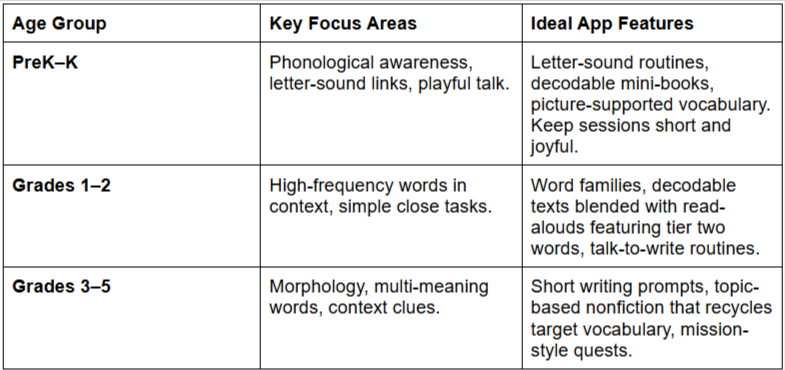
Research shows that a child's vocabulary size in kindergarten is one of the strongest predictors of reading comprehension in later grades. Therefore, matching the app's complexity to the child's developmental stage ensures they are challenged but not overwhelmed.
Which App For Kids Learn Vocabulary Is Most Effective?
An app for kids to learn vocabulary should connect listening, speaking, reading, and writing. A well-designed learning loop allows a child to hear the word in a sentence, repeat it, read it in a short text, then use it in a playful prompt. Pair words with images and examples from everyday life, and recycle them across mini-games so the terms appear in multiple contexts before moving on.
The Ideal Learning Flow
A truly effective digital learning experience follows a structured cycle that moves a word from initial exposure to active use. Here is what a successful interaction looks like:
- Encounter: Preview the word with a picture and clear audio pronunciation.
- Explore: Read a short scene or sentence where the word is used in a meaningful context.
- Check: Identify the meaning with a quick choice or matching game.
- Use: Speak the word aloud or use it in a guided sentence.
- Review: Meet the word again the next day through spaced repetition, a scientifically proven method that enhances long-term retention by reviewing material at increasing intervals.

How Do Apps For Building Vocabulary Kids Fit Into Daily Routines?
With apps for building vocabulary, kids gain the most when adults set a simple routine: 10–15 minutes, several days a week, followed by a two-minute chat about favorite new words. Encourage children to listen for those words in books, shows, and real-life moments, then celebrate when they use them naturally.
At-Home Strategies to Grow Word Knowledge
Digital tools are just one piece of the puzzle. Integrating new vocabulary into daily life solidifies learning and makes it relevant.
- Read together daily: Mix picture books, early chapters, and engaging nonfiction to expose children to rich language. Pause to notice and discuss new words.
- Talk in full sentences: Model precise language during routines. Swap common words for more specific alternatives when it feels natural (e.g., use "exhausted" instead of "tired").
- Dialogic reading: Ask open questions about characters, settings, and ideas. Invite children to explain words in their own terms. This interactive approach has been shown to significantly increase child vocabulary.
- Word of the Week: Place one word in a visible spot, like the fridge. Use it in silly and serious sentences throughout the week during meals, car rides, or bedtime stories.
- Playful practice: Do synonyms and antonyms races, category sorts, or "use it in a riddle" games.
- Revisit and recycle: Bring yesterday’s words into today’s talk. Connect them to new books or experiences.
- Connect to interests: Teach words that fit passions like sports, animals, cooking, building, or nature walks.
- Speak and write: Encourage children to use target words in a drawing caption, a thank-you note, or a short story.
- Listen and notice: Watch a show or read aloud and point out when a target word appears in real use.
- Celebrate attempts: Praise brave word choices, even if imperfect. Offer gentle corrections and try again.
- Use morphology: Explore prefixes and suffixes to unlock families of related words.
- Short app sessions together: Sit nearby, ask a quick question after play, and tie the new word to daily life.

What Makes Apps For Vocabulary Development For Kids Successful?
Effective apps for vocabulary development for kids integrate research-based techniques: spaced review, interleaved practice, explicit teaching of tier two words, morphology mini-lessons, and context-driven activities that conclude with short writing or speaking tasks.
Measuring Progress Without Pressure
Tracking a child's vocabulary growth shouldn't rely on stressful quizzes. Instead, look for these natural indicators of mastery:
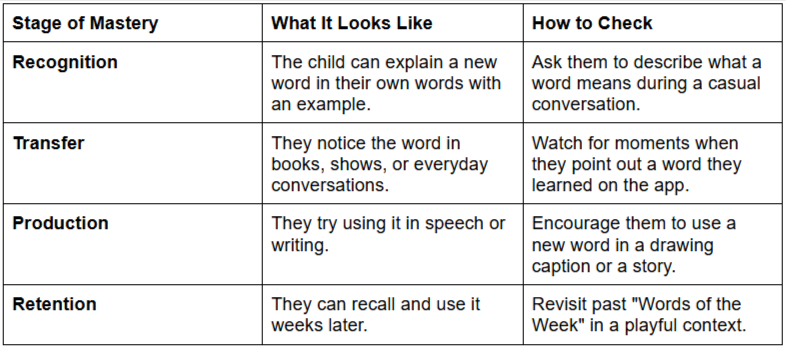
Use a simple family word log, occasional quick checks in context, and short reflection moments rather than graded tests.
Healthy Screen Habits and Safety
Integrating apps into a child's routine requires mindful management of screen time.
- Time: 10–15 minutes per session for young children; more for older kids if engaged and balanced with offline reading.
- Co-use: Sit together when possible to connect app learning with real talk.
- Privacy: Choose child-safe designs with transparent data practices and no disruptive ads.
- Balance: Pair every digital session with a few minutes of offline application.
Building a rich vocabulary is a continuous journey that happens in the quiet moments of reading a bedtime story, the lively chatter of a car ride, and the focused play of a well-designed digital game. Vocabulary grows through frequent, meaningful encounters across reading, talk, and play. With thoughtful choices, vocabulary apps for kids become one part of a well-rounded routine that helps words move from first meeting to confident use. By combining evidence-based digital tools with simple, everyday conversations, parents can foster a lifelong love of language and learning.
Frequently Asked Questions (FAQs)
What are vocabulary apps for kids and how do they help learning?
Vocabulary apps are digital tools designed to teach children new words through interactive games, stories, and phonics practice. They help learning by providing spaced repetition, visual context, and engaging activities that reinforce word meanings.
At what age should children start using vocabulary apps?
Children can start using simple, phonics-based vocabulary apps around PreK or Kindergarten (ages 4-5). The key is to keep sessions short, co-use the app with them, and ensure the content focuses on foundational letter-sound links.
How much time per day is ideal for vocabulary apps?
For young children, 10–15 minutes per session is ideal. Older elementary students can engage for slightly longer periods, provided the screen time is balanced with offline reading and physical activities.
Which features matter most in vocabulary apps for early readers?
Early readers benefit most from apps that offer clear phonics progression, decodable texts, picture supports, and pronounceable audio models to help connect sounds to letters.
How do I know if an app is aligned with reading science?
Look for apps that explicitly teach phonics, use decodable texts, incorporate morphology (prefixes/suffixes), and utilize spaced repetition for reviewing words rather than relying solely on rote memorization.
What is the difference between tier one, tier two, and tier three words?
Tier one words are basic, everyday words (e.g., dog, run). Tier two words are high-utility academic words found across many subjects (e.g., analyze, contrast). Tier three words are domain-specific and rare (e.g., isotope, peninsula).
How do phonics and vocabulary connect?
Phonics helps children decode the sounds of a word, allowing them to read it independently. Once they can read the word, they can connect it to the vocabulary knowledge they already hold in their oral language.
What role does morphology play in vocabulary growth?
Morphology is the study of word parts (roots, prefixes, suffixes). Understanding morphology helps children break down complex, unfamiliar words to determine their meaning, rapidly expanding their vocabulary.
How can I support my child if they forget new words?
Use gentle repetition. Reintroduce the word in a new context, use it in a sentence, or tie it to a recent experience. Avoid pressure and celebrate their effort when they try to recall it.
Are word games as helpful as reading for vocabulary?
Word games are excellent for retrieval practice and quick reviews, but they should complement, not replace, reading. Reading provides the deep, varied context necessary for truly understanding how a word is used.
How can I track vocabulary progress without formal tests?
Look for signs of transfer and production: Does your child notice the word in a book? Do they try using it in a sentence? Keep a casual family word log to celebrate new additions to their vocabulary.