
The surge in digital learning tools has left many families experiencing choice overload. When you search for "reading apps for kindergartners," you are immediately bombarded with hundreds of options, each promising to teach your child to read in just days. But how do you separate the marketing hype from tools that actually work? The reality is that early reading outcomes hinge on a combination of daily practice, the right kind of immediate feedback, and alignment with how the human brain actually learns to process written language.
This guide is designed to cut through the noise. Grounded in early literacy research and the science of reading, we will clarify what works, what features are non-negotiable, and how to build effective routines at home. We won't promote specific brands; instead, we will equip you with the criteria needed to evaluate any literacy app. By the end of this article, you will have a clear understanding of how to choose a phonics app for kids, realistic setup tips, and a concrete two-week starter plan to integrate digital practice with offline reading.
Tools accelerate growth only when paired with human connection. Let's explore how to make the most of that partnership.
What Are the Core Skills Kindergartners Need to Learn to Read?
To evaluate a reading app for kindergarten, we first need to understand the literacy blueprint. The science of reading, a vast body of interdisciplinary research spanning decades, has identified five core pillars of early literacy development. These components must be systematically developed for a child to become a fluent reader.
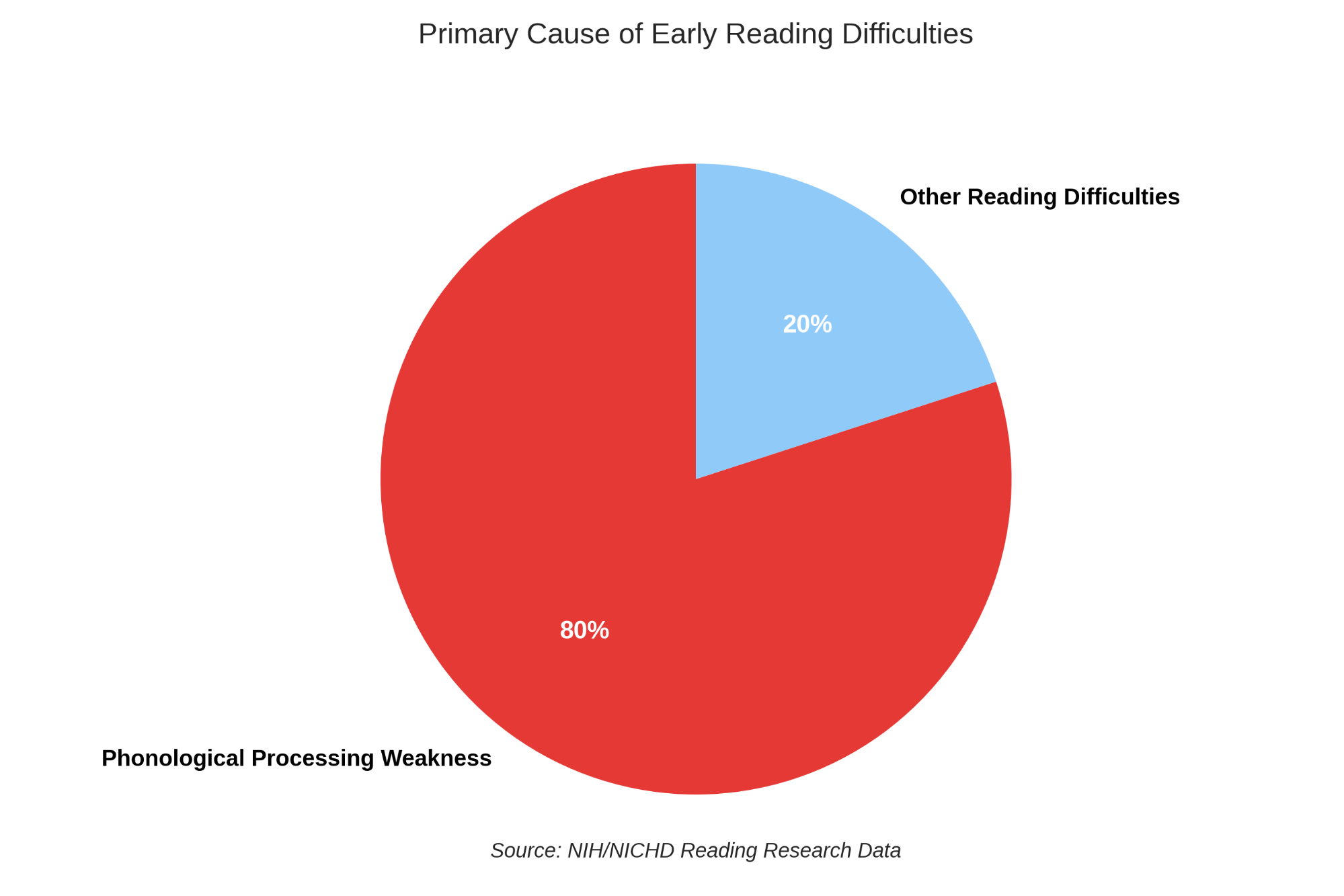
Phonological and Phonemic Awareness: This is the ability to hear, identify, and manipulate individual sounds (phonemes) in spoken words. Research from the National Institutes of Health indicates that at least 80% of all poor readers demonstrate a weakness in phonological awareness or memory. Before a child can understand that the letter "B" makes the /b/ sound, they must be able to isolate that sound in the spoken word "bat."
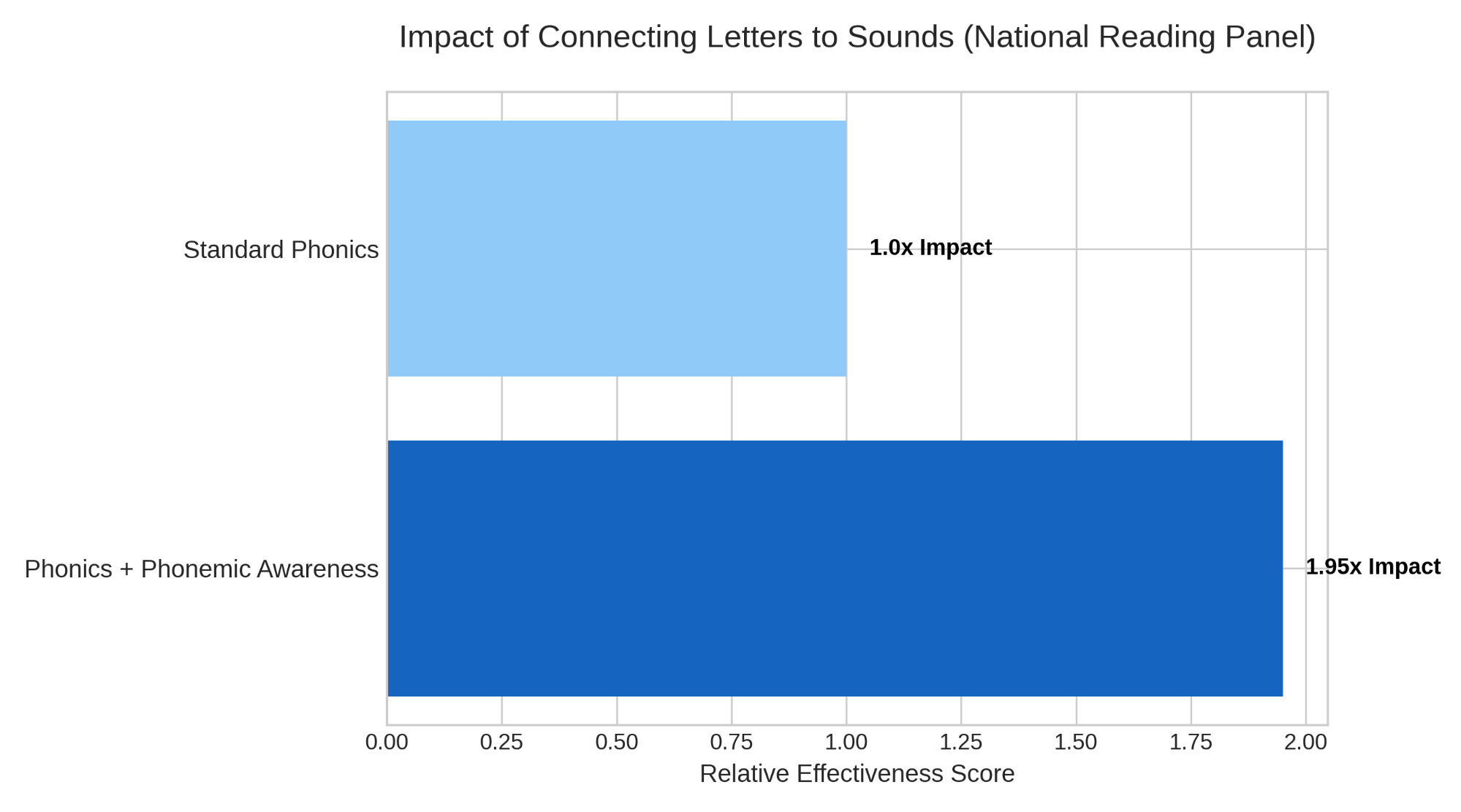
Phonics and Word Recognition: Phonics is the process of mapping those spoken sounds to written letters and letter combinations. This involves decoding (sounding out words) and learning high-frequency words that don't follow standard phonetic rules. The National Reading Panel found that phonemic awareness instruction is almost twice as effective when directly connected to letters.
Reading Fluency: Fluency is the ability to read text accurately, at an appropriate pace, and with proper expression. According to the Hasbrouck & Tindal 2017 Fluency Norms, a kindergarten student transitioning into first grade should aim for around 29 words correct per minute by the middle of first grade to stay on track.
Vocabulary and Oral Language: A child's reading comprehension can only go as high as their spoken vocabulary allows. Talking, listening, and being read to are the foundational activities that build this linguistic database.
Comprehension: The ultimate goal of reading is making meaning. For kindergartners, this often involves picture support, listening comprehension, and answering simple questions about short texts.
While reading apps for kindergartners can provide excellent targeted practice in phonics and decoding, adult interaction remains essential for deep vocabulary building and complex comprehension.
How Do I Identify the Right Features in Reading Apps for Kindergartners?
Once you understand the literacy blueprint, you must translate those needs into concrete, observable app features. A high-quality early reading app should act as a digital tutor, providing systematic instruction rather than just random games.
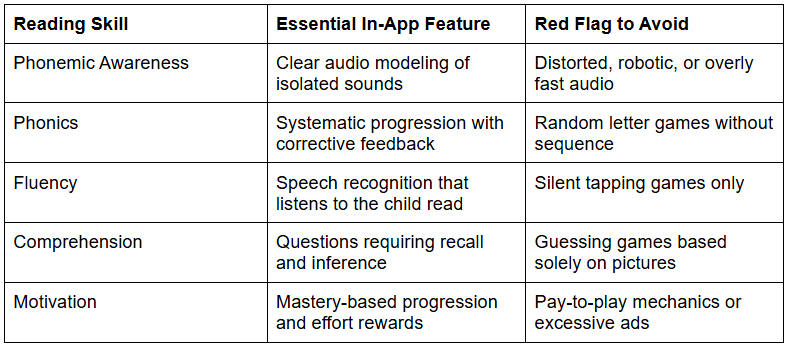
When evaluating an app, look for decodable texts that align strictly with a letter-sound progression. If an app introduces the "sh" sound, the accompanying stories should heavily feature that digraph without throwing in advanced vowel teams the child hasn't learned yet. Built-in phonemic awareness practice with clear, human-voice audio modeling is also critical; robotic or distorted audio can confuse young learners.
Furthermore, look for systematic phonics instruction with cumulative review. The app should provide immediate, corrective feedback when a child makes a mistake, rather than just buzzing a wrong answer. Oral reading features with speech recognition technology are becoming the gold standard, as they can flag miscues and provide gentle coaching prompts in real-time.
Feature Evaluation Checklist
A kindergarten reading app should include:
- Decodable texts matched to specific phonics skills
- Speech recognition for oral reading feedback
- Spaced review for high-frequency sight words
- Picture-supported comprehension questions
- "Read-to-me" options with text highlighting for print tracking
- Short, focused session designs (10-15 minutes)
- Offline availability and an ad-free environment
Why Does Child-Centered Design Matter for Early Literacy Apps?
The best instructional content in the world is useless if a five-year-old cannot navigate the interface. Child-centered design and accessibility are crucial components of effective reading apps for kindergartners.
Young children have developing fine motor skills, meaning apps require simple navigation, clear visual cues, and large touch targets. An app should not require complex swiping or multi-finger gestures. Furthermore, the environment must be error-tolerant; if a child accidentally taps the wrong area, they shouldn't lose all their progress or get trapped in a confusing menu.
Accessibility features make an app inclusive for diverse learners. Look for dyslexia-friendly fonts, adjustable text sizes, and high color contrast. For neurodiverse learners, audio scaffolds and clear, predictable reward feedback loops help maintain focus. Bilingual audio scaffolds are incredibly valuable for multilingual families, allowing instructions to be delivered in the home language while the child practices English reading skills.
Finally, privacy and child-safety standards are non-negotiable. The app must provide an ad-free environment to maintain focus and protect data. Parents should have access to transparent data policies and robust parental controls.
How Can I Build a Daily Routine That Motivates My Kindergartner?
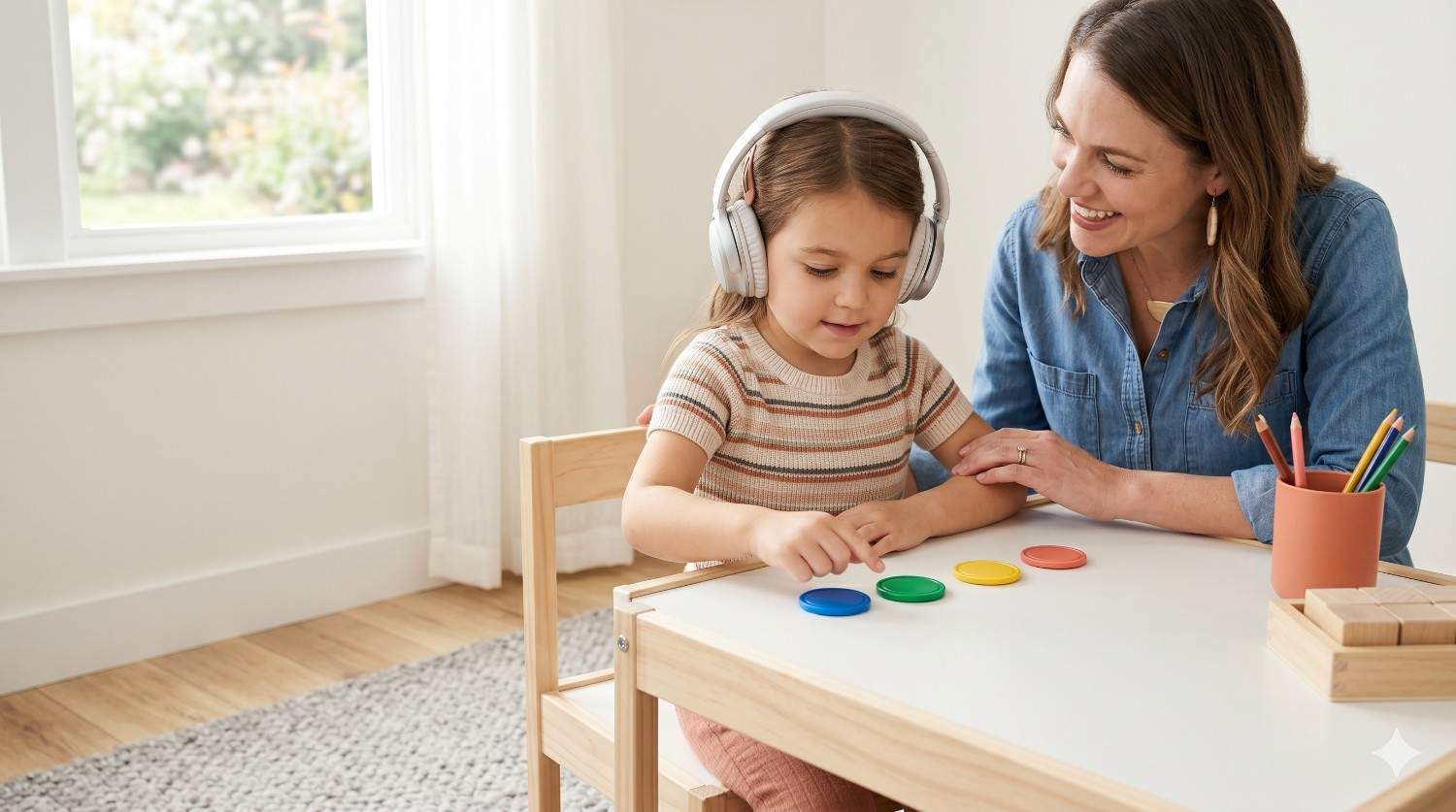
Shifting from "what to buy" to "how to use it" is where the real literacy growth happens. Consistency is far more important than marathon sessions. Setting a predictable 10–15 minute daily window tied to existing routines, such as right after an after-school snack or before the evening bath, builds a sustainable habit.
Motivation should stem from mastery-based goals rather than just accumulating points. Celebrate the effort and the strategies the child uses, such as successfully sounding out a difficult word, rather than just the final score. Involve your child in tracking their own streaks or milestones using a simple physical sticker chart on the refrigerator; this bridges the digital achievement with tangible, real-world pride.
For neurodiverse learners, you may need to adjust the routine. Shorter segments (e.g., two 7-minute sessions), movement breaks between activities, and visual schedules can significantly reduce frustration and cognitive overload.
Always pair app time with adult read-alouds. While the app handles the mechanics of decoding, sitting together with a rich, complex storybook builds the vocabulary and background knowledge that the app cannot provide.
How Do I Blend App Practice With Offline Reading Routines?
A holistic approach to early literacy requires connecting on-screen learning with real books and language-rich activities. The app is a tool, not the entirety of the reading program.
Daily Adult Read-Alouds: Engage in dialogic questioning during read-alouds. Don't just read the words; ask "What do you think will happen next?" or "Why did the character do that?" This grows vocabulary and comprehension far beyond the child's current independent reading level.
Decodable Book Practice: Provide physical decodable book sets that mirror the letter-sound patterns your child is practicing in the app. If the app is teaching short 'a' sounds, hand them a physical book about a "cat on a mat." The tactile experience of turning pages and tracking print with a finger is vital.
Playful Word Work: Take the skills offline. Use magnetic letters on the fridge to build words they learned in the app. Play rhyming and segmenting games in the car ("I spy something that starts with the /t/ sound").
Library Visits: Regular library visits nurture intrinsic motivation. Let them choose books purely for interest, even if the books are too hard for them to read independently. You can read these together, fostering a love for stories that the mechanics of an app cannot replicate.
What Are the Best Practices for Screen Time and Safety?
Managing screen time is a primary concern for parents utilizing digital learning tools. For kindergarten-age children, the American Academy of Pediatrics generally recommends limiting high-quality programming to 1 hour per day, co-viewed with an adult. For a focused reading app, a session length of 10 to 15 minutes per day is optimal. This is long enough to provide meaningful practice but short enough to prevent eye strain and cognitive fatigue.
Device setup is crucial for success. Use Guided Access or App Pinning (Android) to lock the device to the reading app, preventing the child from wandering into YouTube or other games. Turn off all notifications to create a distraction-free digital space.
When considering equity and access, look for apps that offer an offline mode or downloadable content. This is essential for families with limited or inconsistent internet bandwidth, ensuring the daily routine isn't interrupted by connectivity issues.
What Are the Long-Term Benefits of Early Reading Intervention?
Understanding the trajectory of reading development is crucial for parents and educators. The "Matthew Effect" in reading, a term coined by cognitive scientist Keith Stanovich, describes how early success in reading leads to exponentially greater success later on, while early struggles often compound into larger deficits. In simple terms, "the rich get richer, and the poor get poorer" when it comes to vocabulary and reading comprehension.
When kindergartners use evidence-based reading apps to solidify their phonological awareness and phonics skills, they aren't just learning to read a few words; they are fundamentally altering their academic trajectory. Children who leave first grade as fluent readers read more independently, encounter more complex vocabulary, and build broader background knowledge about the world. This background knowledge becomes the foundation for advanced reading comprehension in third grade and beyond, when the curriculum shifts from "learning to read" to "reading to learn."
Conversely, children who struggle with early decoding often find reading frustrating and avoid it. This avoidance means they encounter fewer words and learn less about the world, making future comprehension tasks even more difficult. High-quality reading apps for kindergartners intervene at this critical juncture. By providing engaging, systematic, and bite-sized practice, these tools help prevent the avoidance cycle. They offer a safe, low-stakes environment where making a mistake simply prompts a gentle correction rather than public embarrassment in a classroom setting.
Furthermore, the data generated by these apps can be a powerful advocacy tool for parents. If a child is consistently participating in their 15-minute daily routine but the app's dashboard shows no progress in letter-sound correspondence over several weeks, parents have concrete data to present to the school. Early intervention, before third grade, is significantly more effective than remediation later in a child's academic career. Therefore, a reading app serves not only as an instructional tool but as an early warning system for potential learning disabilities like dyslexia.
How Does the Science of Reading Compare to Balanced Literacy?
To fully appreciate why certain features in reading apps for kindergartners are essential, it's helpful to understand the broader educational context. For decades, a debate known as the "Reading Wars" has dominated educational policy. On one side is the Science of Reading and on the other is Balanced Literacy.
Balanced Literacy programs traditionally emphasized exposing children to rich literature and teaching them to use "three-cueing" strategies to figure out unknown words. If a child didn't know a word, they were taught to look at the picture (meaning cue), think about what makes sense in the sentence (syntax cue), and look at the first letter (visual cue). While this approach fosters a love of books, research has overwhelmingly shown that guessing words based on pictures is what poor readers do, not what skilled readers do.
The Science of Reading, supported by cognitive neuroscience and brain imaging, proves that reading is not a natural process like learning to speak. The brain must be explicitly taught to map spoken sounds to written symbols. Skilled readers process every single letter in a word almost instantaneously; they do not guess based on context.
When choosing a kindergarten reading app, you are essentially choosing which philosophy you want to reinforce at home. Apps that rely heavily on picture-guessing games or predictable texts ("I see the dog. I see the cat.") align with outdated Balanced Literacy models. In contrast, apps that utilize decodable texts and require the child to sound out words from left to right align with the Science of Reading. By selecting SoR-aligned apps, parents ensure their home routines support the most effective, research-backed instructional methods available.
Addressing Common Myths About Screen Time and Early Literacy
The conversation around reading apps for kindergartners inevitably intersects with concerns about screen time. It is vital to differentiate between passive screen time (like watching cartoons) and active, educational screen time.
Myth 1: All screen time is detrimental to young brains.
Reality: While excessive, passive screen consumption is linked to attention and behavioral issues, interactive media designed with educational intent can have positive effects. The key is the "active" component. When a reading app requires a child to listen to a sound, select the corresponding letter, and speak the word aloud, they are engaging multiple neural pathways. This active engagement builds cognitive networks in a way that passive viewing does not.
Myth 2: Digital reading replaces the need for physical books.
Reality: Digital tools and physical books serve different, complementary purposes. Reading apps are exceptional at providing systematic, repetitive practice with immediate feedback, the "drill and skill" necessary for decoding automaticity. However, physical books are superior for building attention span, spatial awareness of text, and deep comprehension through shared reading experiences. The most effective literacy environments utilize both.
Myth 3: Apps can teach a child to read independently.
Reality: No app can fully replace the nuanced, responsive teaching of a human adult. An app cannot answer a child's spontaneous question about why a character is sad, nor can it connect a story's theme to the child's real-life experiences. Apps are powerful supplemental tools, but they require adult facilitation, setting the routine, reviewing the data, and bridging the digital skills to real-world reading, to reach their full potential.
By understanding these nuances, families can confidently integrate high-quality reading apps into their daily lives without guilt, knowing they are providing a targeted, effective boost to their kindergartner's literacy journey.
Conclusion
The successful use of reading apps for kindergartners doesn't come from finding a magical, perfect piece of software. It comes from aligning the app's features with the science of reading, setting consistent and healthy routines, and tracking progress thoughtfully. When you choose an app that offers systematic phonics, speech recognition, and decodable texts, you provide your child with a powerful digital tutor.
However, always remember the most critical insight: educational tools only accelerate growth when they are paired with human connection. The conversations you have, the books you read aloud together, and the encouragement you provide are the true engines of your child's literacy journey.
Frequently Asked Questions (FAQ): Best Reading Apps for Kindergartners
Are reading apps for kindergartners effective?
Yes, when they align with the science of reading. Apps that provide systematic phonics instruction, phonemic awareness practice, and immediate corrective feedback can significantly improve early literacy skills, especially when used consistently for 10-15 minutes a day alongside adult support.
How many minutes per day should my child use a reading app?
For kindergartners, the sweet spot is 10 to 15 minutes of focused daily practice. This duration is long enough to reinforce skills through repetition but short enough to prevent frustration, cognitive fatigue, and excessive screen time.
What is the difference between decodable texts and leveled readers?
Decodable texts use only the specific letter-sound combinations a child has been explicitly taught, forcing them to sound out words. Leveled readers often use predictable sentence patterns and picture cues, which can inadvertently encourage children to guess words rather than read them.
How do I know if the app's phonics sequence matches what my child learns at school?
Check the app's parent dashboard or website for a "Scope and Sequence" document. You can share this with your child's kindergarten teacher to ensure the app is reinforcing, rather than conflicting with, the classroom curriculum.
What if my child guesses at words and resists sounding out?
Gently prompt them to look at the letters, not just the pictures. Say, "Let's slide our finger under the sounds," or use the app's text-highlighting feature. Choose apps that use decodable texts, which naturally discourage guessing by removing predictable patterns.
How can multilingual families use reading apps effectively?
Look for apps that offer bilingual audio scaffolds, allowing instructions to be heard in the home language while the child practices English text. Continue reading aloud in your home language, as strong native language comprehension transfers directly to English reading skills.
When should I seek extra help if reading progress stalls?
If your child consistently struggles with basic phonemic awareness (like identifying the first sound in a word) after weeks of practice, or if the app's data shows no progression in decoding accuracy, print the dashboard reports and schedule a meeting with their teacher or a reading specialist.