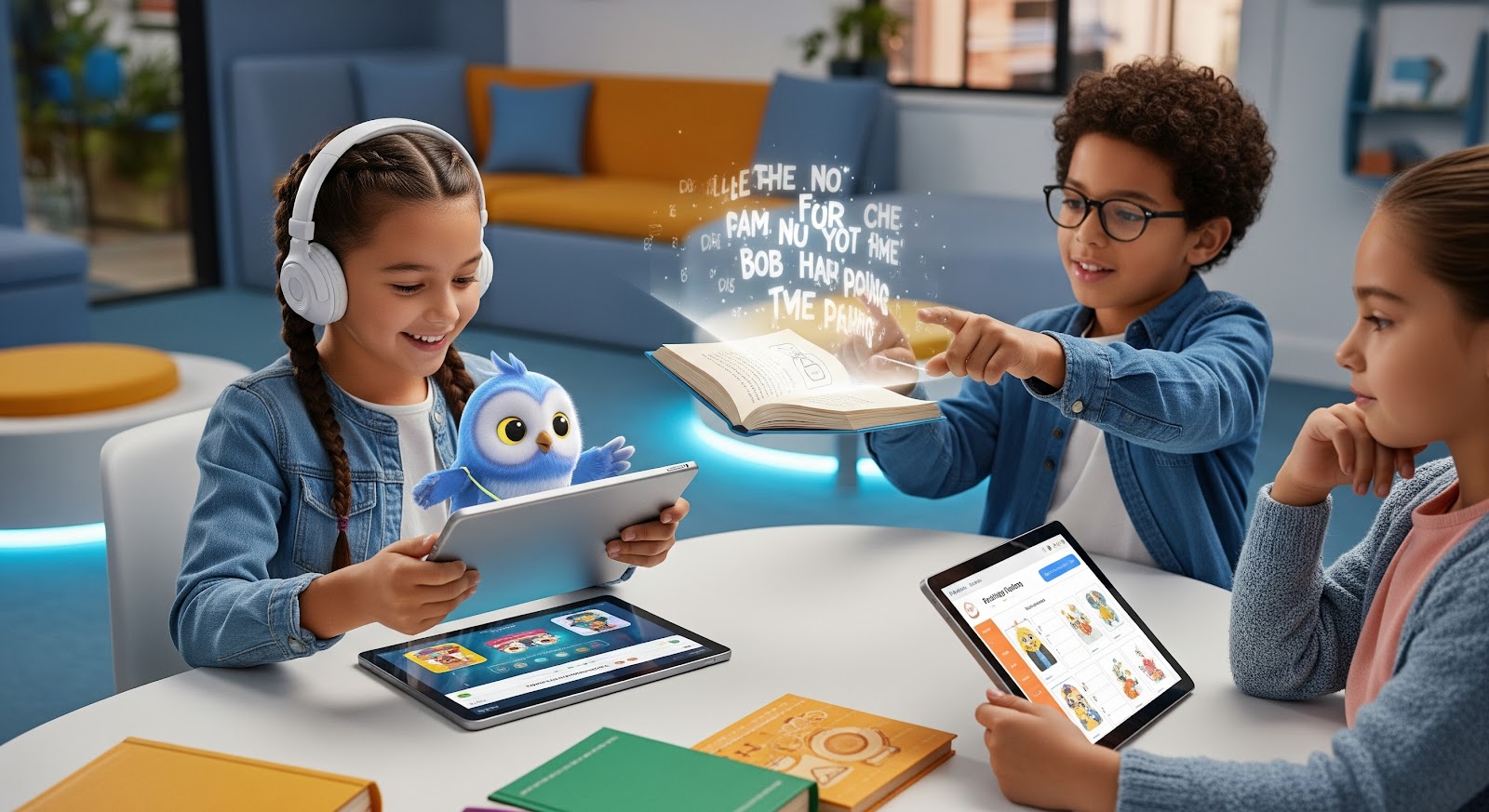
Across classrooms and living rooms alike, a quiet revolution is reshaping how children learn to read. Traditional approaches to literacy instruction, while foundational, are no longer enough to meet the evolving needs of today’s diverse learners. The rise of digital tools, remote learning, and increasingly data-driven education systems has prompted educators and parents to ask: How can we provide effective, individualized reading support at scale?
Enter the AI-powered reading program, a breakthrough innovation that brings the power of real-time feedback, adaptive instruction, and personalized learning into every child’s hands.Unlike static reading apps or generalized curriculum tools, AI-powered reading programs use advanced speech recognition and machine learning to listen as a child reads aloud, detect mispronunciations, track fluency, and provide immediate, tailored support. These programs respond like a one-on-one tutor, guiding students through text at their own pace while offering encouragement and correction when needed.
For parents, these tools offer visibility into their child’s progress that was previously only available through formal testing or teacher reports. For teachers, they serve as a powerful supplement, offering actionable data, supporting differentiated instruction, and freeing up valuable time for targeted intervention. But perhaps most importantly, these tools are being built not in isolation, but in alignment with the Science of Reading, a body of research that clearly defines what effective reading instruction looks like. When thoughtfully designed, AI-powered reading programs don’t just make reading more engaging, they reinforce the very skills proven to help children succeed: phonemic awareness, phonics, fluency, vocabulary, and comprehension.
What Is the Science of Reading?
The term Science of Reading refers to a vast, interdisciplinary body of research that spans cognitive psychology, neuroscience, education, and linguistics. It is not a single program or trend, but rather a research-backed framework that outlines how children learn to read, and which instructional strategies are proven to work best across diverse populations.
Two landmark sources guide this approach:
- The National Reading Panel Report (2000), commissioned by the U.S. Congress, which synthesized decades of reading research to identify the most effective components of reading instruction.
- The National Center on Improving Literacy and its work disseminating the Science of Reading principles to educators and policymakers through ImprovingLiteracy.org.
Together, these sources define five essential components of reading development, often called the “Five Pillars of Reading”:
1. Phonemic Awareness
This is the ability to hear, identify, and manipulate individual sounds, phonemes, in spoken words. It’s an auditory skill, not about letters, but about sounds. For example, being able to separate the word cat into /k/ /a/ /t/, or blend those sounds to form the word, is foundational to becoming a reader.
2. Phonics
Phonics connects those sounds (phonemes) to written letters (graphemes). It teaches children how letters and combinations of letters represent sounds in written language. Mastery of phonics allows children to decode unfamiliar words, an essential skill for fluent reading.
3. Fluency
Fluency is the ability to read with accuracy, appropriate speed, and expression. Fluent readers don’t just read quickly, they read in a way that reflects understanding. Fluency is a bridge between decoding and comprehension, and it requires practice and feedback to develop.
4. Vocabulary
A robust vocabulary is key to understanding what is read. The more words a child knows, the more meaning they can extract from a text. Vocabulary development happens through reading, conversation, and explicit instruction, and it's especially critical for English Language Learners and students with limited exposure to rich language environments.
5. Comprehension
Comprehension is the ultimate goal of reading, understanding, interpreting, and engaging with text. It involves making inferences, identifying main ideas, summarizing, and connecting prior knowledge. Strong comprehension instruction involves both direct questioning and scaffolded thinking strategies.
A Structured Approach: Explicit, Systematic, and Multisensory Instruction
The Science of Reading is not just about what to teach, it also emphasizes how to teach it.
- Explicit instruction means skills are taught directly, not left for students to infer.
- Systematic instruction means skills are introduced in a carefully planned sequence, building from simple to complex.
- Multisensory instruction engages visual, auditory, and kinesthetic learning modalities to reinforce retention, especially effective for students with dyslexia, ADHD, and other learning differences.
This structured approach is critical because reading is not a natural process, it must be taught. Children do not simply "pick it up" by being read to or surrounded by books, though those practices are valuable. The Science of Reading helps ensure that no child is left behind due to ineffective instruction.
In short, the Science of Reading provides a roadmap for literacy success, and when AI-powered tools like Readability align with this science, they can significantly accelerate student progress, especially for those who need it most.
The Rise of AI-Powered Reading Programs
In the last decade, artificial intelligence has made powerful inroads into education, bringing personalization, automation, and real-time feedback to a field long constrained by time, staffing, and instructional variability. Nowhere is this transformation more evident than in the emergence of AI-powered reading programs, which are helping to close long-standing gaps in literacy instruction.But what exactly is an AI-powered reading program, and how does it work?
At its core, an AI-powered reading program leverages machine learning, speech recognition, and natural language processing to support and accelerate the process of learning to read. Unlike traditional apps that simply display books or quiz comprehension after silent reading, these platforms engage with the learner dynamically, responding to how a child reads out loud, moment by moment.
Here’s what today’s leading AI reading programs can do:
Speech Recognition
AI listens as the child reads aloud, identifying pronunciation errors, hesitations, and skipped or repeated words. This allows the program to serve as a virtual tutor, delivering in-the-moment feedback similar to what a skilled teacher might offer during guided reading.
Real-Time Fluency Feedback
The program tracks key metrics such as words correct per minute, reading accuracy, and reading pace. These metrics are analyzed in real-time and overtime to map growth in fluency, a core skill that bridges decoding and comprehension.
Comprehension Assessment
After reading a passage or book, the AI engages the student with spoken comprehension questions, which they answer verbally. The system evaluates their responses to measure understanding, inferencing skills, and recall, giving students immediate feedback and teachers actionable insights.
Adaptive Content Delivery
Perhaps most powerfully, AI reading programs automatically adjust reading level and content complexity based on the student’s performance. This adaptive learning path ensures that children are always reading material that’s appropriate, challenging but not frustrating, which is key to maintaining engagement and growth.
Readability also aligns tightly with the Science of Reading, ensuring that every interaction supports research-backed instruction in phonemic awareness, phonics, fluency, vocabulary, and comprehension.
Key Benefits of AI-Powered Reading Programs
These platforms bring critical advantages that traditional literacy tools, and even one-on-one instruction, often struggle to match:
Scalability
AI tools provide consistent, high-quality reading support to thousands of students simultaneously, regardless of teacher availability or class size. For schools with staffing shortages or limited access to specialists, this is a game-changer.
Individualized Learning Paths
Each child progresses on their own path, with content and support matched to their unique reading level and learning pace. No two students receive the same experience, yet all are guided by the same instructional framework.
Data Visibility for Parents and Teachers
Built-in dashboards track student progress over time, across fluency, comprehension, vocabulary, and time on task. This empowers parents and educators with real-time insights into what’s working, what’s not, and how to intervene early when needed.
In an era where literacy challenges are complex and widespread, AI-powered reading programs offer a scalable, equitable, and evidence-based solution, especially when grounded in the Science of Reading and designed with all learners in mind.
Why AI Works: The Cognitive Learning Connection
While artificial intelligence may seem like a technological leap, the most effective AI-powered reading programs are deeply rooted in proven learning science, specifically cognitive learning theory. These programs are not just “smart” because they process data; they’re effective because they reflect how children actually learn best.
One of the most impactful strategies embedded into tools like Readability is the cognitive framework known as “I Do, We Do, You Do”, a scaffolded learning model that gradually shifts responsibility from teacher to student. This method is especially effective for English Language Learners, neurodivergent students, and struggling readers because it mirrors how humans internalize new skills through guided practice and gradual release.
Scaffolded Learning: “I Do, We Do, You Do”
- I Do: The program models fluent reading and pronunciation through audio prompts and highlighted text.
- We Do: The student reads with support, AI steps in to help decode difficult words, corrects errors gently, and provides encouragement.
- You Do: Once confident, the child reads independently, applying what they’ve learned with minimal intervention.
This gradual shift fosters autonomy, a critical factor in building lifelong readers. It also helps reduce the cognitive overload that often discourages struggling readers.
Repetition + Immediate Feedback = Long-Term Learning
AI excels at delivering two key elements often difficult to achieve consistently in traditional instruction: timely repetition and immediate feedback.
- Repetition helps transfer information from short-term to long-term memory, reinforcing decoding patterns, vocabulary, and fluency over time.
- Immediate feedback prevents the formation of bad habits. When a child mispronounces a word, the AI responds instantly, prompting correction, modeling the correct pronunciation, and inviting another attempt.
This loop of practice–feedback–retry is not only efficient but crucial for young readers still developing their decoding and comprehension skills.
Confidence Without Judgment
AI-powered programs like Readability offer non-judgmental support, a significant benefit for children who feel anxious about reading aloud in front of others. The private, supportive nature of AI feedback helps reduce reading-related shame and frustration, particularly among:
- ELL students grappling with pronunciation
- Students with speech disorders or apraxia
- Children with dyslexia or attention-based challenges
Instead of feeling “behind,” children begin to associate reading with success, progress, and pride, key ingredients for intrinsic motivation. By aligning with cognitive learning theory, AI-powered reading programs do more than track reading, they teach. And when designed intentionally, they provide learners with the repetition, feedback, and emotional safety they need to thrive.
Choosing the Right AI-Powered Reading Program
With the surge of AI-driven tools in education, it can be overwhelming for parents, educators, and school administrators to know which programs truly support student learning, and which simply sound innovative. Choosing the right AI-powered reading program means looking beyond the buzzwords and ensuring the technology aligns with proven instructional frameworks, specifically, the Science of Reading.
The best AI-powered reading platforms don’t just assess a child’s abilities; they teach, support, and adapt to individual learning needs. Whether you're selecting a tool for home, a classroom, or an entire district, use this checklist to evaluate whether a program meets the highest standards for effective, inclusive literacy instruction.
Essential Features of an AI-Powered Reading Program (Aligned with the Science of Reading)
Real-Time Speech Feedback
- The program must include advanced speech recognition that listens as students read aloud.
- Look for tools that provide instant correction and modeling of mispronounced or skipped words.
- This supports phonemic awareness, phonics, and fluency by helping students hear and adjust their reading in the moment, just like they would with a live reading coach.
Comprehension Checks
- Effective AI programs don’t stop at fluency, they must assess and support reading comprehension.
- Look for features that include spoken comprehension questions and the ability for students to answer verbally.
- Strong platforms will track comprehension data over time and adapt instruction accordingly.
Adaptive Text Leveling
- The tool should dynamically adjust reading content based on the child’s current level and progress.
- This supports students across the reading spectrum, from emergent readers to advanced learners, without needing manual adjustments.
- Adaptive text ensures that every child is reading material that’s challenging but achievable, which is critical for growth and engagement.
Inclusive Design
- A high-quality AI-powered reading program should be built with diverse learners in mind, including:
- English Language Learners
- Students with dyslexia
- Children with ADHD or autism
- Speech and language delays
- Features like font customization, accent detection, clear audio modeling, and emotionally safe feedback are crucial.
- Look for tools that promote confidence, not just accuracy.
Why Readability Stands Out
Among all available options, Readability consistently rises to the top as the most comprehensive, instruction-first AI reading platform on the market. Unlike assessment-focused tools such as Amira Learning, which center on measuring performance, Readability delivers daily, guided practice across all five pillars of the Science of Reading: phonemic awareness, phonics, fluency, vocabulary, and comprehension.
What makes Readability unique:
- Built-in speech recognition that understands diverse speech patterns, including those of children with speech apraxia.
- Adaptive content library with thousands of age-appropriate books that adjust as a student progresses.
- Voice-based comprehension assessments that foster active thinking and verbal expression.
- Real-time dashboards for parents and teachers to monitor fluency, accuracy, comprehension, and time spent reading.
- Inclusive features that support learners with dyslexia, ADHD, autism, and ELL backgrounds, ensuring equitable access for all.
Backed by compelling research and real-world case studies, Readability has helped students read over 3.3 million books, improve fluency by an average of 74%, and gain confidence that transforms their learning trajectory.
In today’s educational landscape, the right AI-powered reading program isn’t just helpful, it’s essential. By choosing a platform rooted in the Science of Reading and designed for all learners, families and schools can ensure that every child gets the personalized, effective reading support they deserve.