
Orthographic mapping is the mental process that bonds a word's sounds (phonemes) to its spellings (graphemes) so that words become instantly recognizable. It is the engine that drives automatic word recognition, allowing readers to store words permanently in long-term memory. When educators, literacy leaders, tutors, and families understand orthographic mapping, they can provide research-aligned guidance that transforms how students learn to read.
Orthographic mapping is the cognitive process by which readers permanently bond the sounds of a word to its spelling, enabling instant, effortless word recognition.
At ReadabilityTutor, we recognize that true reading fluency goes beyond simply sounding out words. It requires a seamless transition from decoding to automaticity. This article explores the science behind orthographic mapping, how it works in the brain, the conditions that support it, and practical examples to guide instruction.
How Does Orthographic Mapping Bond Sounds to Spellings for Automatic Word Recognition?
Orthographic mapping is the cognitive mechanism that allows readers to store words for instant retrieval. It is not a teaching strategy, but rather the mental process that occurs when the brain maps the sounds in a spoken word to the graphemes that represent those sounds in print.
The Goal: Automatic Word Recognition
The ultimate goal of orthographic mapping is automatic word recognition. When a word is successfully mapped, it is read "by sight" without the need for guessing or sounding out each letter. This efficiency frees up cognitive capacity for comprehension, allowing the reader to focus on the meaning of the text rather than the mechanics of decoding.
Memory Systems Involved
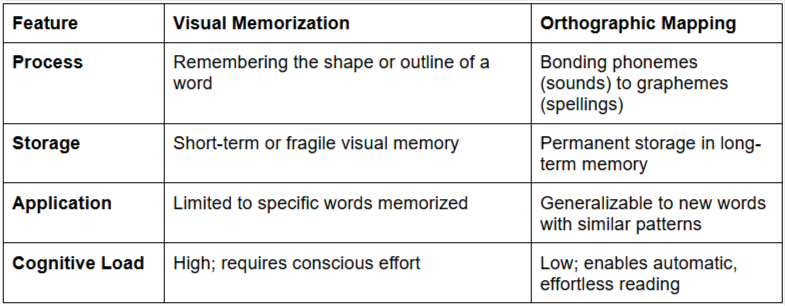
Orthographic mapping integrates phonological memory and orthographic memory into long-term storage. According to Charles Perfetti's dimensions of word knowledge, the more a reader knows about a word, its sounds, letters, meaning, and morphology, the faster the brain can retrieve it. This process contrasts sharply with rote visual memorization. Readers are not simply memorizing the shape of a word; they are actively mapping phoneme-grapheme relationships.
Research by leading experts, such as Linnea Ehri, David Share, and Charles Perfetti, underscores the importance of these connections. Ehri, who coined the term "orthographic mapping" in 2014, emphasizes that proficient readers process every letter and sound, rather than relying on context or whole-word shapes.
Table 1: Memorization vs. Orthographic Mapping
What Are the Cognitive Steps in How Orthographic Mapping Works in the Brain?
Understanding how orthographic mapping works requires looking at the cognitive steps involved. The process involves hearing and segmenting phonemes, aligning them with graphemes, blending them together, and consolidating the word into orthographic memory through successful decoding and repetition.
From First Correct Decoding to Secure Storage
The journey begins with accurate decoding. Each time a reader accurately decodes and writes a word, the bond between the sounds and spellings strengthens. With repeated exposure and practice, the word is consolidated into memory, leading to instant recognition. For example, when mapping the word ship, the reader hears the sounds /ʃ/ /ɪ/ /p/ and maps the digraph sh to the phoneme /ʃ/.
Conditions That Support Mapping
Several conditions must be met for orthographic mapping to occur successfully:
- Strong Phonemic Proficiency: The ability to identify and manipulate individual sounds in spoken words.
- Reliable Phonics Knowledge: Understanding the relationships between letters and sounds.
- Sufficient Review: Repeated practice and exposure to secure the word in memory.
Stanislas Dehaene's neuroscience of reading highlights how different parts of the brain collaborate in this process. The visual cortex perceives letters, the phonological cortex maps sounds to letters, the semantic cortex stores meanings, and the syntactic cortex processes sentence structure. When a word is stored across these systems, it becomes permanently anchored in long-term memory.
How Is Orthographic Mapping Different from Phonics and Phonemic Awareness?
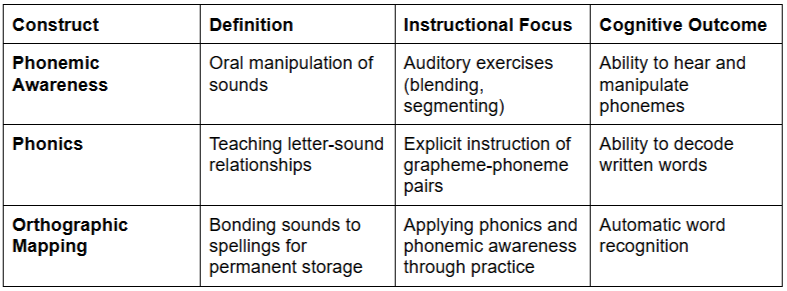
To fully grasp orthographic mapping, it is essential to distinguish it from phonics and phonemic awareness, as these three constructs interact closely but serve different roles.
Phonemic Awareness
Phonemic awareness is the oral ability to identify, segment, blend, and manipulate individual sounds (phonemes) in spoken words. It is an auditory skill that does not involve written letters. Strong phonemic awareness is a critical prerequisite for orthographic mapping.
Phonics
Phonics is the explicit teaching of letter-sound correspondences and spelling patterns. It involves linking spoken sounds to written symbols (graphemes). Phonics instruction provides the tools needed to decode words.
Orthographic Mapping
Orthographic mapping is the cognitive outcome of applying phonemic awareness and phonics. It is the process that permanently stores words in memory after they have been decoded using phonics skills.
Table 2: Comparing Phonemic Awareness, Phonics, and Orthographic Mapping
What Are the Phases from Decoding to Automaticity in Word Recognition?
The progression from slowly sounding out words to instant recognition aligns with developmental phases identified in reading research, particularly Linnea Ehri's phases of word reading.
Early Reliance on Decoding
In the early stages, readers rely heavily on decoding. Accurate decoding lays the groundwork for mapping. During the partial alphabetic phase, children may pay attention to the first letter and guess the rest. As they move to the full alphabetic phase, blending, segmenting, and letter-sound knowledge allow for true mapping.
Consolidation and Automatic Recognition
With consistent practice, readers enter the consolidated phase, where they store and recognize familiar spelling patterns. Eventually, they reach the automatic phase, decoding words effortlessly and freeing up cognitive resources for comprehension.
Worked Examples of Mapping
Here is how different types of words are mapped:
- stop: /s/ /t/ /ɒ/ /p/ (Each letter maps to a single sound)
- light: /l/ /aɪ/ /t/ (The trigraph igh maps to the long /i/ sound)
- jump: /dʒ/ /ʌ/ /m/ /p/ (Blend + inflection)
- was: /w/ /ɒ/ /z/ (Partly irregular; the a and s make unexpected sounds)
How a Word Becomes Mapped:
- Segment the phonemes in the spoken word.
- Align the phonemes with the corresponding graphemes.
- Blend the sounds to read the word.
- Engage in repeated accurate reading and writing to consolidate storage.

What Instructional Practices Support Orthographic Mapping in the Classroom?
Instruction that supports orthographic mapping focuses on building the foundational skills it depends on: phonemic proficiency, systematic phonics, and applied routines.
Build Phonemic Proficiency
Daily practice in segmenting and blending sounds is crucial. Activities should include phoneme manipulation and linking sounds to letters during practice. This strengthens the auditory foundation needed for mapping.
Systematic Phonics and Cumulative Review
Explicitly introduce letter-sound correspondences, digraphs, blends, and syllable types. Cumulative review ensures that previously taught patterns are reinforced, providing the repetition necessary for consolidation.
Applied Routines
Incorporate phoneme-grapheme mapping activities, word building, dictation, and the use of decodable texts. Emphasize the reciprocity of reading and writing; encoding (spelling) supports decoding (reading). A quick 5-minute mapping warm-up can effectively prime students for reading tasks.
How Do Readers Use Orthographic Mapping to Learn High-Frequency and Irregular Words?
A common misconception is that "sight words" or irregular words must be memorized visually. In reality, these words are learned via orthographic mapping, even when parts of them are irregular.
Regular vs. Irregular Elements
When teaching irregular words, it is important to identify both the expected (regular) grapheme-phoneme parts and the unexpected (irregular) parts. Most irregular words have only one or two letters that do not follow typical patterns.
Mapping a Word Like "Said" or "Was"
Take the word said. The s and d are regular, mapping to /s/ and /d/. The tricky part is the ai, which maps to the short /e/ sound. By highlighting the stable letters and explicitly teaching the irregular part, readers can anchor the word in memory. This approach is far more effective than rote visual memorization.
What Are the Signs of Weak Orthographic Mapping and How Can We Address Them?
Recognizing indicators of mapping difficulties allows educators and tutors to provide targeted support.
Signs and Screeners
Students struggling with orthographic mapping often exhibit:
- Slow, labored word reading
- Poor decoding of nonsense words
- Weak spelling alignment to phonemes (e.g., confusing map and mop)
Instructional Responses
To address these weaknesses, intensify phonemic manipulation exercises and provide targeted phonics review. Dictation with immediate feedback and cumulative decoding/encoding practice are highly effective. For example, if a student consistently confuses short vowels, targeted practice mapping words with those specific vowels can correct the error.

How Does Orthographic Mapping Apply Across Different Languages and Word Types?
Orthographic mapping interacts with orthography depth, morphology, and multisyllabic words.
Transparent vs. Opaque Orthographies
In languages with transparent orthographies (consistent sound-symbol relations, like Spanish or Italian), mapping occurs more quickly. English has an opaque orthography, meaning it has complex and sometimes inconsistent spelling patterns, requiring more explicit instruction and practice.
Role of Morphology
Morphology, the study of word parts like roots, prefixes, and suffixes, supports the mapping of complex and academic words. Understanding morphological chunks helps readers map longer words more efficiently. For example, knowing the root sign helps map the related word signal.
Multisyllabic Strategies
Teaching syllable types, stress patterns, and morphological chunks provides students with strategies to break down and map multisyllabic words, expanding their orthographic lexicon.
Orthographic mapping is the engine of automatic word recognition. It relies on the interplay among phonemic awareness, phonics, and consistent practice. By providing aligned instruction that ties sounds to spellings, across both decoding and encoding, educators and tutors can create the conditions for strong mapping. We encourage readers to apply at least one mapping routine and one assessment check-in this week to support their students' journey toward reading fluency.
Frequently Asked Questions: What Is Orthographic Mapping
What is orthographic mapping in simple terms?
Orthographic mapping is the mental process of connecting the sounds in a spoken word to the letters in a written word, allowing the brain to store it permanently for instant recognition.
How is orthographic mapping different from phonics?
Phonics is the instructional method used to teach letter-sound relationships, while orthographic mapping is the cognitive process that occurs in the brain when a reader uses those phonics skills to permanently store a word in memory.
Can you teach orthographic mapping directly?
You cannot teach orthographic mapping directly because it is a mental process. However, you can teach the foundational skills it requires: phonemic awareness, phonics, and ample opportunities for accurate decoding practice.
How long does it take for a word to become mapped?
For skilled readers, a word can become mapped after just 1 to 4 accurate exposures. Struggling readers may require significantly more repetitions and explicit guidance.
Do "irregular" words still use orthographic mapping?
Yes. Readers map the regular parts of the word normally and commit the irregular parts to memory through explicit instruction and practice, rather than memorizing the entire word by its shape.
What activities help with orthographic mapping at home or in class?
Activities like phoneme-grapheme mapping (using sound boxes), word building, dictation, and reading decodable texts help strengthen the bonds between sounds and spellings.
What are signs a student struggles with orthographic mapping?
Signs include slow and labored reading, difficulty remembering words they have practiced, poor spelling that doesn't align with phonemes, and trouble decoding nonsense words.
How does orthographic mapping relate to spelling?
Reading (decoding) and spelling (encoding) are reciprocal processes. Practicing spelling strengthens the phoneme-grapheme connections necessary for orthographic mapping, thereby improving word recognition.