
How to teach phonics, step by step, begins with a simple idea: children learn to read more successfully when adults teach letter-sound relationships clearly, revisit them systematically, and immediately apply them in blending, reading, and writing. That sounds straightforward, but many schools and families still struggle because instruction is fragmented. A teacher may model blending in class, a parent may practice letter names at home, and a child may open an app that presents a different sequence or language cue. The result is not more practice, but mixed messages.
A better approach is to make every phonics lesson part of one shared routine. In school, students need direct instruction, guided practice, decodable text, and quick writing tied to the exact pattern taught that day. At home, families need a short explanation in plain language, a five- to ten-minute activity, and one clearly matched digital assignment. When those parts line up, children hear the same language, use the same strategy, and build confidence faster.
That coherence matters because phonics is not a collection of random worksheets. The National Reading Panel concluded that systematic phonics instruction improves reading outcomes and is more effective than approaches that teach little or no phonics. The Institute of Education Sciences similarly recommends teaching sound segments and how they link to letters, teaching students to decode and write words, and ensuring that students read connected text every day. In other words, strong phonics instruction is explicit, cumulative, and applied.
“Systematic phonics instruction enhances children's success in learning to read and ... is significantly more effective than instruction that teaches little or no phonics.” — NICHD summary of the National Reading Panel findings
The broader reading picture also shows why strong foundational teaching matters. In 2024, 40% of U.S. fourth graders scored below NAEP Basic in reading, while only 31% performed at or above NAEP Proficient. Those numbers do not mean phonics is the only answer, but they do show why early decoding instruction cannot be left to chance. Children need a dependable bridge from speech to print, and families need to know exactly how to support that bridge.

The goal of this guide is practical rather than theoretical. You will see a clear teaching sequence, family-friendly explanations, natural app recommendations, and routines that help children move from isolated sounds to confident reading. The article also includes charts and comparison tables so that educators can use it as a planning tool, not just a background explainer.
What does “Systematic and Explicit” Phonics Teaching Actually Look Like?
Systematic and explicit phonics teaching means that the teacher does not assume children will infer the alphabetic system on their own. Instead, the teacher chooses a purposeful sequence, states the target clearly, models how it works, gives students guided practice, and returns to the pattern until it is secure. That approach is especially important in English, where children must learn that letters and letter groups map to speech sounds in ways that are regular enough to teach directly, even if not perfectly predictable in every word.
A strong daily routine does not need to be long, but it does need to be consistent. In most K–2 classrooms, ten to fifteen focused minutes can cover review, a new sound or pattern, blending, dictation, and a short decodable reading segment. The lesson becomes more powerful when the same language carries into home practice. If the classroom prompt is “touch the sounds, then sweep to read,” the home prompt should not suddenly become “guess the word from the picture.”
The table below shows what a brief, research-aligned lesson block can look like in practice.

This kind of structure also creates better communication with parents. Instead of saying, “We worked on phonics today,” the teacher can say, “Today we taught short a, practiced blending CVC words, and assigned one matching lesson in the letters and sounds module.” That level of precision reduces confusion and increases the odds that practice will reinforce instruction rather than compete with it.
What are Phonics Sounds
Phonics sounds are the speech sounds that letters and letter groups represent, and learning to map those sounds to print is the foundation of decoding. For beginners, the most useful starting point is not an alphabetical march from A to Z, but a sequence of high-utility consonants and short vowels that can quickly form many real words. When children learn sounds that combine into many CVC words, they can start blending and reading sooner, which gives them an early sense of success.
This is where many families need a simple explanation. Parents often know letter names better than letter sounds, so they may naturally say “em” for m instead of /m/. That difference matters because decoding depends on sounds, not names. A child can read mat only if the sounds stay close to /m/ /a/ /t/ rather than expanding into “em-ay-tee.” One of the most helpful parent messages is therefore short and direct: at this stage, we are practicing the sound each letter usually spells, not the letter name alone.
A sensible introduction sequence might begin with common consonants and short vowels, followed by additional consonants, digraphs, and blends. The point is not that one published scope and sequence is universally correct; the point is that the sequence should be intentional, cumulative, and matched to decodable reading. The IES guide reinforces this by recommending that students learn the segments of sounds in speech and how they link to letters, rather than encountering those relationships in a scattered way.
For Families: The concept here is simple: each printed letter or letter group stands for a sound you can say and blend. Try this at home for five minutes: choose three words such as map, sat, and sit; touch under each letter, say each sound, then sweep your finger across the word to read it smoothly. In the app, assign or open Letters > Sounds > Short Vowels > A and I, and keep practice to two short sessions of about five minutes each. If the child hesitates, prompt with “say the sounds and read,” not “what word would make sense?”
Alphabet Phonics
Alphabet phonics pairs each letter with its most common sound first, then gradually introduces additional sounds and spellings as children are ready. In effective classrooms, this does not mean teaching the alphabet as a disconnected chant. It means linking letter formation, sound production, and word reading so that children understand from the beginning that letters are symbols used for reading and writing, not decorations to memorize.
One reason this matters is that children remember letters better when movement, speech, and print are aligned. When a teacher models how to write m while saying /m/, students are learning far more than handwriting. They are strengthening a connection between what they hear, what they see, and what they produce. That is particularly useful for young learners who need multisensory support, and for multilingual learners who benefit from clear mouth placement and repeated audio modeling.
The bridge to home should stay concrete. Parents do not need a lecture on orthography; they need a tiny routine they can actually sustain. Tracing the letter, saying the sound, and finding an object that starts with the sound is enough. What matters is accuracy and consistency. If the classroom says b is /b/ as in bat, the home routine should use the same anchor rather than switching examples every day.
Below is a simple comparison that families and teachers can use to keep language aligned.
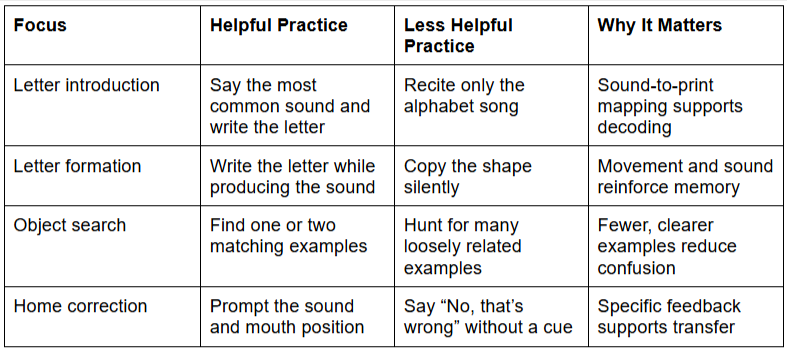
For Families: The big idea is that children should connect the shape of the letter to the sound it usually spells. At home, trace the letter with a finger, say the sound out loud, and name one object that starts with that sound. In the app, use the Letter Formation Mini-Lessons and Sound Cards inside the letters and sounds module. Keep reminding your child, “Say the sound while you trace,” because the goal is not only to recognize the letter but to use it for reading.

Phonics Instruction
Phonics instruction works best when it is explicit, cumulative, and applied immediately in blending, reading, and writing. That sentence captures the heart of effective teaching. Explicit means the teacher says exactly what the pattern is and models how to use it. Cumulative means new learning is added to secure prior learning rather than replacing it. Applied means students use the target right away in words, sentences, and connected text instead of waiting for “real reading” to happen later.
The need for application is one reason decodable reading matters so much in the early stages. If students have been taught short a, m, s, t, and p, then the reading they encounter should largely draw on those patterns. Otherwise, they are forced to rely on memory, pictures, or guessing. Castles, Rastle, and Nation argue that phonics is central because the alphabetic code does not reveal itself automatically; children need explicit instruction in the path from print to sound. At the same time, they stress that reading develops beyond phonics into vocabulary, fluency, and comprehension. Good phonics instruction therefore teaches code-based skills while preparing students to use those skills in meaningful reading.
Data can help teachers make this instruction more precise. Quick checks after a lesson, a weekly mastery probe, and analytics from a matched digital practice tool can reveal whether a child is confusing sounds, failing to blend, or reading accurately in isolation but not in connected text. These are not just accountability measures. They help the teacher decide whether to reteach, slow the pace, increase review, or assign extra practice.
For Families: Phonics instruction is most helpful when children use the same pattern in several ways on the same day. If your child learned short o at school, have them read three short-o words, write one short-o word, and read one tiny decodable passage with short-o words in it. In the app, look for the matching decodable books aligned to short vowels and complete one short activity rather than several unrelated games. Short, accurate practice beats long, scattered practice.
Phonics Alphabet
A phonics alphabet chart helps children connect letter symbols to their most frequent sounds with one consistent keyword and image. The word consistent is the important part. Early readers do better when the chart uses one reliable cue for each sound rather than multiple pictures or mixed terminology. If a chart shifts between letter names, sounds, and several examples at once, it becomes visually busy and instructionally muddy.
Teachers often underestimate how much clarity a good chart provides for families. In school, students hear the teacher explain how to use the chart. At home, parents may glance at the same poster and assume it is just decor. A short parent handout or a brief model video can change that. Families should know that the chart is a prompt for saying the sound, tracing the letter, and checking a consistent keyword. It is not a cue to guess an entire word from the picture.
The chart is also useful for multilingual learners when it includes clear visuals and audio support. Some children benefit from seeing the teacher exaggerate mouth position while pointing to the grapheme. Others need the sound repeated slowly and cleanly without extra vowel sounds attached. This is one reason a digital version of the chart can be helpful: it allows students to hear and replay the exact sound they are expected to produce.
For Families: A phonics alphabet chart is a sound map, not just an alphabet poster. Point to one letter, say its sound, trace it in the air, and then read one word that starts with that sound. Use the interactive phonics alphabet chart or the app’s Listen and Repeat practice so your child hears the same cue used in class. If you are ever unsure whether to prompt the letter name or the sound, begin with the sound.
Phonics for Kindergarten
Phonics for kindergarten should emphasize phonemic awareness, letter-sound mapping, simple blending, and decodable reading with short vowels. Kindergarten students do not need rushed coverage of every pattern in English. They need secure foundations. That means hearing and manipulating sounds orally, linking those sounds to print, blending simple words, and writing words and sentences that reflect the exact patterns they have learned.
A practical kindergarten scope and sequence often works best when divided into two broad stages: a first semester focused on sound awareness, letter-sound correspondences, and simple CVC blending, and a second semester that expands into more consonants, digraphs, and early connected reading. The purpose is not speed. The purpose is transfer. Children should be able to use each new pattern in reading and writing before the class moves on too quickly.

Kindergarten instruction also benefits from tight school-to-home communication. A five-minute sound hunt, a quick rhyme game, or a magnetic letter word build is enough when it matches the classroom target. Families do not need packets full of mixed patterns. They need one narrow focus that they can repeat with confidence.
The data from England’s phonics screening check offer a useful reminder that early decoding benchmarks can improve when phonics remains a visible priority. In 2024, 80% of Year 1 pupils met the expected standard, and 89% met it by the end of Year 2. The same release also showed a meaningful disadvantage gap, with 68% of disadvantaged pupils in Year 1 meeting the expected standard compared with 84% of other pupils. That does not tell schools exactly how to teach, but it does underline the importance of timely support, clear routines, and repeated practice.
For Families: Phonics for kindergarten should feel short, clear, and repeatable. Spend five minutes doing a sound hunt, building one or two words with magnets, and reading one aligned decodable page. In the app, start with the placement assessment, then assign the exact Short Vowel or Letters and Sounds lesson that matches what was taught in class. Repetition across the week is more helpful than a long practice session once.
Phonics Blends
Phonics blends are two or three consonants that keep their sounds, such as st, bl, and sm, and they are usually easiest to teach after students can already blend simple CVC words. The phrase keep their sounds matters because it distinguishes blends from digraphs. In stop, students still need to hear /s/ and /t/ separately before sweeping them together. If they have not yet learned to blend individual phonemes in short words, blend instruction often becomes frustrating.
A strong instructional path starts with oral work and visible articulation. The teacher can exaggerate the first sound, then add the next sound with minimal pause: /s/.../t/...st. That oral bridge helps students avoid inserting a schwa, which is a common problem when children say “suh-tuh” instead of a clean blend. After that, word building with letter tiles or magnetic letters allows children to feel how the onset changes while the rime stays stable: sat, stat is not useful, but sit, slip, slid, and slim can show how blending grows out of earlier phonics knowledge.
Once students can read blend words in lists, they need to carry that skill into connected text immediately. This is where many lessons stall. Children may read stop and slip on a card but then revert to guessing in sentences. Short decodable passages with multiple examples of the target blend help them move from isolated word reading to sentence reading without losing accuracy.
For Families: Blends are easier when children still say each sound, then pull them together quickly. Try this at home with three words such as step, spin, and smile. Point under the first two letters, say both sounds cleanly, then read the whole word. In the app, open Blends Path > st, sp, sm or the matching consonant blends practice set. Two short sessions in the same week are usually enough to reinforce what was taught at school.
Blends Phonics
Blends phonics lessons should include mouth placement tips, word building, and immediate transfer to reading short sentences with targeted blends. That combination matters because many students do not need more exposure to blends in the abstract; they need more accurate production and more connected-text practice. When the teacher shows what the mouth does for /s/ and /t/, then builds stop, then reads “Stop at the step,” the child sees the full path from articulation to print to meaning.
This is also the point in instruction where families often need support about what not to do. Well-meaning adults may tell a child to “sound it out” without showing how to move through the blend, or they may ask the child to guess from context if the first attempt is slow. A better prompt is specific: “Touch each sound and sweep.” If the child says the sounds separately but cannot blend, the adult can model once and then ask for another try. That keeps the focus on decoding rather than on performance pressure.
The table below is especially useful for families and tutors who mix up blends and digraphs.

For Families: Blends phonics practice should be brief and direct. Say the two sounds, slide them together, and read the word in a sentence right away. In the app, assign the Blend and Read mini-games and send a parent note through the portal: “Use finger taps under each sound, then sweep to read. Avoid guessing from the picture.” That one sentence can improve practice quality more than a longer explanation.
Phonics Activities
Phonics activities should be short, hands-on, and tightly aligned to the sound or pattern you just taught. The strongest activities are not the flashiest ones. They are the ones that make the target visible and repeatable. A magnetic word build for short a, a sound box routine for segmenting, a quick dictation line, and a decodable reread often do more for transfer than a center full of mixed games.
That alignment matters because children need repeated success with a narrow target before they can generalize it. If the weekly pattern is sh, then the classroom activity should ask students to read, sort, build, and write sh words. The home activity should do the same on a smaller scale. An app assignment should also stay on sh rather than switching to unrelated vowel teams because they happen to look more advanced. Consistency creates mastery; novelty often creates noise.
There is also a pacing issue here. Families are more likely to follow through when the task feels achievable. A seven-minute practice target, three times a week, is realistic. A thirty-minute mixed packet often leads to stress and inconsistent completion. When teachers package phonics activities as one small concept plus one short action, engagement tends to rise.
A final note on activity design: keep visuals accessible. Use clear fonts, strong contrast, and descriptive alt text for digital images. Multilingual learners benefit from audio support and mouth placement cues, while families benefit from printable directions in more than one language whenever possible.
For Families: Choose one activity that matches the week’s target and repeat it across several days. Do not worry about making practice elaborate. Read one decodable, build two or three words, and complete one matching app activity in the family reading link or Decodables Library by pattern. The best phonics activities are simple enough that adults can do them accurately and children can feel successful.

How should Teachers Assess Progress and Communicate Clearly with Families?
Assessment in phonics should answer a practical question: Can the student use the pattern accurately and independently in reading and writing? A child has not truly mastered short i because they recognized it on a worksheet once. Mastery appears when the child reads short-i words accurately, spells them with reasonable independence, and applies the pattern in connected text without heavy prompting. That is why strong phonics assessment includes more than one measure.
Quick daily checks can show whether yesterday’s sound is still secure. Weekly checks can reveal whether a child can read and write aligned words and sentences. Periodic screeners and app analytics can show patterns over time, such as a student who knows letter sounds in isolation but cannot blend efficiently. Those different views matter because they help teachers decide what kind of support is needed. Some students need more cumulative review. Others need more oral blending. Still others need less cognitive load and more tightly controlled text.
Families should not have to guess what progress reports mean. A helpful update avoids vague statements like “doing better in phonics.” Instead, it explains the pattern taught, the child’s current level of independence, and the next step. For example: Your child can read short-a CVC words accurately with teacher support and is now practicing short-i words independently. This week’s home focus is blending and writing one short-i sentence. That kind of message makes practice purposeful.
The larger research picture supports this focus on foundational skills. The IES practice guide recommends linking sound segments to letters, teaching students to decode and write words, and ensuring daily connected-text reading. Castles and colleagues add an equally important reminder: phonics is central, but reading success ultimately expands into language, vocabulary, fluency, and comprehension. That is exactly why parent communication should not stop at “do the app.” It should explain what the app is reinforcing and how the family can connect that practice to real reading.
What is the Simplest Way to Make Phonics Teaching More Effective?
The simplest way to make phonics teaching more effective is to reduce mismatch. Teach one clear pattern. Use the same language in class and at home. Give children controlled text that matches what they have learned. Add a short writing task so they encode as well as decode. Then assign one matching digital activity rather than a pile of unrelated practice. When all of those pieces point in the same direction, progress becomes easier to see and easier to support.
That coherence is especially important because phonics works best as part of a broader pathway into reading. Systematic instruction helps children crack the code, but confident reading grows when decoding is connected to fluency, vocabulary, comprehension, and motivation. Families do not need to become reading specialists to help. They simply need accurate routines, clear explanations, and practice that matches what school is actually teaching.
Frequently Asked Questions: How to Teach Phonics at Home
What is the best order to teach phonics if I want kids to start reading quickly?
Begin with phonemic awareness, common consonants, and short vowels that can quickly build many CVC words. After that, add more consonants, digraphs, blends, final e, vowel teams, and other advanced patterns in a cumulative sequence. The best order is the one that allows children to immediately read and write with each pattern instead of merely being exposed to it.
How many new sounds should I teach per week in kindergarten or first grade?
For many students, one or two new elements per week is manageable when daily review and application are built in. The right pace depends on screening data, the complexity of the pattern, and whether students can already use prior patterns independently. A slower pace with stronger transfer is usually more effective than fast coverage with weak retention.
What are phonics sounds versus letter names, and why does the difference matter?
Letter names are the labels for symbols, while phonics sounds are the speech sounds those symbols most often represent in words. Early decoding depends more directly on sounds than on names because children blend sounds to read and segment sounds to spell. That is why teachers and parents often prompt the sound first during beginning reading.
Are decodable books really necessary, or can children just read regular picture books?
Decodable books are especially valuable in the early stages because they let children practice the exact patterns they have been taught. Picture books remain important for read-alouds, vocabulary, and comprehension, but they are not always suitable for independent decoding practice. Controlled text helps prevent guessing and strengthens the connection between teaching and reading.
How do I teach blends to a child who keeps adding extra vowel sounds?
Model the blend with clean consonant sounds and minimal pause between them, using visible mouth cues and finger tracking. Keep the words short, practice orally before reading, and move quickly into simple sentences so the child uses the blend in context. Prompts such as “touch each sound and sweep” are usually more helpful than vague reminders to “sound it out.”
What are examples of effective phonics activities that do not take much time?
Effective phonics activities include magnetic word building, sound boxes, quick dictation, timed review of taught graphemes, and short decodable rereads. At home, building three words, writing one sentence, and reading one aligned passage can be enough. The key is not the number of activities, but how closely they match the taught pattern.
How can parents practice phonics at home without turning homework into a struggle?
Keep practice brief, specific, and predictable. A five- to ten-minute routine that includes saying sounds, blending one or two words, writing one word or sentence, and completing one matched app activity is usually enough. Parents should use the same cues the classroom uses and avoid asking children to guess from pictures or context.
How long should kindergarten phonics lessons be?
A focused ten- to fifteen-minute lesson can be highly effective when it includes review, a clearly taught target, blending, writing, and connected reading. Many teachers also add short review opportunities across the day. Young children generally benefit more from consistency and repetition than from long blocks packed with too many new concepts.