
Parents, teachers, and literacy coaches often hear the terms phonics, phonemic awareness, and phonological awareness used in the same conversation. That is understandable because all three belong to the foundation of reading instruction. However, they do not mean the same thing, and confusing them can lead to weak instructional choices. A child who cannot hear the sounds in a word needs something different from a child who hears the sounds but cannot connect those sounds to letters on the page.
The distinction matters because reading develops in layers. Before children can read print efficiently, they must understand that spoken words are made up of smaller sound units. Then they must learn how those sounds are represented with letters and spelling patterns. When adults know which layer is missing, they can respond with more precise support rather than using generic reading practice that may not address the actual problem.
Research supports that precision. The National Reading Panel found that phonemic awareness instruction improves reading and spelling outcomes and that systematic phonics instruction is significantly more effective than instruction that teaches little or no phonics. At the same time, broader research on phonological awareness shows that difficulty with phoneme awareness and related phonological skills is a strong warning sign for later reading and spelling difficulty. The best question is not whether phonics or phonemic awareness is more important. The better question is how each one contributes to reading success and how they should be taught together.
What Is Phonemic Awareness, And Why Does It Matter Before Children Read?
Phonemic awareness is the ability to hear, identify, blend, segment, and manipulate phonemes, the smallest sound units in spoken words. It is completely oral and auditory. If a child can hear that dog starts with /d/, ends with /g/, or can be broken into /d/ /o/ /g/, that child is demonstrating phonemic awareness. Letters do not have to be present.
This is the point that most often gets blurred. The National Reading Panel explains that phonemic awareness instruction teaches children to focus on and manipulate phonemes in spoken words, whereas phonics instruction teaches them to use letter-sound relationships for reading and spelling. In practical terms, phonemic awareness lives in speech, not print.
That oral foundation matters because children cannot make sense of alphabetic writing unless they recognize that words are made of separable sounds. If a child cannot hear that map contains three phonemes, it is much harder to understand why three letters are needed to represent the word in writing. Reading Rockets emphasizes that phonological awareness is critical for learning to read alphabetic writing systems and that phoneme awareness predicts later outcomes in reading and spelling.
In strong instruction, phonemic awareness is usually taught through short, focused tasks such as identifying first sounds, blending spoken phonemes into words, segmenting a word into its individual sounds, or changing one sound to make a new word. These activities may look simple, but they build the mental flexibility children need before print-based decoding becomes efficient.

What Is Phonics, And How Does It Help Children Read Words On The Page?
Phonics is the method of teaching children how sounds in spoken language connect to letters and spelling patterns in written language. If phonemic awareness helps a child hear the sounds in ship, phonics helps the child understand that those sounds can be represented as sh-i-p. Phonics is the part of reading instruction that turns sound awareness into print reading and spelling.
The National Reading Panel defines phonics instruction as instruction that stresses the acquisition of letter-sound correspondences and their use in reading and spelling.1 That definition is important because phonics is not just about memorizing letter names. It is about using sound-symbol knowledge to decode unfamiliar words, spell known words, and eventually recognize common words automatically.
Systematic phonics is especially important because it is taught in a deliberate sequence rather than only when a teacher notices a pattern in a book. Children learn specific correspondences, practice them in words and sentences, and apply them in connected text. According to the National Reading Panel, systematic phonics instruction benefits students from kindergarten through sixth grade and helps children who are having difficulty learning to read.
For families, phonics often feels more visible than phonemic awareness because it produces immediate reading behaviors. A child learns that m says /m/, a says /a/, and t says /t/, then blends them to read mat. That visible payoff is one reason phonics is so central in early literacy, but it works best when children can already attend to the sounds in words.
Phonemic Awareness Vs Phonics: What Are The Key Differences?
The clearest way to understand phonemic awareness vs phonics is to compare what each skill asks a child to do. One focuses on spoken sounds, and the other focuses on connecting those sounds to print.

This comparison becomes easier to grasp in real instruction. If a teacher asks children to say cat without /k/, that is phonemic awareness. If the teacher shows cat, teaches the sounds of c, a, and t, and asks children to decode the word, that is phonics.
The distinction also appears in the research base. On the National Reading Panel findings page, 52 studies met the final criteria for the phonemic awareness meta-analysis, and 38 studies met the final criteria for the phonics meta-analysis. That does not mean one skill matters more than the other. It means each has its own evidence base and its own role in reading development.
The easiest way to remember the difference is this: phonemic awareness helps children hear the structure of language, while phonics helps them read and write that structure in print.
What Is Phonological Awareness, And How Does It Fit Into The Bigger Picture?
Phonological awareness is the broader umbrella that includes awareness of larger sound units such as words, syllables, rhyme, onset-rime patterns, and phonemes. Phonemic awareness is one part of phonological awareness because phonemes are the smallest units in the sound system.
That hierarchy matters because children usually develop sensitivity to larger sound units before they can manipulate individual phonemes. A child may notice that cat and hat rhyme before being able to separate cat into /k/ /a/ /t/. A child may clap the syllables in banana before being able to delete the middle sound from a shorter word. Strong early literacy instruction often follows that progression.

Seeing phonological awareness as the larger framework helps educators avoid an overly narrow view of foundational skills. Rhyming, syllable work, and oral sound play are not distractions from reading instruction. They are part of the language pathway that makes alphabetic learning easier.

How Do Phonemic Awareness And Phonics Work Together In Reading Instruction?
The two skills work best as connected steps in one reading process. Phonemic awareness helps children understand that spoken words can be taken apart into sounds and put back together again. Phonics then shows them how those sounds are represented with letters. Together, they support decoding, spelling, and more automatic word recognition.
The National Reading Panel makes this relationship explicit by noting that children need phonemic awareness to make effective use of letter-sound information. They must be able to blend sounds together to decode words and break spoken words apart to write them. In other words, phonics does not replace phonemic awareness. It depends on it.
A strong lesson often connects the two directly. A teacher may first ask students to orally segment sat into /s/ /a/ /t/. Next, the teacher shows the letters s-a-t and links each sound to its letter. Then the teacher asks students to blend the sounds and read the printed word. Finally, students might write sat, replace the first sound to make mat, and read a short sentence containing both words. In that short sequence, oral sound work and print work reinforce one another.
This integration is especially important for struggling readers. The National Reading Panel reported that systematic phonics instruction had positive and significant effects for disabled readers, low-achieving students, and low-SES students, while phonemic awareness instruction produced strong and lasting gains in reading and spelling. The practical lesson is that children benefit most when foundational skills are taught as part of a coherent system rather than as disconnected exercises.
“The meta-analysis indicated that systematic phonics instruction enhances children’s success in learning to read and that systematic phonics instruction is significantly more effective than instruction that teaches little or no phonics.” — NICHD, National Reading Panel findings
Why Do National Reading Data Make Foundational Skills So Important?
The case for strong early literacy instruction is not only theoretical. Current national reading data show why foundational skills still matter. On the 2024 NAEP reading assessment, 31% of fourth-grade students and 30% of eighth-grade students performed at or above NAEP Proficient in reading. Those figures suggest that many students are still not reaching strong reading benchmarks.
The same NAEP reports show that the national average reading score in 2024 was 2 points lower than 2022 and 5 points lower than 2019 at both grade 4 and grade 8. These data do not prove that phonics or phonemic awareness alone explain national reading outcomes, because reading achievement also depends on vocabulary, oral language, comprehension instruction, content knowledge, attendance, and intervention quality. Even so, the results reinforce the importance of building strong reading foundations early so that later comprehension demands do not rest on weak decoding and word recognition.
Reading Rockets adds another important warning sign: at least 80% of poor readers are estimated to show weakness in phonological awareness and/or phonological memory. That figure helps explain why early screening for sound-based difficulties can be so valuable. When children show trouble hearing, blending, or segmenting sounds, early intervention can prevent later reading failure from becoming more entrenched.

How Can Teachers And Parents Teach Phonics For Kids In Practical Ways?
Effective phonics for kids does not need to feel mechanical or disconnected from real reading. The strongest instruction is explicit, brief, cumulative, and immediately applied. Children learn a small number of sound-symbol relationships, use them in words and sentences, and then encounter them in connected text.
At the phonemic awareness level, teachers and parents can ask children to identify first sounds, blend spoken sounds into a word, segment a word into phonemes, or change one sound to make a new word. At the phonics level, those same sounds can be tied to letter cards, decodable words, controlled sentences, and simple spelling tasks. The key is that oral awareness should lead naturally into print practice.
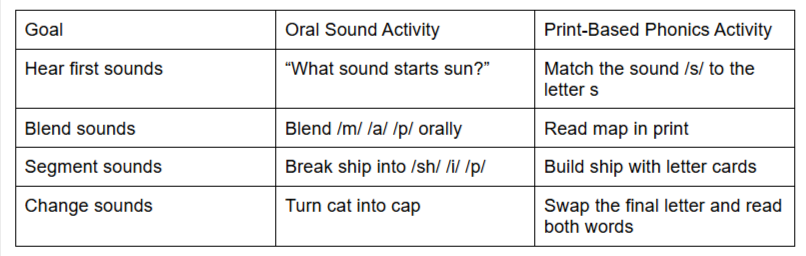
In classrooms, this may look like a short oral warm-up followed by direct phonics teaching and then reading practice. At home, it may look like a parent playing a quick sound game, showing the matching letters, and reading a few words or a short decodable passage. The routine stays simple, but the sequence matters.
What Should Parents And Educators Remember Most About Phonics Vs Phonemic Awareness?
The central takeaway is that phonemic awareness and phonics are not competing approaches. They are different skills that support the same long-term goal: helping children become accurate, confident readers. Phonemic awareness builds sensitivity to the sound structure of spoken language. Phonics builds the ability to map that sound structure onto print for reading and spelling.
Understanding that relationship improves instruction. When a child cannot hear or manipulate sounds, adults should strengthen oral sound awareness. When a child can hear the sounds but cannot connect them to letters, adults should strengthen phonics. In many cases, children need both, taught together in a clear sequence that moves from sound to symbol to connected reading.
Research from the National Reading Panel and broader literacy scholarship points in the same direction: reading success depends on strong foundational skills, and those skills need to be taught explicitly and purposefully. In a national environment where reading performance remains under pressure, clarity about these terms is not a minor technical detail. It is part of helping more children gain access to fluent, meaningful reading.
Frequently Asked Questions: Phonics Vs Phonemic Awareness
What Is The Difference Between Phonics And Phonemic Awareness In Simple Terms?
Phonemic awareness is the ability to hear and manipulate the sounds in spoken words. Phonics is the ability to connect those sounds to letters and spelling patterns in print. A simple shortcut is that phonemic awareness is about sounds, while phonics is about sounds plus print.
What Is Phonological Awareness, And How Is It Different From Phonemic Awareness?
Phonological awareness is the broader category that includes rhyme, syllables, onset-rime patterns, and phonemes. Phonemic awareness is the most specific level within that category because it focuses on individual phonemes. So phonemic awareness is part of phonological awareness, not a separate system.
How Is Phonics Taught In Schools?
Strong phonics instruction is usually explicit and systematic. Teachers introduce letter-sound relationships and spelling patterns in a planned order, then guide students to apply them in word reading, sentence reading, spelling, and connected text.
Why Is Phonics Important For Early Reading?
Phonics is important because alphabetic reading depends on understanding how letters represent sounds. Without that knowledge, children often struggle to decode unfamiliar words and build automatic word recognition. The National Reading Panel found that systematic phonics instruction is significantly more effective than instruction with little or no phonics.
How Can I Improve My Child’s Phonemic Awareness At Home?
You can build phonemic awareness through brief oral activities such as identifying first sounds, blending spoken sounds into words, segmenting words into phonemes, and changing one sound to make a new word. These activities work well when they are playful, short, and later connected to print.
Should Phonemic Awareness Be Taught Without Letters?
It can begin without letters because its target is spoken-sound awareness. However, effective instruction often moves fairly quickly toward connecting sounds to letters so that children can transfer what they hear into reading and spelling.