
Reading comprehension is the cornerstone of academic success and lifelong learning. It is the critical bridge between simply decoding words on a page and truly understanding, analyzing, and applying information. For many parents, especially those with young readers entering 1st grade, children with dyslexia, speech apraxia, or those who are homeschooling, a recurring and vital question arises: how to improve reading skills in students effectively without causing frustration or tears?
The early years of literacy, particularly around 1st grade, are pivotal. This is the stage where children transition from "learning to read" to "reading to learn." If a child struggles during this transition, the academic gap can widen quickly. If you are wondering how to improve reading skills in your young child, the key lies in responsive, interactive instruction and active engagement tailored to their developmental stage.
This article provides actionable strategies designed to move young students beyond basic word recognition to deep, metacognitive text comprehension. By equipping children with conscious plans, and supporting them with tools that listen and encourage, we empower them to take control of their own reading journey, transforming reading time from a battleground into a confident, independent success.
How Do I Build Foundational Literacy to Improve Reading Skills?
Before a child can comprehend complex narratives, they must master the foundational building blocks of reading. For a 1st grader, this means solidifying phonemic awareness and phonics. Phonemic awareness is the ability to hear, identify, and manipulate individual sounds (phonemes) in spoken words. Phonics connects these sounds to written letters.
When parents ask, "how can I improve my reading skills for my child who is just starting out?", the answer often lies in these fundamentals. If a child cannot decode a word smoothly, their brain expends all its energy on the mechanics of reading, leaving no cognitive resources available for comprehension.
The Pillars of Early Literacy
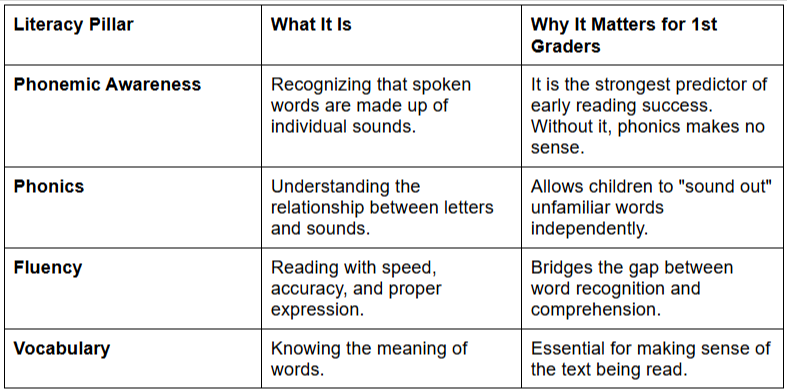
For young readers, especially those with learning differences, mastering these pillars requires patience and immediate, gentle feedback. When a 1st grader mispronounces a word, correcting them immediately, before the incorrect pronunciation becomes a habit, is crucial. This is where a responsive AI reading tutor becomes invaluable, acting as a tireless companion that listens to every syllable and provides real-time guidance.
How Can I Teach Metacognition to Improve Reading Comprehension Skills in Young Children?
Metacognition, often defined simply as "thinking about thinking," is a fundamental component of strong reading skills. While it sounds like an advanced concept, even 1st graders can begin developing metacognitive awareness. Good readers do not just read; they actively monitor their understanding throughout the entire process. If a parent is looking to guide a young reader and asking, "how can I improve my reading comprehension skills?", introducing simple metacognitive habits is the first step.
This process involves distinct phases: before, during, and after reading.
Before Reading: For a 1st grader, this means looking at the book's cover, reading the title, and making a prediction. "What do you think this story is about based on the picture?" This simple question activates prior knowledge and sets a purpose for reading.
During Reading: Metacognitive readers are highly active. They adjust their reading speed based on the difficulty of the text. Most importantly, they notice when their comprehension breaks down. For a young child, this might manifest as a confused look or a pause.
When a confusing passage arises, they employ "fix-up" strategies. These might include rereading the sentence, looking back at previous pictures for context, or sounding out a difficult word. Teaching these self-awareness techniques is crucial for improving reading skills over the long term. This is exactly why an interactive approach, where a child is prompted to pause and reflect, is so vital for struggling early readers.
After Reading: The child should be able to recount the basic events. "What happened first? What happened next?" This solidifies the narrative in their mind.
What Are the Best Ways to Monitor Comprehension When Improving Reading Skills?
Building directly on the concept of metacognition is the explicit practice of comprehension monitoring. Students who excel at monitoring their comprehension know exactly when they understand what they are reading and, crucially, when they do not. For young children with learning differences, this self-monitoring can be particularly challenging, making real-time feedback essential.
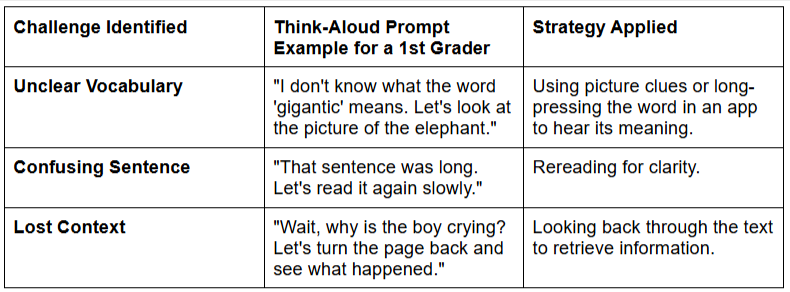
To teach comprehension monitoring effectively, parents must guide students to identify exactly what is causing their confusion. Is it a specific vocabulary word? Is it a complex sentence? Once the difficulty is pinpointed, students can apply appropriate strategies to resolve it.
Adults can model this behavior using "Think-Aloud" prompts, making the invisible act of comprehension visible to young students. Alternatively, an AI reading tutor can seamlessly integrate this monitoring by asking targeted questions as the child reads, ensuring they aren't just rushing through the words but actually grasping the meaning.
Think-Aloud Prompts for Early Comprehension Monitoring
How Does Building Vocabulary Naturally Help Improve Your Reading Skills?
A robust vocabulary is intrinsically linked to reading comprehension. For young students wondering how to improve your reading skills, expanding word knowledge is a direct path to success. However, rote memorization of flashcards is rarely effective, especially for 1st graders who already struggle with reading.
The most effective way to build vocabulary is naturally, in context, as the child reads. When a child encounters a new word in a story, hearing it pronounced correctly and immediately understanding its meaning within that specific sentence cements the knowledge far better than isolated study.
By actively engaging with new words during Storytime, children not only improve their reading comprehension but also build the confidence needed to tackle more complex texts. This contextual learning is a core pillar of the Science of Reading.
When using a smart reading program, if a child struggles with a word, the AI tutor can provide immediate pronunciation and define it. Furthermore, adding these words to a personalized vocabulary list allows the child to review them later, ensuring that vocabulary growth leads to long-term reading success.

How Can Strategic Questioning Improve My Reading Skills?
Questions are not just tools for assessment; they are powerful engines for active reading. Strategic questioning gives young students a clear purpose for reading, focuses their attention on what they need to learn, and encourages them to monitor their comprehension continuously. When a parent asks, "how can I improve my reading skills for my child?" integrating interactive questions is a critical answer.
For 1st graders, questions should be immediate and relevant to the page they just read. Waiting until the end of a book to ask questions often relies too heavily on a young child's working memory, which is still developing.
Interactive Voice-based Questions & Answers (IVQA™) mimic the effectiveness of 1-on-1 tutoring. By prompting children with questions about the material they just read, it ensures they fully understand the narrative before moving on. This prevents the common issue where a child reads a whole page perfectly out loud but cannot recall what happened.
The Power of Interactive Questioning for Early Readers
- Recall Questions: These ask for explicit information found right in the text or pictures. Example: "What color was the balloon?" This ensures basic attention and decoding.
- Inferential Questions: These require students to combine what they read with their own logic. Example: "Why do you think the boy was sad when the balloon popped?" This builds early critical thinking.
- Vocabulary Questions: Checking the understanding of specific words in context. Example: "The story says the dog was 'exhausted.' Does that mean he was tired or hungry?" This reinforces the natural vocabulary building mentioned earlier.
How Do I Improve Reading Skills by Fostering Independence?
While answering parent-led or tutor-led questions is important, a crucial shift occurs when young students begin to feel independent in their reading journey. For children who have faced reading anxiety or meltdowns, gaining independence is a massive confidence booster.
Fostering independence means providing an environment where the child can read at their own pace without feeling pressured or judged. When a 1st grader can sit down, engage with a story, receive gentle corrections when they stumble, and answer comprehension questions on their own, their attitude towards reading completely changes. They move from feeling defeated to feeling capable.
This independent practice, supported by responsive technology that understands unique speech patterns, is often the turning point for reluctant readers. A system that listens patiently and provides help only when needed empowers the child to take ownership of their learning.
How Does Tracking Quantifiable Progress Improve Reading Comprehension?
Improvement is motivating. For both the parent and the child, seeing tangible evidence of progress is essential for maintaining momentum. When working on how to improve reading comprehension skills, guessing isn't enough; you need data.
Tracking metrics such as words correct per minute, accuracy percentage, and comprehension scores provides a clear picture of a child's reading development. For a 1st grader, these metrics change rapidly, and tracking them allows parents to celebrate small victories.
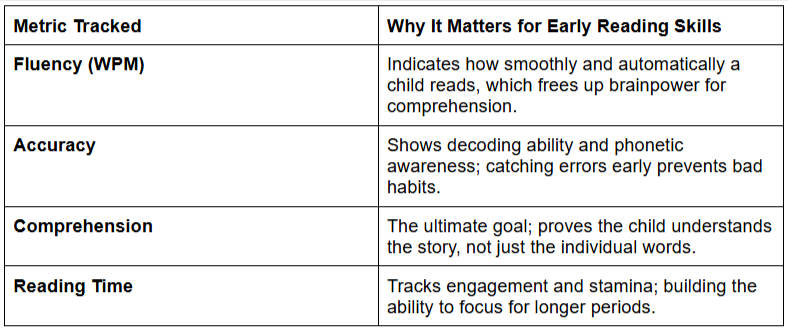
By reviewing detailed daily and weekly reading reports via a Progress Dashboard, parents can celebrate victories, identify areas needing more support, and set realistic, achievable reading goals for their young learners.
What is the Best Way to Deliver Instruction for Improving Reading Skills in 1st Graders?
Knowing what strategies to teach is only half the battle; knowing how to deliver them without causing frustration is equally critical, especially for young children with dyslexia or those on the autism spectrum.
The best instruction is responsive, patient, and personalized. It provides the right reading material at the exact right level, challenging enough to promote growth, but not so difficult that it causes a breakdown. For a 1st grader, reading material must be engaging, colorful, and phonetically appropriate.
Instruction must also be consistent. Daily practice is essential for early readers. However, this practice must be supported. Leaving a struggling 1st grader alone with a book often leads to guessing and frustration.
Whether through a dedicated human tutor or an advanced AI reading app like Readability, the goal is to provide real-time support. This ensures that the child is never left struggling alone with a difficult word or a confusing plot point. By turning reading time into a supported, interactive, and successful experience, we can foster a lifelong love of reading.

How Can Storytime Improve Reading Skills and Focus?
For young learners, engagement is just as important as instruction. If a child is bored or overwhelmed, they will not retain information. This is where the concept of "Storytime" becomes a powerful educational tool.
Storytime is not just about entertainment; it is an active learning environment. When children listen to stories, they are exposed to new sounds, complex sentence structures, and advanced vocabulary that they might not yet be able to decode on their own. This auditory exposure develops early literacy skills that enhance their focus and concentration.
For a 1st grader, listening to a well-narrated story models proper fluency and expression. It shows them what good reading sounds like. Furthermore, interactive Storytime, where the child is asked questions about the plot or characters, keeps them actively engaged and practicing comprehension skills even when they are not the ones doing the decoding.
The Role of Consistent Feedback in Improving Reading Skills
Imagine trying to learn to play the piano, but you only find out if you hit the wrong note a week later. Learning to read is similar. Delayed feedback is ineffective for young learners. When a 1st grader mispronounces a word, they need to know immediately so they can correct it and map the correct sound to the letters in their brain.
Consistent, real-time feedback is the hallmark of effective reading instruction. When a child struggles with a word, a gentle prompt or a correct pronunciation provided immediately allows the child to self-correct and move on without losing the thread of the story.
This is a significant challenge for parents who cannot always sit with their child for every reading session. This is where technology steps in to bridge the gap. An AI reading tutor that listens and corrects in real-time ensures that every reading session is a productive learning opportunity, reinforcing correct habits and preventing frustration.
Conclusion
Improving reading skills in young students, especially 1st graders who have struggled or those with learning differences, is a multifaceted endeavor that requires patience, the right strategies, and responsive support. By focusing on foundational literacy, metacognitive monitoring, building vocabulary in context, utilizing strategic interactive questioning, and tracking quantifiable progress, parents can equip their children with the tools they need to succeed.
Reading should not be a source of anxiety; it should be an engaging journey. By utilizing smart reading programs that automatically select the right material and provide real-time, voice-based support, we can ensure these strategies become second nature to our children. We encourage parents to embrace tools that offer this level of personalized, 1-on-1 tutoring effectiveness, transforming tears into confidence and building strong, purposeful readers for life.
Frequently Asked Questions (FAQs): How to Improve Reading Skills in Students
How to improve reading skills quickly for a struggling 1st grader?
The fastest way to see gains is through consistent, supported daily practice using material at the child's exact reading level. Tools that provide real-time pronunciation correction and comprehension questions, like Readability's AI tutor, can build measurable gains in fluency and accuracy in under 60 days.
How to improve reading comprehension skills if my child reads too fast?
Children who read too fast often skip words and lose meaning. Interactive comprehension questions force the child to slow down, reflect on the story, and prove they understood the narrative, rather than just racing to the end of the page.
How to improve your reading skills if you have dyslexia?
Children with dyslexia benefit immensely from reading out loud with immediate, gentle correction. An environment that allows them to read at their own pace, combined with technology that understands unique speech patterns and doesn't cause frustration, is crucial for building confidence.
How to improve my reading skills without getting frustrated?
Removing the pressure of performance is key. Using a responsive reading program that listens, helps sound out difficult words without judgment, and provides engaging stories helps relax the child and promotes internal motivation rather than anxiety.
How can I improve reading skills at home effectively?
Consistency is vital. Set aside dedicated reading time daily. Use a program that tracks your child's progress (like WPM and accuracy) so you can monitor their growth through a parent dashboard, ensuring the time spent reading is actually translating into skill development.