

What happens when a student who barely speaks begins reading aloud with confidence and comprehension? What changes when an entire special education classroom starts hitting fluency goals once considered out of reach?
At Horace Mann Elementary, a Title I school serving students with complex needs, veteran special education teacher Tom has spent over a decade answering those questions with action. In a classroom where most students have IEPs and traditional instruction often falls short, Tom faced a challenge familiar to many educators: how do you deliver daily, differentiated reading instruction to students with widely varying needs, especially when speech delays, attention differences, and decoding struggles are all part of the equation?
This case study follows Tom’s journey to answer that challenge. The solution? A daily, structured reading routine powered by Readability, an AI-driven platform that provides real-time speech feedback, adaptive comprehension support, and data educators can actually use. The results were striking, not only in student confidence and independence, but in measurable gains across fluency, comprehension, and expressive language. For one student, the impact was transformative: from nonverbal to reading 80+ words correct per minute aloud.
The Challenge: One Teacher, Ten Different Needs
Tom’s classroom isn’t quiet, and that’s intentional. His students don’t benefit from silent sustained reading; they need to hear themselves speak, decode, reread, and respond out loud. They need feedback. They need structure. They need repetition. And they need it every day.
But with students reading at different levels, working on different IEP goals, and requiring different kinds of support, phonics, fluency, comprehension, expressive language, Tom faced an impossible math problem: one teacher, ten students, zero capacity to give each one the consistent, one-on-one reading instruction they needed.
“You can’t clone yourself,” he says.
“Even with the best routines, I couldn’t sit next to every student and coach them through every sentence.”
Add to that the fact that many of his students struggle with transitions, attention, or executive functioning. Traditional reading programs often required too many steps, too much supervision, or too much frontloading to sustain daily momentum. What Tom needed was something that could meet each student exactly where they were, and keep them moving forward without losing engagement.
He needed a solution that didn’t just assess reading skills, but actively taught them, one that could serve as a personal reading coach for every student, without sacrificing instructional time or creating more work for his already full plate.
That’s when he turned to Readability.
Implementation: A Daily Routine That Runs Itself
Tom didn’t need another tool that looked good on paper but collapsed under real classroom conditions. To work, Readability had to do three things: integrate seamlessly into his routine, support students independently, and generate meaningful data without adding to his workload.
It delivered on all three.
Each morning, after completing differentiated math tasks, Tom’s students transition straight into reading. They grab their iPads, put on headsets equipped with noise-canceling mics, and open Readability.
“It’s frictionless,” Tom says.
“No logging in headaches. No asking, ‘What do I do next?’ They open the app, start reading, and the program takes over.”
But what’s most powerful is how Readability supports the student experience from day one. Tom started by asking his students to read for just one minute. That small task helped build a sense of “I can do this” giving them early wins and preventing overwhelm. From there, he gradually increased reading time: five minutes, then ten, fifteen, eventually reaching twenty-five minutes of sustained, independent reading.
“It’s like building muscle,” Tom explains.
“They start small. But before long, reading for 25 minutes a day is just part of their rhythm.”
As students read aloud, Readability listens, offering real-time feedback, correcting mispronunciations, supporting decoding, prompting with encouragement, and reinforcing progress. For students with attention challenges, Tom uses Guided Access mode to reduce distractions. For students with expressive language difficulties, the app’s spoken comprehension questions and optional visual prompts provide low-pressure, daily opportunities to be heard and understood.
What began as a test with just two students quickly expanded. And rather than replacing instruction, Readability amplified it. Tom could monitor, coach, and collect real-time data, while every student received personalized, structured literacy support, every single day.
The Impact: Measurable Growth, Meaningful Change
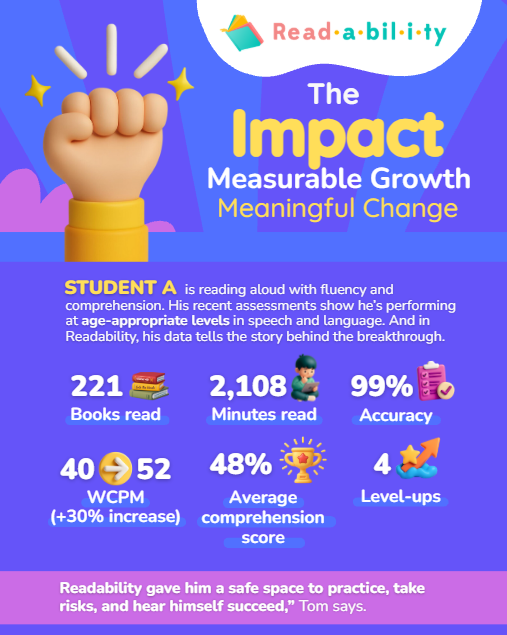
The most visible transformation in Tom’s classroom came from one student: Student A. When the school year began, Student A was largely nonverbal. Reading aloud caused distress. Academic demands often triggered shutdowns. But with consistent daily reading on Readability, his confidence grew, first in sounds, then in words, then in full sentences.
Today, Student A is reading aloud with fluency and comprehension. His recent assessments show he’s performing at age-appropriate levels in speech and language. And in Readability, his data tells the story behind the breakthrough:
- Books read: 221
- Minutes read: 2,108
- Accuracy: 99%
- Fluency: 40 → 52 WCPM (+30% increase)
- Average comprehension score: 48%
- Level-ups: 4
“Readability gave him a safe space to practice, take risks, and hear himself succeed,” Tom says.
“Confidence unlocked language.”
But Student A isn’t an outlier, he’s part of a pattern. Across Tom’s Readability users, students are building fluency, improving comprehension, and increasing time-on-task.

Classroom-wide totals show powerful momentum:
- Books read: 812 (about 135 per student)
- Minutes read: 5,466 (about 911 per student)
- Accuracy: 94%
- Fluency: 31 → 47 WCPM (+51% increase)
- Comprehension: Average score of 37%
- Level-ups: ~2.2 per student
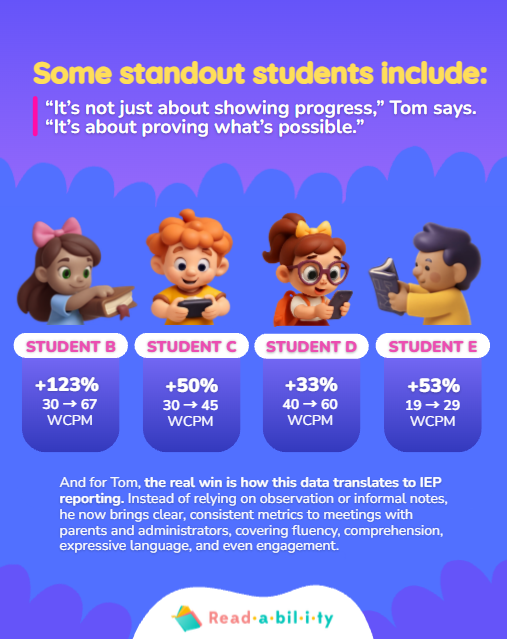
Some standout students include:
- Student B: 30 → 67 WCPM (+123%)
- Student C: 30 → 45 WCPM (+50%)
- Student D: 45 → 60 WCPM (+33%)
- Student E: 19 → 29 WCPM (+53%)
And for Tom, the real win is how this data translates to IEP reporting. Instead of relying on observation or informal notes, he now brings clear, consistent metrics to meetings with parents and administrators, covering fluency, comprehension, expressive language, and even engagement.
“It’s not just about showing progress,” Tom says.
“It’s about proving what’s possible.”
A Model for Inclusive Literacy
What’s happening in Tom’s classroom isn’t accidental. It’s the result of a teacher who starts by assuming competence, not limitation.
Where others might see a diagnosis and lower expectations, Tom sees potential, and pushes toward it. He doesn’t wait for students to “catch up” to be treated like readers. He creates the conditions where reading can emerge, and he adapts everything around that goal: the tools, the timing, the tech, the mindset.
“I assume every student can do everything,” he says.
“And then I adjust when they can’t, not the other way around.”
That mindset is at the heart of his classroom’s transformation. Readability became the right partner because it aligned with his values: every student deserves daily, individualized support. Every student can grow with the right structure. Every student deserves to be seen, not just for where they are, but for who they can become.
It’s that belief, combined with the consistency and capability of Readability, that’s helping students speak, read, comprehend, and most of all, believe in themselves.
“Readability changed what my students believed about themselves,” Tom says.
“And when a child starts believing they can read – that changes everything.”
Together, Tom and Readability are delivering something rare in education: measurable outcomes and meaningful identity shifts. Students who once struggled to speak are now reading fluently. Families who once felt defeated are celebrating IEP goals met. And a teacher who refuses to settle is proving what’s possible when high expectations meet the right support.
