

Article Summary
This guide demystifies dyslexia reading tools—what they are, when to use them, and how they pair with structured literacy—to help students access grade-level content while building decoding and fluency. You’ll learn early signs and screening essentials, the difference between accommodations and remediation, tool categories (text-to-speech, audiobooks, speech-to-text, decodables, AI feedback), and a step-by-step home–school implementation plan.
For parents and educators supporting children with dyslexia, the journey to fluent reading can feel like navigating an intricate maze. Dyslexia is a neurobiological learning difference that primarily affects word recognition, spelling, and decoding. It is not a reflection of intelligence; rather, it is a difference in how the brain processes language. Fortunately, modern educational technology has opened new pathways to literacy. When paired with evidence-based instruction, the right dyslexia reading tools can bypass mechanical barriers, reduce cognitive fatigue, and foster long-term reading independence.
Families often search for reading tools for dyslexia and dyslexia learning tools that are easy to set up and use every day. In this guide, we compare practice-aligned options and access accommodations, explain which dyslexia tools for students fit common profiles, and share how to choose dyslexia reading tools for kids and adults without wasting time or money.
At Readability, we understand that there is no one-size-fits-all solution for struggling readers. Effective support requires a dual approach: systematic instruction to build core skills, and accommodations to ensure access to grade-level content. This comprehensive guide explores the science of dyslexia, the critical importance of early intervention, the distinct categories of reading tools, and a practical blueprint for selecting and implementing them at home and in the classroom.
How Can I Understand Dyslexia Reading Science to Select the Best Dyslexia Reading Tools?
To choose the most effective tools, we must first look to the science of reading, a vast body of gold-standard research from cognitive science and neuroscience. This research demonstrates that reading is not a natural process like speaking; the human brain must build new neural pathways to connect visual letters (graphemes) to spoken sounds (phonemes).
One of the most influential frameworks in reading science is Dr. Hollis Scarborough's Reading Rope. This model visualizes skilled reading as a strong rope made of two primary braided strands: Word Recognition and Language Comprehension.

For children with dyslexia, the primary breakdown occurs within the Word Recognition strand, specifically in phonological awareness (isolating and manipulating sounds) and decoding (applying letter-sound correspondences). When a child struggles to decode words automatically, their working memory is entirely consumed by the mechanics of reading. This leaves virtually no cognitive space for comprehension, leading to frustration, avoidance, and what is known as the Matthew Effect in reading: where the rich get richer and the poor get poorer, as struggling readers read less and fall further behind across all academic subjects.
Understanding this scientific foundation is critical. It helps us recognize that a child who struggles with causes of poor reading comprehension often has an underlying decoding bottleneck. Therefore, the tools we select must target the specific strand of the Reading Rope that requires support, whether that means using assistive technology to bypass the decoding bottleneck or using structured practice tools to strengthen word recognition pathways.
What Are the Early Signs of Dyslexia and Why is Early Screening Crucial for K-2 Students?
The neural pathways responsible for reading are highly malleable in early childhood. Research from the National Institute of Child Health and Human Development (NICHD) shows that when intervention is provided in kindergarten or first grade, up to 85% of struggling readers can reach grade-level performance. However, if intervention is delayed until third grade or later, the success rate drops significantly, and students require exponentially more hours of instruction to make the same gains.
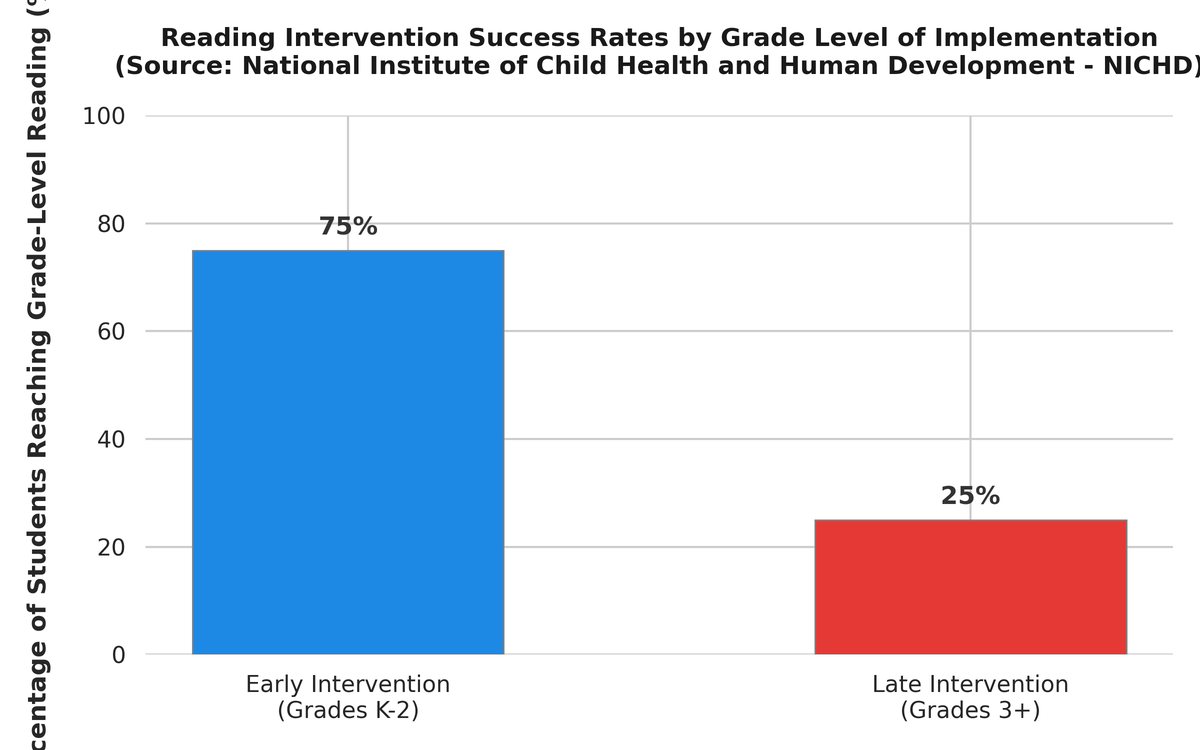
This stark contrast highlights why early screening and intervention are non-negotiable. To catch difficulties early, parents and teachers must be vigilant in recognizing the early signs of dyslexia across different developmental stages:
Early Signs in Preschool (Ages 3 to 4)
- Difficulty learning simple nursery rhymes or appreciating rhyming patterns.
- Late talker or slow to add new words to their spoken vocabulary.
- Persistent trouble pronouncing common words or mixing up sounds (e.g., saying "aminal" instead of "animal").
- Difficulty remembering the names of letters, numbers, or days of the week.
Early Signs in Kindergarten and First Grade (Ages 5 to 6)
- Struggle to associate letters with their corresponding sounds.
- Difficulty with basic phonological awareness, such as blending sounds to make a word (e.g., combining /c/ /a/ /t/ into "cat").
- Persistent errors in reading common high-frequency sight words.
- Using pictures or guessing words based on the first letter rather than sounding them out.
- Avoidance of reading tasks and expressing high frustration or anxiety around books.

If a child exhibits several of these signs, parents should seek a formal screening. Educators can utilize a structured level reading assessment tool to identify specific gaps in the student's phonological and decoding skills. By assessing students early, schools can design targeted support plans and write precise IEP reading goals that focus on phonemic awareness, systematic phonics, and automatic word recognition.
How Do We Balance Systematic Reading Instruction and Accommodations with Dyslexia Reading Tools?
When supporting a student with dyslexia, a common point of confusion is the distinction between remediation (instruction) and accommodation (access). Some worry that providing assistive technology like text-to-speech will prevent a child from learning how to read. In reality, both are essential components of a comprehensive literacy plan, but they serve entirely different purposes and must be used in the correct contexts.
Remediation involves systematic, explicit, and cumulative instruction designed to rebuild the brain's reading pathways. This is typically delivered through a structured literacy approach (such as Orton-Gillingham) that teaches the progression of reading skills from the smallest unit of sound to complex multisyllabic words. Remediation is hard work, and it must occur during dedicated instructional blocks or specialized tutoring sessions.
Accommodations, on the other hand, are designed to bypass the reading barrier to ensure the student can access the broader curriculum. As students progress through school, the reading demands of science, social studies, and literature quickly outpace their decoding skills. If we force a dyslexic student to read every textbook page manually, they will experience massive cognitive fatigue and fall behind in subject-matter knowledge. Accommodations preserve the student's intellectual potential and prevent academic delays.
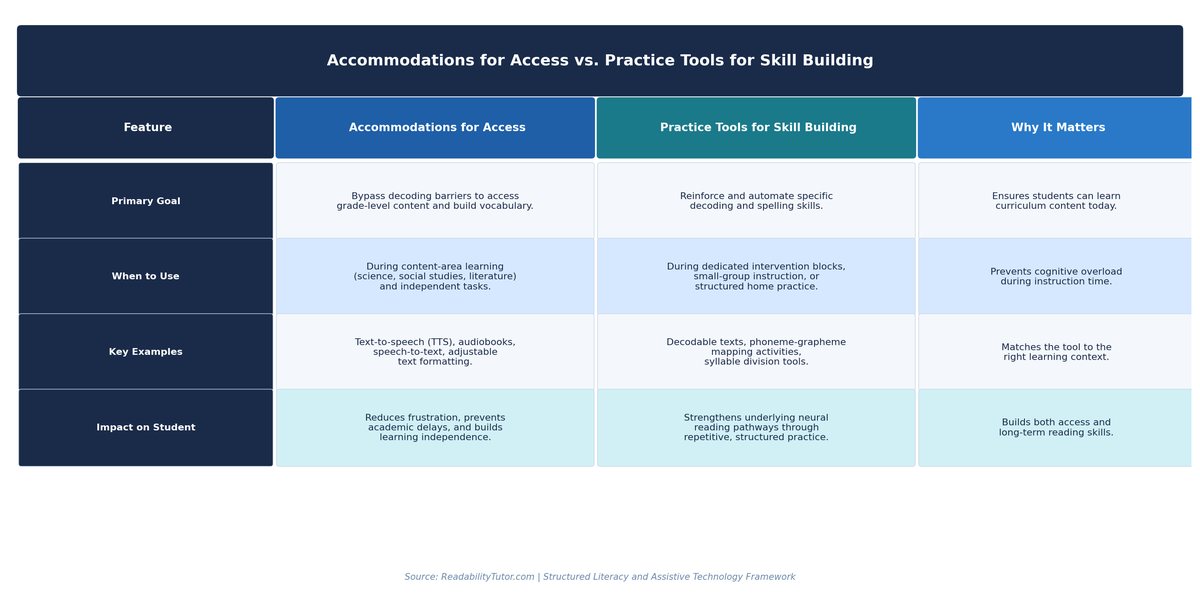
The key is balance. A student should use practice tools during their dedicated reading intervention time to build their decoding and spelling skills. However, during science class or independent research, they should have full access to accommodations like audiobooks and speech-to-text. This dual approach ensures they are actively learning to read while simultaneously reading to learn.
Classroom Integration with Dyslexia Learning Tools: Station Rotations and Enrichment
Use dyslexia learning tools within a station-rotation model to meet learners where they are while keeping the whole class engaged. A typical rotation includes: a decoding station with practice-aligned tools (phoneme–grapheme mapping, sequenced decodables), a content-access station using reading tools for dyslexia (text-to-speech with highlighting or human-narrated audiobooks), and an enrichment station for advanced readers or early finishers (research playlists, vocabulary challenges, or student-created podcasts). This balances remediation with accommodations and prevents students with reading disabilities from missing grade-level knowledge.
Design each station through a Universal Design for Learning lens: provide multiple means of representation (print, audio, visuals) and action/expression (speech-to-text, graphic organizers, short video responses). Sample 45-minute rotation: 15 minutes decoding practice (structured lesson + quick fluency reps), 15 minutes content access (TTS/audiobook + scaffolded note-taking), 15 minutes enrichment (choice board with independent projects). To sustain momentum, label stations “Good for homework” (content access + notes), “Good for essays” (speech-to-text + citation helpers), and “Good for fluency” (timed, teacher-modeled rereads).
What Are the Categories of Dyslexia Reading Tools and How Do They Map to Reading Components?
Dyslexia reading tools can be broadly categorized into three families: Practice and Instruction-Aligned Tools, Access and Accommodation Tools, and Organizational Supports. To build an effective toolkit, we must map these categories directly to the specific components of reading that require support.
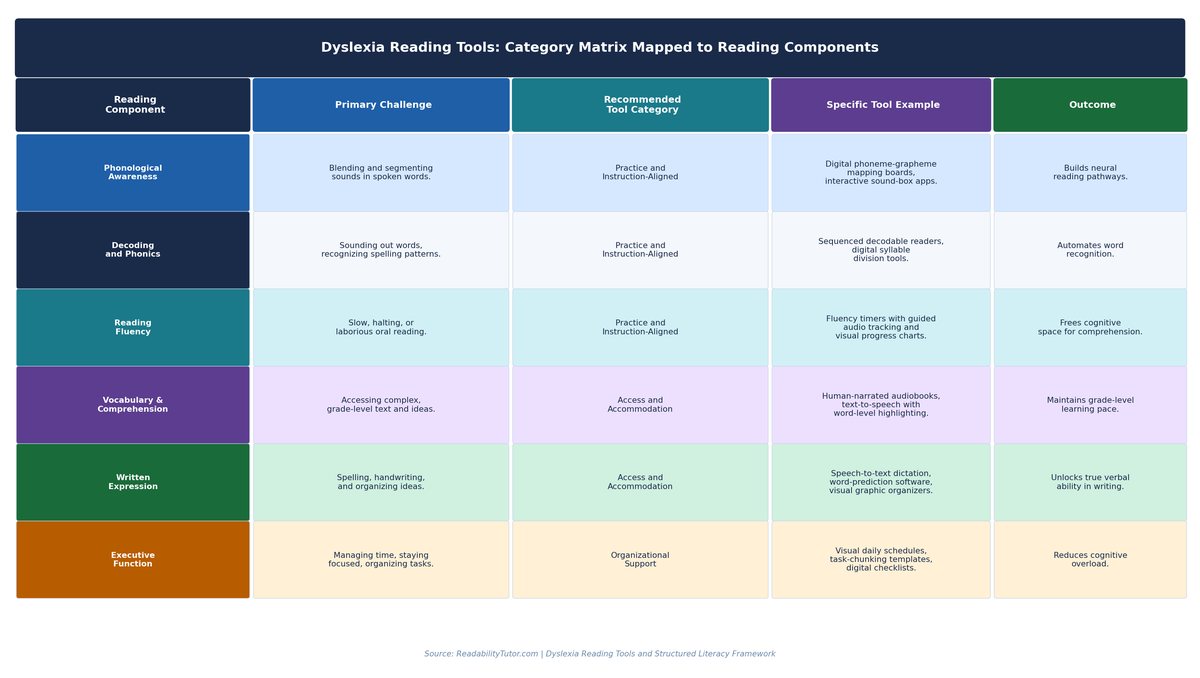
By understanding this matrix, parents and educators can move away from generic recommendations and select tools that target the student's precise profile. For example, a student who has strong language comprehension but severe decoding struggles will benefit immensely from Access and Accommodation tools like text-to-speech, which allow them to engage with complex stories and high-level ideas. Conversely, a younger student who is still building the foundations of word recognition will benefit most from Practice and Instruction-Aligned tools that make phonics practice engaging and interactive.
Put simply, dyslexia tools for reading fall into two buckets: practice tools that remediate skills and access tools that keep learning on track. Choosing reading tools for dyslexia that match the student’s current needs prevents frustration and builds steady momentum.
Quick-Start Toolkits: Dyslexia Reading Tools for Kids, Teens, College, and Adults
Match dyslexia reading tools to age, context, and immediate goals. K–2 learners need practice-first supports: decodables aligned to taught phonics patterns, interactive phoneme–grapheme mapping, and adult read-alouds to build knowledge. Add lightweight access tools that don’t displace instruction, such as text-to-speech (TTS) for directions or science labels. Good for homework: short read-alongs and picture walks that reinforce taught sounds.
Grades 3–5 benefit from a mixed approach: TTS or human-narrated audiobooks for content learning, structured fluency practice with modeled rereads, and morphology scaffolds (prefix/suffix practice) to grow vocabulary and decoding flexibility. Middle and high school students need tools for content access and productivity: TTS with annotation, speech-to-text for drafting essays, HI–LO nonfiction sets for independent reading, and note-taking aids that pair with read-aloud. Good for essays: speech-to-text plus revision checklists; good for research: TTS-enabled PDFs and citation helpers.
College students and adults often prioritize speed and independence. Build a lightweight workflow: OCR scanning apps for handouts, smartpens for lectures, citation managers with read-aloud previews, and distraction controls. Pair dyslexia reading tools for adults with workplace accommodations where applicable (e.g., screen readers, meeting transcription, and flexible formats). Good for workplace tasks: TTS for long reports, dictation for emails, and readers with sentence/word highlighting for efficient review.
How Do We Implement Assistive Technology for Access When Reading Demands Exceed Current Skills?
As academic reading demands grow, assistive technology (AT) becomes a lifeline. The goal of AT is to reduce the intrinsic vs extrinsic loads on working memory, allowing the student to focus on high-level comprehension and critical thinking. When implemented correctly, these tools do not make students "lazy"; instead, they level the playing field and unlock academic independence.

Let us look at the primary assistive technology tools and how they support access:
1. Text-to-Speech (TTS) with Multi-Sensory Highlighting
Text-to-speech software reads digital text aloud while simultaneously highlighting the words on the screen. This dual-modality input (hearing the word while seeing it highlighted) is highly effective for students with dyslexia. It reinforces letter-sound connections, improves word recognition, and allows students to read complex materials independently. When utilizing TTS, ensure the software offers high-quality, natural-sounding human voices and allows the user to adjust the reading speed to match their auditory processing pace. For many families, a dyslexic reading tool that pairs TTS with word-by-word highlighting becomes the daily go-to for homework and independent study.
2. Human-Narrated Audiobooks
While synthesized TTS is excellent for web articles and worksheets, high-quality human-narrated audiobooks (such as those from Learning Ally or Bookshare) are superior for literature and long-form novels. Human narrators bring character, emotion, and proper prosody to the text, which is critical for developing deep comprehension. Listening to audiobooks allows dyslexic students to build their vocabulary and background knowledge alongside their peers, preventing the academic gap from widening while they are still learning to decode print. When paired with a print or digital copy, these reading tools for dyslexia can also support tracking, prosody, and stamina.
3. Speech-to-Text (Dictation)
Dyslexia rarely exists in isolation; it is frequently accompanied by dysgraphia, which affects handwriting, spelling, and the mechanical aspects of writing. When a child must struggle to spell every word, their writing becomes brief and simplistic, failing to reflect their true verbal intelligence. Speech-to-text tools allow students to dictate their thoughts, essays, and answers directly into a document. This bypasses the spelling barrier, reduces frustration, and allows students to express complex ideas fluently.
4. Visual Text Adjustments
Simple visual modifications can make a massive difference in readability. Many digital reading platforms allow users to customize the text layout. Increasing line spacing, character spacing, and margin width reduces visual crowding, a common challenge for dyslexic readers. Adjusting the background color to a soft cream or pastel tone can reduce glare and visual strain. While specialized "dyslexia fonts" (like OpenDyslexic) have mixed scientific backing, some students find them helpful; the key is to allow the child to experiment and choose the font and spacing that feels most comfortable for them.
Accessible Content Sources: Reading Tools for Dyslexia via Audiobooks and eBooks
Access to high-quality audio and eBooks multiplies the impact of dyslexia learning tools. Many students qualify for Learning Ally or Bookshare (with documentation from a school professional); both offer human-narrated or high-quality TTS, synchronized highlighting, and extensive libraries of textbooks and literature. For public library access, Libby and Sora provide eBooks, audiobooks, and read-along titles that pair audio with on-screen text—ideal for fluency practice and vocabulary growth.
To build stamina and accuracy, sync print with audio: start with audio + text (full support), then fade to text-only rereads for short sections. Aim for purposeful listening: preview headings, set a question, listen/read, then annotate. For trusted background on reading supports, see resources like “Reading Rockets dyslexia” alongside your school’s library integration guides.
Best Reading Tools for Dyslexia: Practice-Aligned Options to Build Decoding and AI Reading Fluency
While accommodation tools provide access, practice-aligned tools are designed to actively build and reinforce reading skills. These tools should align with the principles of structured literacy, providing explicit, systematic, and multisensory practice in decoding, spelling, and fluency. In school settings, these evidence-based options are often called dyslexia intervention tools because they directly target decoding accuracy and oral reading fluency.
When selecting practice tools, look for features that incorporate the following elements:
1. Interactive Phoneme-Grapheme Mapping
Phoneme-grapheme mapping is the process of physicalizing the relationship between spoken sounds and written letters. Digital sound-box tools allow students to tap virtual boxes as they hear sounds in a word, and then drag letters into those boxes to spell the word. This active, multisensory manipulation builds strong orthographic mapping, which is the process the brain uses to store words for instant, effortless retrieval.
2. Sequenced Decodable Readers
Unlike predictable leveled books that encourage guessing, decodable readers contain only the spelling patterns that the student has been explicitly taught. Digital decodable libraries allow students to practice reading in a controlled environment where they can apply their phonics knowledge with 100% success. This builds confidence and prevents the development of harmful guessing habits. Many modern platforms include interactive features where a student can tap a difficult word to hear its individual sounds blended, providing immediate, supportive feedback.
3. Real-Time Speech Recognition and Feedback
One of the greatest challenges in reading practice is ensuring the student reads accurately. If a child practices reading words incorrectly, they reinforce incorrect neural pathways. This is where advanced speech recognition technology—often described as AI reading fluency tools—such as the AI engine built into Readability becomes a game-changer. As the child reads aloud, the technology listens in real time, providing gentle, immediate corrections when a word is mispronounced. This continuous feedback loop ensures high accuracy during independent practice, accelerating the development of why is reading fluency important and reducing the need for constant adult supervision.
4. Progress Tracking and Visual Analytics
Motivation is a critical factor for struggling readers who have experienced repeated failure. For older users, including adults returning to education, dyslexia learning tools with mature content and discreet interfaces can improve buy-in. Practice tools should include clear, child-friendly progress dashboards. Seeing their reading speed, accuracy, and "words read" grow over time provides powerful intrinsic motivation. For parents and teachers, detailed reports highlight specific phonetic patterns that require further instruction, allowing for highly targeted lesson planning.
Reading Fluency AI: What Today’s Engines Can Do for Dyslexia
Modern reading fluency AI can flag miscues (insertions, omissions, substitutions), estimate prosody (phrasing, stress, intonation), and categorize error types to guide instruction. Used well, these dyslexia intervention tools provide immediate, specific feedback and adaptive passages that target the right difficulty level without overwhelming the learner. Teachers remain essential: AI accelerates data collection, while expert modeling and coaching build accurate, expressive reading.
Set guardrails before use. Confirm where audio is processed (on-device vs. cloud), data retention and deletion timelines, and who can access recordings. Provide families with a plain-language overview of privacy, and test mic quality and background noise for accurate results. Good AI feedback is gentle, precise (“You read ‘through’ as ‘though’; look for the r-blend and ough pattern”), and paired with quick reteach options. For accountability, align AI fluency metrics with human scoring on periodic checks.
How Do Parents and Teachers Choose, Trial, and Pilot Dyslexia Reading Tools?
With hundreds of educational apps and assistive technologies on the market, selecting the right tool can feel overwhelming. To avoid "app fatigue" and ensure a high return on investment, families and schools should follow a structured, collaborative selection process.
Step 1: Conduct a Needs Assessment
Before looking at software, define the student's specific reading profile. Review recent evaluations, IEP documents, or progress reports. Identify the primary bottleneck: Is it phonological awareness, decoding accuracy, oral reading fluency, or writing and spelling? Consult with the student's speech-language pathologist, reading specialist, or classroom teacher to ensure the tool targets the correct skill area.
Step 2: Match the Tool to the Student's Age and Interests
A tool designed for a first-grader will quickly turn off a middle-school student, even if they read at the same level. Ensure the interface, illustrations, and content are age-appropriate. For younger learners, prioritize dyslexia reading tools for kids that feature decodable text and game-like feedback; for teens and adults, look for dyslexia reading tools for adults with mature interfaces and workplace-ready features like robust text-to-speech and speech-to-text. For older struggling readers, look for platforms that offer high-interest, low-readability (HI-LO) books. These books feature sophisticated themes, science, and history topics appropriate for their age, but use accessible vocabulary and sentence structures that match their current decoding skills.
Step 3: Run a Structured Trial (The Pilot Phase)
Never commit to a long-term subscription or school-wide implementation without running a structured trial. Most reputable reading tools offer a free trial period. Set a specific pilot window, typically 2 to 4 weeks, and commit to using the tool consistently during this time. Establish clear baseline metrics: Note the child's current reading frustration levels, their independence during reading tasks, and their daily reading duration.
Step 4: Gather Qualitative and Quantitative Feedback
At the end of the trial, evaluate the tool's impact. Look at the quantitative data: Did the student complete the sessions? Does the app's internal dashboard show progress in accuracy or speed? Equally important is qualitative feedback: Ask the student how they felt while using the tool. Did they find it engaging, or did it feel like a chore? Did it reduce their anxiety? A tool is only effective if the child is willing to use it consistently.
In practice, the best reading tools for dyslexia combine structured practice (for decoding and fluency) with accommodations (for access), so students can learn to read and read to learn every day. Prioritize options that are simple to deploy, data-rich, and truly usable—these learning tools for dyslexia tend to see the highest week-to-week engagement.
What is the Implementation Blueprint for Integrating Dyslexia Reading Tools at Home and School?
Once you have selected the right tools, the final step is successful implementation. Simply downloading an app or granting access to software is rarely enough; without a structured routine and clear expectations, tools are quickly abandoned. This implementation blueprint ensures long-term success and strong collaboration between home and school.

1. Establish a Consistent Daily Routine
Consistency is the key to building new neural pathways. For skill-building practice tools, aim for short, focused daily sessions rather than long, sporadic blocks. A routine of 15 to 20 minutes of targeted practice, 4 to 5 days a week, is highly effective and prevents cognitive fatigue. Link the reading session to an existing daily habit, such as immediately after an afternoon snack or right before dinner, to build a natural routine.
2. Foster Strong Home-School Collaboration
To maximize progress, reading tools should be integrated across both environments. If a student is using a specific speech-to-text tool or text-to-speech platform at school, the same tool should be accessible at home for homework. Shared licenses and single sign-on help ensure dyslexia tools for students work seamlessly across school and home. Teachers should share reading assessment data, such as the student's current reading levels by grade, so parents can select books at the appropriate level of difficulty. Regular communication ensures that accommodations are applied consistently, reducing confusion for the student.
3. Create a Distraction-Free, Supportive Environment
Children with dyslexia must exert immense mental effort to read, making them highly susceptible to distractions. Set up a dedicated learning space that is quiet, well-lit, and free from background noise, television, or active family traffic. Ensure the child has comfortable, high-quality over-ear headphones, especially when using tools with speech recognition or audiobooks. This helps them focus on the auditory feedback and improves the accuracy of the software's voice recognition engine.
4. Celebrate Effort and Focus on Growth
For a child with dyslexia, reading is a marathon. Celebrate their effort, persistence, and consistency rather than just their accuracy or speed. Use the tool's progress charts to show the child how far they have come. Seeing visual proof of their growth builds a growth mindset, helping them realize that reading is a skill they can improve with practice and the right supports.
By combining evidence-based structured literacy instruction with powerful, modern dyslexia reading tools, we can break down the barriers to literacy. Whether through real-time AI speech feedback, immersive audiobooks, or customized text layouts, these technologies empower children with dyslexia to bypass their struggles, discover the joy of stories, and reach their full academic and personal potential.
Frequently Asked Questions About Dyslexia Reading Tools
Are Dyslexia Reading Tools a Replacement for Learning to Read Through Instruction?
Absolutely not. Dyslexia reading tools, particularly accommodations like text-to-speech and audiobooks, are designed to provide access to curriculum content and prevent academic delays. They do not teach a child how to read. To build core reading skills, students with dyslexia require explicit, systematic, and cumulative instruction based on the science of reading, such as a structured literacy program. Reading tools should be used alongside instruction, not as a replacement for it. For younger students, utilizing targeted 1st grade reading activities for struggling readers is essential to build decoding foundations while using assistive technology for broader access.
What Age is Appropriate to Introduce Text-to-Speech or Audiobooks?
Assistive technology like text-to-speech and audiobooks can be introduced as soon as a student's reading difficulties begin to interfere with their ability to access grade-level content, typically around second or third grade. At this stage, classroom reading demands increase rapidly, and students are expected to read to learn. Introducing these tools early prevents academic frustration and helps students build vocabulary and background knowledge alongside their peers. For younger children in kindergarten and first grade, focus primarily on interactive practice tools that support phonological awareness and basic decoding, while reading aloud to them to build comprehension.
Do Colored Overlays or Font Changes Help Everyone with Dyslexia?
No, they do not. While some students find colored overlays, background color adjustments, or specialized fonts (such as OpenDyslexic) helpful, scientific research shows mixed results. These visual adjustments do not address the core neurobiological cause of dyslexia, which is a phonological processing difficulty, not a visual one. However, because dyslexia can present differently in each individual, some students may experience reduced eye strain or visual crowding with these adjustments. The best approach is to allow the student to trial different visual settings, such as line spacing and background contrast, and choose what feels most comfortable for them.
Can Using Audiobooks Reduce Motivation to Read Print?
On the contrary, research shows that listening to high-quality audiobooks can actually increase a student's motivation to engage with print. When a dyslexic student is forced to struggle through print books that are far below their intellectual level, they quickly develop reading avoidance. Audiobooks allow them to experience rich, engaging stories and complex ideas that match their cognitive ability, fostering a love for literature. Many students enjoy following along with a printed copy of the book while listening to the audio, a multi-sensory approach that actually helps build word recognition and reading fluency over time.
How Do I Know if a Dyslexia Reading Tool is Working?
To determine if a tool is effective, monitor both quantitative data and qualitative changes over a 2 to 4 week trial period. Look for a reduction in reading frustration, an increase in the student's independence during homework or reading tasks, and a willingness to engage with reading materials for longer periods. Many modern digital practice tools, including Readability, feature built-in parent dashboards that track reading speed, accuracy, and comprehension growth. If the tool is working, you should see steady progress on these metrics, alongside positive feedback from the student's classroom teacher regarding their participation and confidence.
What Accommodations are Typical for Students with Dyslexia in an IEP or 504 Plan?
Typical accommodations for students with dyslexia in an Individualized Education Program (IEP) or 504 Plan include extended time on tests and assignments, reduced reading loads in content areas, and access to assistive technology. This often includes text-to-speech for reading assignments, audiobooks for literature, speech-to-text for writing tasks, and spelling checkers. Students may also receive preferential seating near the teacher to reduce distractions, simplified directions, and the ability to demonstrate their knowledge through oral presentations or visual projects rather than written essays. These accommodations are designed to level the playing field and ensure the student's academic progress is not bottlenecked by their decoding struggles.
How Do Dyslexia Reading Tools Support Multilingual Learners?
Multilingual learners who struggle with reading face a dual challenge: acquiring a new language while simultaneously building decoding skills. Dyslexia reading tools can provide critical, double-layered support for these students. For example, text-to-speech tools with real-time translation features allow students to hear English words pronounced accurately while accessing definitions or translations in their native language. Interactive reading apps that offer visual vocabulary support, picture dictionaries, and immediate audio feedback help build English language comprehension alongside word recognition. By reducing the cognitive load of decoding, these tools allow multilingual learners to focus on language acquisition and academic content simultaneously.
What are the best dyslexia reading tools for kids right now?
Answer: The most effective dyslexia reading tools fall into two groups: access tools and intervention tools. For access, use text-to-speech with word-by-word highlighting, human‑narrated audiobooks (e.g., Learning Ally, Bookshare), speech‑to‑text for writing, and visual text adjustments (larger spacing, soft backgrounds). These reading tools for dyslexia let students engage with grade‑level content without the decoding roadblock.
For intervention, choose dyslexia intervention tools aligned with structured literacy: interactive phoneme‑grapheme mapping, sequenced decodable readers, and AI‑driven real‑time speech feedback (as found in platforms like Readability) to correct errors as students read aloud. This combination strengthens decoding and fluency while maintaining access to the curriculum.
- Try this: Enable word-by-word highlighting in your TTS tool.
How do I choose between accommodations and remediation when using dyslexia reading tools?
Answer: Use accommodations (text‑to‑speech, audiobooks, speech‑to‑text, visual adjustments) whenever the goal is access to content in science, social studies, or literature; they reduce cognitive load so the student can focus on comprehension and ideas. Use remediation tools during dedicated intervention time to teach skills explicitly—phonemic awareness, phonics, decoding, and fluency—through structured literacy and decodable practice.
In short, accommodations help students read to learn, while remediation helps them learn to read. A dual approach prevents fatigue and accelerates long‑term progress.
- Try this: Set a 15-minute daily practice timer for remediation.
What are the early signs of dyslexia in K–2 and which tools help pinpoint early literacy skill deficits?
Answer: Common early signs include difficulty with rhyming, letter‑sound links, blending sounds into words, recognizing high‑frequency words, and reliance on guessing from pictures or first letters. If multiple signs appear, request screening in K–2; research shows early intervention can move most struggling readers to grade level when started in kindergarten or first grade.
To pinpoint deficits, use brief screeners and a leveled reading assessment that target phonological awareness, letter‑sound knowledge, decoding accuracy, and oral reading fluency. The results guide IEP or 504 goals and help you select the right dyslexia reading tools (e.g., decodable readers for decoding, text‑to‑speech for access).
- Try this: Review 1st grade reading activities for struggling readers.
Does AI for reading fluency really help students with dyslexia?
Answer: Yes—AI that listens as a child reads aloud and gives immediate, gentle corrections prevents practicing errors and supports accurate decoding in real time. Paired with decodable texts, this kind of reading fluency AI strengthens word recognition and prosody without constant adult prompting.
Look for platforms that combine real‑time speech recognition with progress dashboards (accuracy, speed, comprehension) so parents and teachers can confirm that the dyslexia reading tools are improving independent, accurate reading.
- Try this: Review the dashboard weekly to track progress.
What dyslexia reading tools work for adults?
Answer: Dyslexia reading tools for adults mirror those for kids but with adult‑friendly interfaces and content. For access at work or college, use high‑quality text‑to‑speech for articles and long documents, human‑narrated audiobooks for literature, speech‑to‑text for reports and emails, and visual settings that reduce crowding.
For skill growth, adults can still benefit from structured practice—targeted phoneme‑grapheme work, decodable or HI‑LO texts, and AI‑based read‑aloud feedback—to solidify decoding and fluency while maintaining productivity with access tools.
- Try this: Adjust your TTS to a comfortable reading speed.